Key Highlights
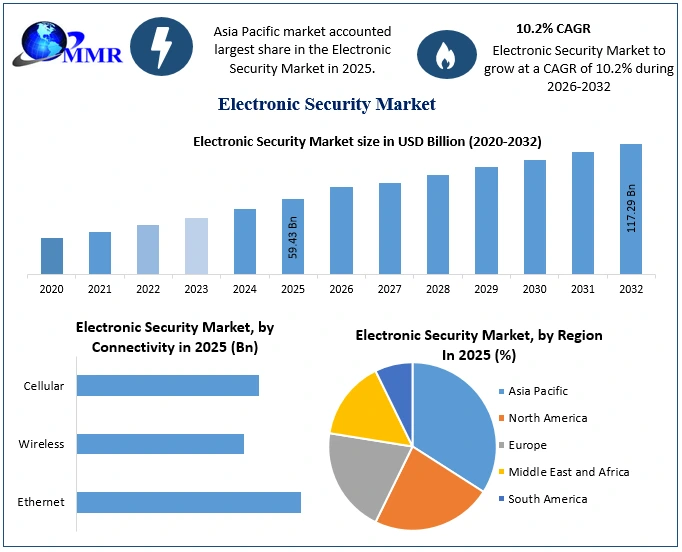
The global electronic security market concluded 2025 with an established valuation of USD 59.43 billion and is positioned to reach USD 117.29 billion by 2032.
Structural compounding is locked at a steady 10.2% CAGR across the 2026 to 2032 forecast window, supported by corporate spending on infrastructure protection.
The video surveillance product type segment is expanding at an isolated 10% CAGR, driven by continuous integration of advanced camera systems across public domains.
Ethernet infrastructure serves as the foundational connectivity framework, holding a projected 40% market share throughout the analytical timeline.
The Asia Pacific geographic region represents the fastest-growing market territory, compounding at an accelerated 11.2% CAGR due to rapid urbanization.
Why This Matters Now
Global enterprise security is no longer an isolated physical asset protection function; it has evolved into a baseline operational continuation requirement. As global business networks expand, corporate entities face rising financial exposures from retail shrinkage, external theft, asset misappropriation, and complex security breaches. This environment forces a deep shift in risk management protocols, requiring advanced monitoring solutions that can verify activities across highly distributed physical layouts.
This systemic transformation creates a direct demand pull for advanced hardware fabrication and assembly ecosystems. Electronics manufacturing services (EMS) providers and original equipment manufacturers (OEMs) must scale up production lines to handle a surge in system endpoints, including HD CCTV networks, electronic sensors, detectors, fire alarm configurations, and access control interfaces. To protect investments, corporations are moving away from reactive, standalone security items and adopting fully networked environments that link multi-sensor nodes directly to centralized data hosts.
Market Overview
Electronic Security Market According to the empirical research compiled by Maximize Market Research, the global electronic security market achieved an operational valuation of USD 59.43 billion in 2025. Driven by steady infrastructure modernization and a worldwide increase in small and medium enterprise (SME) formations, the market is on track to compound at a 10.2% CAGR from 2026 to 2032. This trajectory will grow the total market value to USD 117.29 billion by the conclusion of the 2032 forecast period.
Electronic Security Market Growth Path (2025 – 2032)

  2025: [■■■■■■■■■■■■■] USD 59.43 Bn
  2032: [■■■■■■■■■■■■■■■■■■■■■■■■■■] USD 117.29 Bn  (CAGR: 10.2%)
The underlying demand is driven by the practical benefits of digital protection frameworks: rapid conflict resolution, improved employee safety, internal loss prevention, and real-time observation of high-vulnerability environments from remote locations. Furthermore, the market experienced increased deployment tailwinds following shifts in public crime patterns, such as thefts and robberies. These changes forced public and private operators to replace old, unmonitored points with continuous digital surveillance infrastructure.
Key Trends Driving Growth
Four structural shifts are defining the technical and commercial direction of the global market:
Remote Mobile-Centric Management Architectures
Organizations are rapidly migrating toward decentralized command systems that allow operators to access active security systems via computers, tablets, and smartphones. This cloud-supported remote access capability removes geographical constraints for corporate security teams, allowing them to monitor high-risk locations and receive instant system updates while commuting or working offsite.
Real-Time Access Control Intervention
Modern access control mechanisms are being re-engineered to provide immediate operational responses during high-consequence security events or criminal actions. These systems use automated locking protocols and perimeter isolation rules to contain localized threats before they can spread to adjacent corporate assets or put personnel at risk.
𝐃𝐨𝐰𝐧𝐥𝐨𝐚𝐝 𝐏𝐃𝐅 𝐁𝐫𝐨𝐜𝐡𝐮𝐫𝐞 @ https://www.maximizemarketresearch.com/request-sample/31191/
Critical Infrastructure Investment and Casualty Prevention
Large enterprise networks and utility providers are increasing their capital spending to harden physical sites against operational downtime and prevent casualties. This trend involves installing synchronized equipment arrays—including specialized sensors, detectors, automated fire alarm networks, control panels, and communication nodes—to form defensive barriers around key economic hubs.
Cloud Deployment and Advanced Digitalization
Traditional local recording setups are being replaced by cloud-powered camera architectures that simplify data storage and lower upfront hardware costs. This digital shift allows operators to run complex video analytics programs on remote servers, eliminating the need to maintain expensive computing hardware at every physical site.
Segment Insights
Ethernet Connectivity (Dominant Segment): Projected to maintain a dominant 40% market share throughout the forecast timeline, serving as the primary pipeline for transmitting uncompressed digital data from edge security cameras to host computers.
Video Surveillance (Dominant Product Segment): Moving forward at a 10% CAGR, driven by widespread public sector investments to deploy security cameras and automated alarm networks across airports, transit centers, and retail zones.
Asia Pacific (Fastest-Growing Regional Segment): Expanding at a 11.2% CAGR, outperforming all other geographical zones due to large-scale urbanization, globalization, and expanding manufacturing hubs.
Residential End-User: Achieving steady growth as rising consumer awareness combines with affordable wireless setups and expanding IoT networks to make smart home monitoring systems accessible to broader markets.
Defense End-User: Utilizing specialized electronics-based architectures to deliver high-performance electronic attack, defense, and detection capabilities to reduce casualties in complex field operations.
Regional Growth Story
The global market shows distinct investment patterns across North America, Europe, and Asia Pacific. In North America, commercial growth is driven by the expansion of international retail networks into the United States market. This retail buildout is happening alongside a push to lower retail shrinkage, which has accelerated the installation of advanced video surveillance networks, integrated alarms, and automated asset-tracking systems across commercial real estate.
Regional Expansion Profiles (CAGR Comparison)
┌────────────────────────────────────────┐
│ Global Baseline Market: 10.2% CAGR     │
├────────────────────────────────────────┤
│ Asia Pacific Segment:   11.2% CAGR     │ ◄── Fastest Growing Region
└────────────────────────────────────────┘
Concurrently, the Asia Pacific region is expanding rapidly due to ongoing globalization and urbanization across major industrial hubs. The region’s growth is supported by large-scale digital transformations, with China’s cloud deployment segment alone projected to reach a value of USD 4.6 million by 2025. This expanding digital foundation is accelerating the adoption of cloud-powered CCTV cameras and enterprise access networks across the region’s commercial landscapes.
Competitive Landscape
The operational moves made by major market players show a clear shift away from standalone hardware production and toward integrated multi-sensor networks:
ADT LLC and Brinks Home Security are focusing on scaling up their subscription-based monitoring services by linking automated home and business security networks with cloud applications, allowing them to secure steady recurring revenue streams.
Axis Communications AB and Bosch Security Systems are strengthening their market positions by developing high-definition IP cameras and complex detector units that interface smoothly with centralized Ethernet backbones, ensuring high data reliability for enterprise clients.
ASSA ABLOY AB, HID Global, and Allegion plc are solidifying their leadership in physical security by embedding advanced digital authentication technologies into access control systems, enabling real-time identity verification and threat response at high-traffic entry points.
Dahua Technology Co., Ltd. and CP PLUS GmbH & Co. KG are capturing high-volume market share by manufacturing cost-effective, mass-market video surveillance portfolios designed for rapid installation across expanding SME footprints.
Recent Developments
System developers entered a three-party strategic partnership involving Innoviz Technologies and Cron AI to merge 3D LiDAR sensors and multi-sensor camera perception systems directly into perimeter security architectures.
Hardware manufacturers integrated secure wireless modules into residential security packages, removing the need for professional installation and lowering the entry barrier for cost-conscious homeowners.
Industrial facilities deployed specialized multi-sensor control panels that link fire detection, intrusion alarms, and access logs into a single software dashboard to simplify facilities management.
Enterprise users upgraded their legacy analog camera networks to digital IP systems running over standard Ethernet lines, increasing video resolutions while cutting down on separate power cabling needs.
Strategic Implications
The changing technical demands of the security sector have direct strategic impacts on electronics OEMs, system integrators, and enterprise technology buyers.
Technical Migration of Security Architecture
┌──────────────────────────────┐
│  Legacy Localized Arrays     │ -> Isolated analog systems with high manual oversight
└──────────────┬───────────────┘
               ▼
┌──────────────────────────────┐
│ Centralized Networked Hubs   │ -> Ethernet-backed, cloud-connected multi-sensor platforms
└──────────────────────────────┘
What changed? Security platforms have shifted from simple, isolated recording systems to highly interconnected, data-driven networks. Why now? Rising operational complexities and the need to protect distributed corporate assets mean organizations can no longer rely on manual security checks or delayed data processing.
Who benefits? Equipment manufacturers and system integrators who can deliver reliable, Ethernet-backed hardware that interfaces smoothly with cloud networks will secure long-term commercial contracts. However, technology buyers face a key hurdle: electronic security expansion is currently limited by high ongoing maintenance costs and privacy concerns. Because modern systems must connect back to centralized networks, they require regular software and hardware maintenance, forcing operators to balance system scaling against long-term maintenance budgets.
Future Outlook
The next phase of the global electronic security market will be defined by how effectively system designers can manage high data volumes over standard network infrastructures. As video surveillance installations continue to grow at a 10% CAGR, the volume of digital information sent to host computers will put significant pressure on existing network links. This reality ensures that Ethernet connectivity will remain a core design choice, sustaining its 40% market share as organizations prioritize reliable data delivery over wireless flexibility.
The dividing line between market participants will depend on how successfully they navigate these networking and maintenance challenges. Technology providers who can deliver high-resolution monitoring and real-time access control while lowering long-term maintenance demands will lead the market, while vendors stuck offering disconnected, hardware-heavy options will find themselves sidelined as commoditized suppliers.
Analyst Perspective
“The electronic security market is experiencing a significant shift as organizations transition away from isolated hardware tools and toward fully integrated digital networks. High-density video surveillance installations and real-time access systems are now standard requirements for corporate asset protection. Companies that design their hardware to run efficiently over centralized Ethernet lines while minimizing long-term system maintenance costs will capture high-margin contracts, while those that fail to adapt to cloud-managed platforms will lose ground in an increasingly competitive environment.” — Alpana Patil, Research Analyst, Maximize Market Research
About Maximize Market Research
Maximize Market Research Pvt. Ltd. (MMR) is a global market research and consulting company that provides reliable, data-focused, and practical business insights. The firm serves a wide range of industries, including healthcare, pharmaceuticals, technology, automotive, electronics, chemicals, personal care, and consumer goods. Through market forecasts, competitive analysis, strategic consulting, and industry impact assessments, MMR helps organizations understand changing market conditions, identify growth opportunities, and make informed business decisions for long-term success.
2nd Floor, Navale IT Park Phase 3
Pune Banglore Highway, Narhe
Pune, Maharashtra 411041, India
+91 9607365656
sales@maximizemarketresearch.com
