Key Highlights
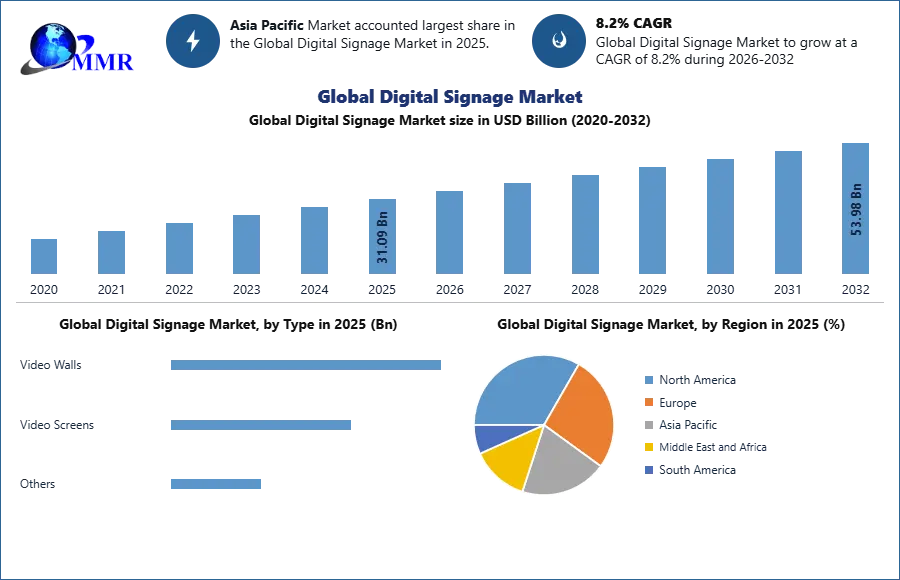
The global Digital Signage Market reached a valuation of USD 31.09 billion in 2025 and is projected to scale to USD 53.98 billion by 2032, progressing at a steady 8.2% CAGR.
Light Emitting Diode (LED) display configurations captured the dominant technology position in 2025, expanding commercial use cases as mass production lowers panel fabrication expenses.
High-resolution screens represent the primary product footprint, capturing 65% of active display installations worldwide.
The Asia-Pacific region emerged as the primary volume driver, controlling a 37% share of the global marketplace in 2025 while recording the highest localized expansion speed.
High structural setup costs and systemic data vulnerabilities during transmission between management systems and endpoints represent the main operational hurdles.
Why This Matters Now The structural shift in the Digital Signage Market represents a significant volume opportunity for chip fabrication plants, display foundries, and electronic components suppliers. Commercial display systems have advanced past basic television screens that repeat local video files. Modern signage networks function as connected edge-computing nodes that process real-time viewer data, manage localized artificial intelligence processing, and stream high-resolution content under continuous operating conditions. This development changes display procurement, shifting enterprise focus toward advanced panel architectures and integrated system-on-chip controllers.
As retail networks and smart city programs scale up their physical media footprints, pressure mounts on component supply chains to supply energy-efficient logic devices and secure communication modules. Fabs that align their manufacturing capacities with micro-media player demand will secure multi-year component contracts with tier-one electronics OEMs. Meanwhile, manufacturers relying on legacy, non-connected panel technologies face shrinking margins as commercial buyers prioritize interactive, software-driven display networks.
Market Overview The global Digital Signage Market recorded a verified valuation of USD 31.09 billion in 2025 and is on track to reach USD 53.98 billion by 2032. This long-term commercial projection represents a consistent 8.2% CAGR across the forecast timeline. The core market factor driving this capital reallocation is the continuous migration from analog printed billboards to automated multi-media display systems. Corporate entities can no longer rely on static paper advertisements to engage shifting consumer segments, making software-managed display hardware the baseline standard for modern retail, corporate, and municipal infrastructure.
This systematic growth relies directly on falling fabrication costs across the semiconductor panel manufacturing ecosystem. Large-scale production efficiencies allow hardware providers to supply high-purity LED and organic light-emitting diode (OLED) systems at lower average selling prices. As entry costs drop, medium-sized businesses are deploying automated display grids to handle real-time customer messaging, widening the market beyond premium corporate installations and stimulating high-volume silicon consumption across regional fabrication hubs.
Key Trends Driving Growth The most critical technical trend reshaping the global market landscape is the rapid penetration of high-resolution screens and interactive touchscreen interfaces. Modern installations are shifting away from traditional passive viewing models, utilizing 28% integration rates for interactive touchscreens to enable direct consumer engagement at the point of sale. This interactive trend requires localized processing infrastructure, forcing electronics OEMs to embed advanced graphical processing blocks and responsive micro-controllers directly into the display frame, which boosts volumes for logic chip foundries.
Concurrently, educational institutions are executing large-scale structural modernizations, creating a major application driver for multi-media signage installations. Comprehensive institutional data shows that campuses are deploying digital signs across several core functions, with campus news and announcements leading at a 90% deployment rate. Digital menu boards follow at 85%, classroom scheduling systems at 58%, and emergency notification setups at 50%, while third-party advertising accounts for 15%. This multi-point institutional deployment requires highly secure local media players capable of rendering real-time scheduling changes and emergency alerts without system lag.
Furthermore, outdoor advertising infrastructure firms are converting legacy assets into automated digital billboards to maximize yield per square foot. Commercial utilization metrics indicate that modern industries deploy digital displays across 80% of roadside billboards, 52% of high street representations, 67% of outdoor digital signs, and 35% of window touch screens. This massive outdoor expansion requires ruggedized electronic components that can withstand extreme weather and variable sunlight conditions, accelerating demand for specialized power semiconductors and high-brightness panel backlights.
𝐃𝐨𝐰𝐧𝐥𝐨𝐚𝐝 𝐏𝐃𝐅 𝐁𝐫𝐨𝐜𝐡𝐮𝐫𝐞 @ https://www.maximizemarketresearch.com/request-sample/11883/
Segment Insights
LED Configurations (Dominant Segment): This technology architecture held the leading market share in 2025 and is projected to maintain an 8.2% CAGR through 2032. Mass production efficiencies are lowering LED fabrication expenses, allowing commercial properties to deploy large-scale video walls while pushing older liquid crystal display (LCD) setups into legacy positions.
High-Resolution Screens (Dominant Product Type): Capturing 65% of global installations, high-resolution screens represent the main design pattern for new commercial projects. This dominance forces component foundries to optimize their advanced sub-pixel fabrication lines to sustain high manufacturing yields.
Interactive Touchscreens and OLED Displays: Interactive touchscreens hold a 28% adoption footprint, while OLED technology commands a 15% share of specialized deployments. These segments represent the fastest-growing technology zones for premium indoor retail setups that require exceptional color accuracy and low latency.
Regional Growth Story North America maintains a highly consolidated position in the global digital media landscape, capturing a dominant revenue share of over 35% in 2025. The regional market focus centers on integrating advanced display networks with cloud-managed enterprise software platforms, growing at a 7.15% CAGR to sustain regional dominance. High labor costs across the United States accelerate the deployment of automated interactive kiosks and self-service signage networks, keeping the region at the center of high-value system-on-chip controller utilization.
Concurrently, the Asia-Pacific region is emerging as the fastest-growing market hub, controlling a dominant 37% share of the global total in 2025. China anchors this regional dominance, commanding 58% of the APAC market footprint, followed by rapid infrastructure deployments across India and Japan. Rising urbanization, corporate office expansion, and localized display panel fabrication investments in China and India are creating significant volume demand for affordable, innovative digital systems. This high concentration of panel manufacturing facilities turns the APAC territory into the primary supplier for global electronics manufacturing services, drawing heavy infrastructure capital from international hardware brands.
Competitive Landscape The competitive field within the Digital Signage Market is characterized by aggressive technology races among established global hardware giants and enterprise software providers. Top-tier market entities, including Samsung Electronics, LG Display Co Ltd, Microsoft Corp., Scala Digital Signage, Intel Corp., Intuilab Sa, Mvix (USA) Inc., Stratacache, and Navori Labs, are competing to deliver complete, integrated solutions that merge display hardware with secure content orchestration engines. This intense rivalry signals that future market victory belongs to companies that combine advanced display lithography with low-power edge compute blocks.
This technology race is changing how leaders position their product portfolios to preserve pricing power. In 2024, Samsung Electronics launched its next-generation Neo QLED, Micro LED, OLED, and lifestyle display portfolios, aiming to spark the AI Screen Era and establish new standards for connected commercial devices. This strategic product rollout highlights a broader trend where leading electronics brands integrate artificial intelligence directly into display panels, allowing signs to autonomously optimize brightness and modify content layouts based on local environmental factors.
Recent Developments
Component manufacturers are introducing advanced system-on-chip architectures that combine media playback, network connectivity, and display driving logic on a single piece of silicon, reducing internal wiring requirements.
Global software providers are deploying edge-based device management systems that use machine learning to predict display component failures before they cause screen downtime.
Manufacturing lines are shifting toward wafer-level packaging for Micro LED arrays, aiming to cut assembly costs and accelerate adoption across mass commercial display channels.
Security engineers are integrating hardware-level cryptographic chips into digital media players to protect commercial signs from unauthorized content tampering and network intrusion.
Strategic Implications The transition toward connected, AI-enabled commercial displays alters how electronics original equipment manufacturers (OEMs) handle product development lifecycles. OEMs can no longer treat digital signage as basic display screens; they must build robust edge-computing platforms that handle high-speed data transmission securely. This shift requires significant software engineering investments to protect displays against remote exploitation, making built-in data encryption and secure boot capabilities core competitive requirements for enterprise equipment sales.
For semiconductor foundries, the drop in LED and OLED manufacturing costs means capital allocation strategies must pivot toward supporting flexible, high-resolution panel production. Fabs must upgrade their automated inspection systems and cleanroom lithography lines to deliver defect-free micro-arrays at high yields. Foundries that master these micro-scale display processes will capture lucrative multi-year supplier status with global consumer brands, while slower fabrication facilities will find themselves locked out of high-margin corporate display projects.
Future Outlook As smart city systems and automated retail hubs expand globally, market leadership will depend on the successful deployment of energy-efficient Micro LED panels and secure edge-computing media nodes. The continuous push for reduced power draw and thinner screen profiles will drive a widespread transition away from traditional backlit displays toward self-emissive, chiplet-driven structures. This evolution will open up new monetization models centered on context-aware advertising networks, localized consumer data processing, and secure automated public alert systems. Ultimately, the market will reward integrated technology leaders who successfully bundle hardware-level network security with high-yield, flexible panel architectures, while legacy hardware builders relying on un-encrypted, high-consumption displays will suffer from declining margins, regulatory penalties, and complete market obsolescence.
Analyst Perspective “The rapid expansion of the Digital Signage Market highlights a permanent convergence between advanced display lithography and edge-computing networks,” states Alpana Patil, Research Analyst at Maximize Market Research. “As commercial properties replace analog signs with high-resolution, interactive screens, success depends on software-hardware synchronization and secure data transmission. The enterprises that master low-power micro-media player design and advanced LED packaging will dominate the future of commercial media infrastructure.”
About Maximize Market Research
Maximize Market Research Pvt. Ltd. (MMR) is a global market research and consulting company that provides reliable, data-focused, and practical business insights. The firm serves a wide range of industries, including healthcare, pharmaceuticals, technology, automotive, electronics, chemicals, personal care, and consumer goods. Through market forecasts, competitive analysis, strategic consulting, and industry impact assessments, MMR helps organizations understand changing market conditions, identify growth opportunities, and make informed business decisions for long-term success.
2nd Floor, Navale IT Park Phase 3
Pune Banglore Highway, Narhe
Pune, Maharashtra 411041, India
+91 9607365656
sales@maximizemarketresearch.com
