Key Highlights
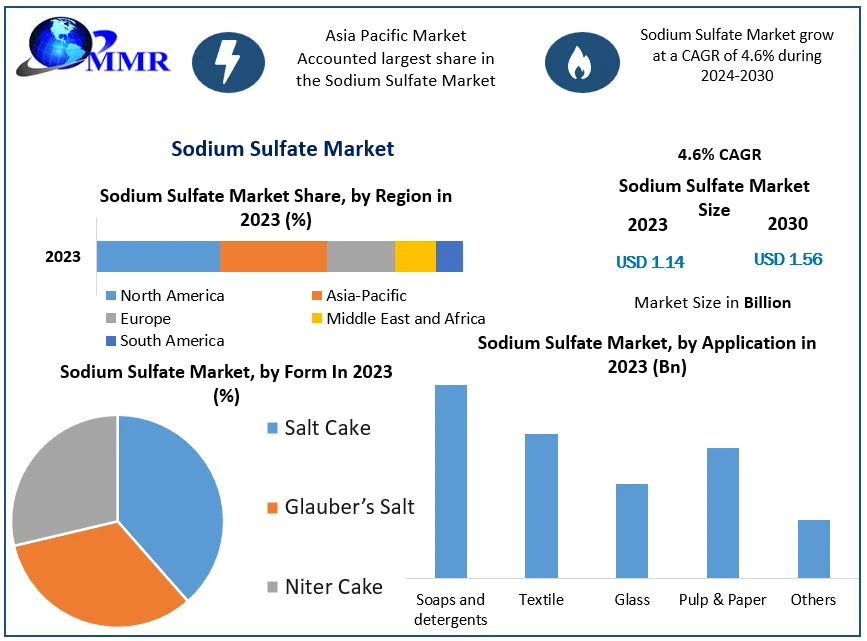
- Global Sodium Sulfate Market valued at US$ 1.14 Bn in 2023
- Market projected to reach US$ 1.56 Bn by 2030
- CAGR of 4.6% during 2024–2030
- Asia Pacific remains the dominant regional market
- Detergent industry continues to represent the largest downstream demand
- Industrial sustainability and production efficiency are reshaping competitive strategies
Why This Matters Now
Chemical manufacturers are facing tighter cost controls while downstream industries continue to demand reliable supplies of commodity chemicals. Sodium sulfate, once viewed as a mature industrial material, is becoming strategically important as detergent production, glass manufacturing, and industrial processing expand across Asia and other manufacturing centers.
The market was valued at US$ 1.14 Bn in 2023 and is expected to reach US$ 1.56 Bn by 2030, growing at a 4.6% CAGR. That growth signals continued purchasing activity for procurement teams while encouraging producers to optimize production capacity, strengthen raw material sourcing, and improve operational efficiency.
Market Overview
Sodium sulfate Market Size remains an essential inorganic chemical used across detergents, glass production, textiles, pulp and paper, and chemical processing. Although considered a commodity chemical, demand patterns are increasingly influenced by industrial production cycles and manufacturing investments.
The detergent industry continues to account for the largest share of consumption because sodium sulfate functions as an effective filler in powdered detergents. Stable household cleaning demand provides manufacturers with relatively predictable downstream consumption even during broader economic fluctuations.
Glass manufacturing represents another significant application. Rising infrastructure investment and automotive production continue to support demand for high-quality glass, creating consistent opportunities for sodium sulfate suppliers serving industrial customers.
Supply availability is supported through both natural and synthetic production routes, allowing manufacturers to diversify sourcing strategies while responding to changing regional demand.
Key Trends Driving Growth
Industrial buyers are placing greater emphasis on supply reliability rather than simply securing the lowest purchase price. That shift encourages producers to strengthen logistics networks and maintain consistent product quality.
Manufacturers are also investing in process improvements that reduce production costs and improve operational efficiency. These investments strengthen competitive positioning while helping companies respond to fluctuations in industrial demand.
Sustainability is becoming a larger competitive factor. Chemical producers continue exploring cleaner manufacturing processes, improved resource efficiency, and waste reduction initiatives as customers increasingly evaluate environmental performance alongside product quality.
Trade patterns are also evolving. Growing industrialization across emerging manufacturing economies is increasing regional demand while encouraging suppliers to optimize production footprints closer to end users.
Explore detailed analysis, insights, and growth opportunities
Segment Insights
- Dominant Segment: Detergent application remains the leading consumer of sodium sulfate, supported by steady global demand for household and industrial cleaning products.
- Fastest-Growing Segment: Not specified in the MMR report summary.
- Natural sodium sulfate continues to serve major industrial applications where cost efficiency is important.
- Synthetic sodium sulfate remains essential for industries requiring consistent product quality and controlled specifications.
- Glass manufacturing represents a major downstream industry supporting long-term market demand.
- Textile processing and pulp & paper applications continue to provide diversified industrial consumption.
Regional Growth Story
Asia Pacific continues to dominate the Sodium Sulfate Market as expanding manufacturing activity supports strong consumption across detergents, textiles, chemicals, and glass production. Large-scale industrial capacity and growing domestic demand strengthen the region’s leadership position.
China remains a critical production and consumption hub due to its extensive chemical manufacturing base and detergent industry. Continued industrial investment supports stable long-term demand across multiple downstream sectors.
India is benefiting from expanding chemical production, increasing detergent consumption, and broader industrial development. Manufacturing investments continue creating opportunities for domestic suppliers while strengthening regional supply chains.
The United States maintains consistent demand across detergents, glass manufacturing, and industrial processing. Stable industrial production supports procurement activity despite changing global trade conditions.
Germany remains an important European chemical manufacturing center where production efficiency, regulatory compliance, and sustainable manufacturing continue shaping purchasing decisions.
Japan and South Korea continue emphasizing high-quality industrial production supported by advanced manufacturing technologies and diversified chemical industries.
Competitive Landscape
Competition within the Sodium Sulfate Market remains centered on production efficiency, supply reliability, manufacturing scale, and customer relationships rather than rapid product differentiation.
Capacity investments signal confidence in long-term industrial demand while helping producers improve utilization rates and reduce manufacturing costs. Companies capable of maintaining efficient operations during raw material price fluctuations are better positioned to protect margins.
Manufacturers are also strengthening regional supply networks to reduce transportation costs and improve delivery reliability. These strategies enhance pricing flexibility while increasing resilience against supply chain disruptions.
Sustainability investments increasingly influence competitive positioning as industrial customers evaluate suppliers based on operational efficiency, environmental performance, and long-term reliability.
Recent Developments
- Continued investments in production efficiency across chemical manufacturing operations
- Ongoing focus on strengthening regional supply chains
- Sustainability initiatives supporting cleaner manufacturing processes
- Capacity optimization to improve operational utilization
- Rising industrial demand from detergent and glass manufacturing sectors
- Increased emphasis on reliable procurement and long-term supply agreements
Strategic Implications
Procurement leaders should closely monitor regional supply availability as industrial demand expands across Asia. Stable sourcing agreements may become increasingly valuable as downstream consumption continues to grow.
Chemical manufacturers can strengthen competitiveness through operational efficiency, optimized logistics, and sustainable production practices rather than relying solely on pricing strategies.
Industrial investors should view sodium sulfate as a market supported by diversified downstream industries. Demand from detergents, glass, textiles, and chemical processing provides a balanced consumption profile that reduces dependence on a single end-use sector.
Future Outlook
The Sodium Sulfate Market is expected to remain supported by steady industrial demand, expanding manufacturing activity, and ongoing investments in production efficiency. Companies that combine reliable supply chains, cost-efficient manufacturing, and sustainability initiatives will be best positioned to capture future opportunities, while producers unable to modernize operations may face increasing competitive pressure.
Analyst Perspective
“The Sodium Sulfate Market continues to demonstrate resilience through diversified industrial demand. As detergent manufacturing, glass production, and chemical processing expand, companies investing in operational efficiency, supply chain resilience, and sustainable manufacturing will strengthen their competitive position in the years ahead.”
About Maximize Market Research
Maximize Market Research Pvt. Ltd. (MMR) is a global market research and consulting company that provides reliable, data-focused, and practical business insights. The firm serves a wide range of industries, including healthcare, pharmaceuticals, technology, automotive, electronics, chemicals, personal care, and consumer goods. Through market forecasts, competitive analysis, strategic consulting, and industry impact assessments, MMR helps organizations understand changing market conditions, identify growth opportunities, and make informed business decisions for long-term success.
Contact Us :
2nd Floor, Navale IT Park Phase 3
Pune Banglore Highway, Narhe
Pune, Maharashtra 411041, India
+91 9607365656
sales@maximizemarketresearch.com
