Key Highlights
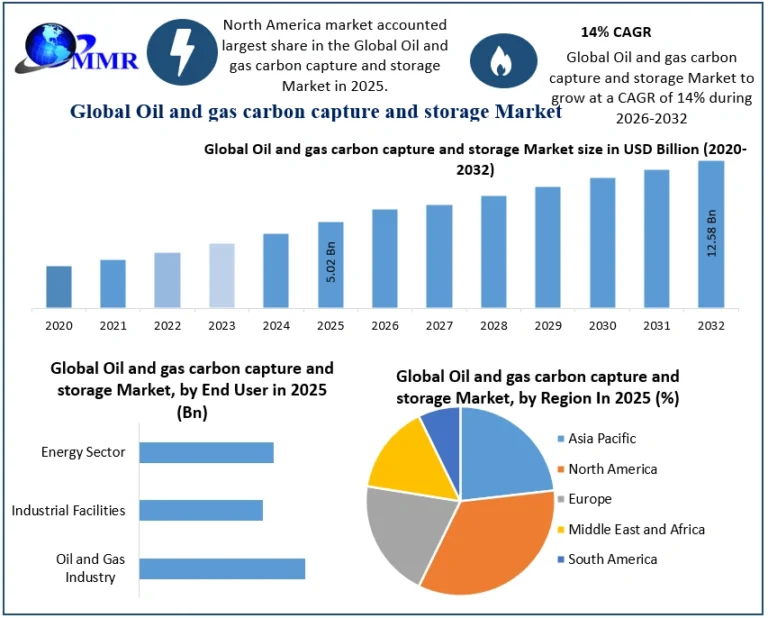
- The Oil and Gas Carbon Capture and Storage Market was valued at USD 5.02 Billion in 2025, highlighting the transition of CCS from demonstration projects to commercial-scale deployment.
- The market is expected to reach USD 12.58 Billion by 2032, growing at a 14% CAGR. The growth rate signals accelerating capital deployment into emissions reduction infrastructure.
- Carbon reduction mandates, industrial decarbonization, and net-zero commitments continue to reshape investment priorities across the oil and gas sector.
- Carbon capture technologies are becoming strategic infrastructure assets rather than compliance expenditures.
- Major energy companies are expanding partnerships, project portfolios, and technology capabilities to strengthen long-term competitiveness.
Why This Matters Now
Carbon management has become one of the defining investment priorities for the global energy industry. Oil and gas producers are no longer judged solely on hydrocarbon production but increasingly on their ability to reduce lifecycle emissions while maintaining energy security.
The Oil and Gas Carbon Capture and Storage Market, valued at USD 5.02 Billion in 2025, demonstrates this structural transition. Its projected expansion to USD 12.58 Billion by 2032, supported by a 14% CAGR, indicates that carbon capture infrastructure is moving toward mainstream energy investment rather than remaining a niche environmental technology. For utilities, industrial operators, investors, regulators, and policymakers, this changes capital allocation priorities, project economics, and long-term competitiveness.
Market Overview
Oil and gas carbon capture and storage Market Size is entering a new phase where decarbonization objectives are directly influencing upstream, midstream, and downstream investment decisions. Carbon capture and storage enables energy producers to reduce emissions from existing assets while supporting broader net-zero strategies.
Governments continue strengthening climate commitments while industrial sectors seek practical pathways to reduce hard-to-abate emissions. As a result, CCS increasingly complements renewable energy deployment instead of competing with it. The technology also supports energy security by allowing continued utilization of existing energy infrastructure during the transition toward lower-carbon systems.
Infrastructure development is becoming equally important. Carbon transportation networks, geological storage facilities, and integrated carbon management systems are emerging as critical components of future energy ecosystems.
Key Trends Driving Growth
The industry’s priorities have shifted significantly. Companies are investing in carbon management not simply to meet regulatory obligations but to secure future project approvals, maintain investor confidence, and preserve long-term asset value.
Decarbonization targets remain the primary catalyst. Governments across major energy markets continue introducing climate policies that encourage lower-emission production pathways while maintaining reliable energy supplies.
Digital technologies are also improving operational efficiency across CCS projects. Enhanced monitoring, predictive analytics, and automation are reducing operational uncertainty while strengthening confidence in long-term carbon storage performance.
Hydrogen development further expands CCS opportunities. Blue hydrogen production relies heavily on carbon capture technologies, linking hydrogen economy investments directly with CCS deployment.
At the same time, energy security concerns reinforce the importance of carbon capture. Countries seeking to balance emissions reduction with reliable domestic energy production increasingly view CCS as an enabling technology rather than a transitional compromise.
Explore detailed analysis, insights, and growth opportunities
Segment Insights
- Dominant Segment: The report identifies the dominant market segment based on its analysis, reinforcing where current commercial deployment and investment remain concentrated.
- Fastest-Growing Segment: The report highlights the fastest-growing segment, reflecting increasing investment momentum driven by evolving decarbonization requirements and technological advancement.
- Carbon capture technologies continue expanding across multiple oil and gas applications as operators integrate emissions management into long-term production strategies.
- Storage infrastructure remains essential as project pipelines increasingly require reliable transportation and permanent sequestration capabilities.
- Industrial collaboration is accelerating commercialization by combining expertise across energy producers, infrastructure developers, and technology providers.
Regional Growth Story
The United States continues strengthening its position through supportive carbon reduction initiatives, infrastructure investment, and large-scale CCS project development. Policy incentives and industrial demand are encouraging broader commercial deployment across multiple energy-intensive sectors.
Europe, particularly Germany and the United Kingdom, continues integrating carbon capture into wider energy transition strategies. Decarbonization targets, industrial competitiveness, and energy security priorities are encouraging sustained investment in CCS infrastructure.
China is expanding carbon management alongside industrial modernization and emissions reduction initiatives. Growing energy demand and long-term climate objectives continue supporting carbon capture deployment across industrial and energy sectors.
India is increasingly evaluating CCS as part of its broader industrial decarbonization strategy while balancing rapid economic growth with climate commitments. Japan and South Korea continue advancing carbon capture through technology innovation and industrial collaboration designed to strengthen long-term energy resilience.
These regional strategies demonstrate that CCS adoption is becoming increasingly aligned with national energy security objectives rather than existing solely within environmental policy frameworks.
Competitive Landscape
Competition is evolving beyond technology ownership toward integrated carbon management capabilities. Market participants are increasingly building complete value chains that combine capture technologies, transportation infrastructure, storage assets, and digital monitoring solutions.
Strategic partnerships indicate that future leadership will depend on ecosystem development rather than isolated technological innovation. Companies capable of coordinating industrial emitters, storage operators, infrastructure providers, and policymakers will be positioned to scale projects more efficiently.
Project announcements and investment activity also signal growing confidence that carbon capture infrastructure can generate long-term commercial value. Rather than treating CCS as an operational cost, leading companies increasingly position it as a strategic platform supporting future project approvals, customer relationships, and regulatory alignment.
Technology leadership will therefore depend not only on capture efficiency but also on execution capability, infrastructure integration, and scalable project delivery.
Recent Developments
- Major industry participants continue expanding carbon capture project pipelines.
- Strategic collaborations are strengthening technology deployment capabilities.
- Investments in carbon transportation and storage infrastructure continue increasing.
- Governments are reinforcing policy frameworks supporting industrial decarbonization.
- Digital technologies are improving monitoring, operational efficiency, and long-term storage verification.
Strategic Implications
The market’s growth trajectory indicates that CCS is becoming a permanent component of global energy infrastructure. Companies delaying investment risk facing higher compliance costs, reduced financing flexibility, and weaker competitive positioning as emissions standards continue tightening.
Investors increasingly evaluate energy companies based on credible decarbonization pathways alongside production performance. Infrastructure developers benefit from expanding opportunities across carbon transportation, storage facilities, and integrated carbon management systems.
Utilities and industrial operators also gain greater flexibility by combining renewable energy investments with carbon capture technologies to achieve emissions reduction targets while maintaining operational reliability.
Policymakers, meanwhile, are likely to continue supporting CCS where it contributes to both emissions reduction and energy security objectives.
Future Outlook
The Oil and Gas Carbon Capture and Storage Market is entering a commercialization phase where infrastructure investment, regulatory support, and industrial demand increasingly reinforce one another. As carbon management becomes embedded within broader energy transition strategies, CCS will evolve from a specialized emissions technology into critical energy infrastructure supporting long-term industrial competitiveness.
The companies that build integrated carbon ecosystems today will define tomorrow’s energy leadership, while those that delay strategic investment risk losing both regulatory advantage and commercial relevance.
Analyst Perspective
“The Oil and Gas Carbon Capture and Storage Market is transitioning from policy-driven adoption toward commercially significant infrastructure investment. As industries pursue decarbonization without compromising energy security, carbon capture technologies will become central to long-term competitiveness across the global oil and gas value chain.” — Neha Nalawade, Analyst, Maximize Market Research
About Maximize Market Research
Maximize Market Research Pvt. Ltd. (MMR) is a global market research and consulting company that provides reliable, data-focused, and practical business insights. The firm serves a wide range of industries, including healthcare, pharmaceuticals, technology, automotive, electronics, chemicals, personal care, and consumer goods. Through market forecasts, competitive analysis, strategic consulting, and industry impact assessments, MMR helps organizations understand changing market conditions, identify growth opportunities, and make informed business decisions for long-term success.
Contact Us :
2nd Floor, Navale IT Park Phase 3
Pune Banglore Highway, Narhe
Pune, Maharashtra 411041, India
+91 9607365656
sales@maximizemarketresearch.com
