Key Highlights
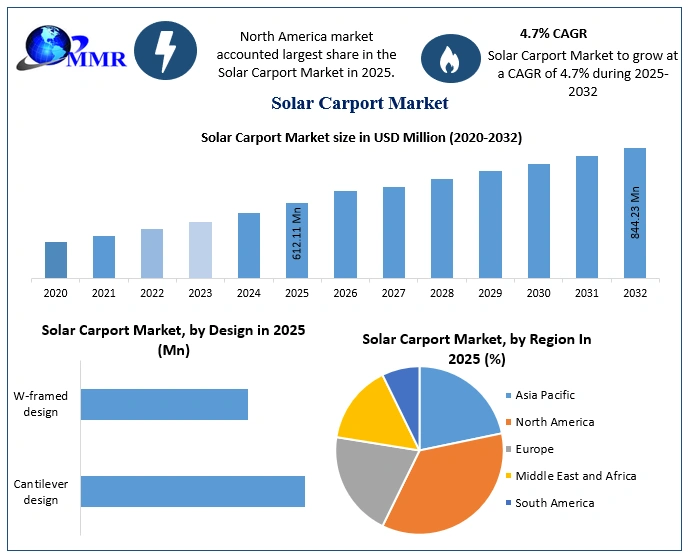
- Solar Carport Market was valued at USD 612.11 Million in 2025.
- Market revenue is projected to reach nearly USD 844.23 Million by 2032, growing at a 4.7% CAGR from 2026 to 2032.
- Growing renewable energy adoption is transforming parking infrastructure into electricity-generating assets.
- Integration with EV charging infrastructure is creating additional commercial value.
- Commercial, industrial, institutional, and public infrastructure projects continue expanding deployment opportunities.
Why This Matters Now
Parking infrastructure is becoming part of the global energy transition. Instead of occupying valuable land for solar farms, developers are increasingly generating renewable electricity from existing parking spaces while simultaneously improving customer experience, supporting electric vehicle charging, and advancing corporate decarbonization goals.
Utilities, infrastructure investors, commercial property owners, airports, universities, manufacturers, and municipalities now view solar carports as infrastructure investments rather than simple parking structures. That shift is redefining project economics across renewable energy markets.
Market Overview
The Solar Carport Market Size reached USD 612.11 Million in 2025 and is forecast to approach USD 844.23 Million by 2032, expanding at a 4.7% CAGR. The steady growth indicates increasing confidence among commercial property owners and energy developers that dual-purpose infrastructure can improve both operational efficiency and sustainability performance.
Unlike conventional rooftop installations, solar carports convert underutilized parking areas into distributed power generation assets. The electricity produced can support onsite consumption, battery storage, or electric vehicle charging, creating multiple revenue and cost-saving opportunities while avoiding additional land acquisition.
Key Trends Driving Growth
Renewable energy deployment continues to reshape commercial infrastructure investment. Organizations are increasingly prioritizing projects that reduce operating costs while supporting net-zero commitments and energy security objectives.
Electric vehicle adoption is creating another growth catalyst. Solar carports can incorporate EV charging stations, allowing businesses to combine renewable generation with transportation electrification. This strengthens the long-term value proposition for retail centers, corporate campuses, industrial facilities, airports, educational institutions, and municipalities.
The market also benefits from efficient land utilization. Rather than dedicating additional land for solar farms, developers maximize existing parking assets. In urban environments where available land remains limited, this approach offers significant infrastructure advantages.
Technical planning is also becoming increasingly sophisticated. Load analysis, energy demand assessment, and charging profile optimization are influencing project design, allowing developers to align solar generation with actual electricity consumption patterns.
Download the report to explore key trends and growth insights.
Segment Insights
- Dominant Segment: Not specified in the supplied MMR report excerpt.
- Fastest-Growing Segment: Not specified in the supplied MMR report excerpt.
- Solar carports continue gaining traction because they generate renewable electricity while protecting vehicles from weather conditions.
- Integration with battery storage and EV charging increases long-term infrastructure value.
- Commercial and institutional deployments remain key opportunity areas based on market applications discussed in the report.
Regional Growth Story
The market’s expansion reflects broader investments in renewable energy infrastructure across major economies including the United States, Europe, and Asia-Pacific. Countries pursuing decarbonization, distributed energy resources, and transport electrification are creating favorable conditions for solar carport deployment.
Urban regions with high vehicle density offer particularly attractive opportunities because existing parking facilities can become electricity-generating assets without requiring new land development. This aligns with national energy security priorities and long-term renewable energy targets.
Competitive Landscape
Competition is moving beyond supplying solar structures. Companies increasingly compete on integrated energy solutions that combine photovoltaic systems, smart energy management, EV charging infrastructure, and long-term operating efficiency.
Recent deployments illustrate this strategic direction. Tata Power’s 6.2 MW solar carport demonstrates how industrial facilities can simultaneously reduce emissions, generate renewable electricity, and utilize existing infrastructure more efficiently. Such projects indicate that future competition will focus on delivering comprehensive clean-energy ecosystems rather than standalone installations.
As project scale increases, engineering expertise, project execution capability, and integration with distributed energy systems are likely to become stronger competitive differentiators.
Recent Developments
- Tata Power deployed a 6.2 MW solar carport capable of generating approximately 86.4 lakh kWh annually while supporting corporate carbon reduction objectives.
- The project is expected to reduce approximately 7,000 tons of carbon emissions annually, strengthening industrial decarbonization efforts.
- Paradise Energy Solutions completed a commercial solar carport installation for a Pennsylvania automotive distributor.
- North America continues to witness large-scale solar carport deployment, including major institutional projects highlighted in the report.
Strategic Implications
Solar carports increasingly occupy the intersection of renewable power generation, transportation electrification, and infrastructure modernization. Organizations investing today gain more than electricity generation—they create flexible energy assets capable of supporting future battery storage, smart charging, and distributed grid participation.
For utilities, these projects contribute to distributed generation. For commercial property owners, they improve asset productivity. For policymakers, they accelerate renewable deployment without expanding land requirements.
Future Outlook
The next phase of market competition will focus less on installing solar panels and more on building integrated energy infrastructure capable of supporting electrified transportation, distributed generation, and resilient power systems. Companies that combine engineering capability, digital energy management, and scalable deployment strategies will define the industry’s next decade, while those treating solar carports as standalone construction projects risk falling behind.
Analyst Perspective
“Solar carports are evolving from niche renewable installations into strategic infrastructure assets that combine clean energy generation, efficient land utilization, and transportation electrification. Their long-term value extends well beyond electricity production.” — Neha Nalawade
About Maximize Market Research
Maximize Market Research Pvt. Ltd. (MMR) is a global market research and consulting company that provides reliable, data-focused, and practical business insights. The firm serves a wide range of industries, including healthcare, pharmaceuticals, technology, automotive, electronics, chemicals, personal care, and consumer goods. Through market forecasts, competitive analysis, strategic consulting, and industry impact assessments, MMR helps organizations understand changing market conditions, identify growth opportunities, and make informed business decisions for long-term success.
Contact Us :
2nd Floor, Navale IT Park Phase 3
Pune Banglore Highway, Narhe
Pune, Maharashtra 411041, India
+91 9607365656
sales@maximizemarketresearch.com
