Key Highlights
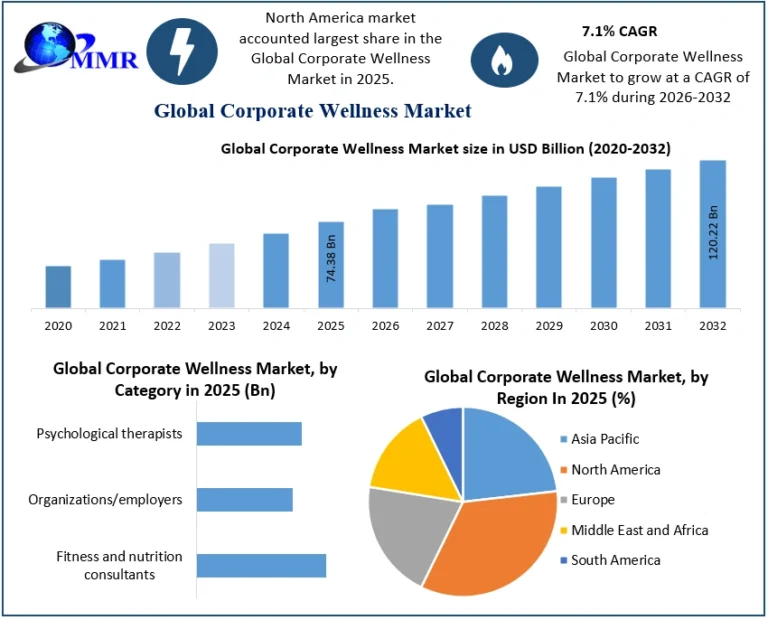
- Corporate Wellness Market valued at USD 74.38 Billion in 2025
- Market projected to reach USD 120.22 Billion by 2032
- Expected CAGR of 7.1% from 2025 to 2032
- Preventive healthcare continues to gain priority among employers
- Digital wellness platforms are improving accessibility and employee participation
- Mental health and stress management programs remain major investment areas
- AI-enabled wellness platforms are supporting personalized employee engagement
- North America leads the global market, while Asia-Pacific presents strong growth opportunities
Why This Matters Now
Corporate wellness is becoming central to healthcare cost management and workforce planning. Employers are recognizing that preventive care reduces absenteeism, improves employee engagement, and strengthens organizational performance.
Healthcare providers, insurers, digital health companies, and technology vendors are responding by expanding integrated wellness solutions that combine physical health, mental wellbeing, nutrition, fitness, and chronic disease management. This shift creates new opportunities across healthcare delivery and employer-sponsored health programs.
Market Overview
The Corporate Wellness Market programs have evolved well beyond traditional fitness initiatives. Organizations increasingly deploy comprehensive solutions that integrate preventive care, behavioral health, nutrition counseling, health assessments, smoking cessation, stress management, and digital monitoring tools.
Growing awareness of chronic diseases, rising healthcare expenditure, and greater emphasis on preventive medicine continue to support market expansion. Employers are also recognizing that healthier workforces contribute directly to productivity, talent retention, and reduced medical costs.
Digital transformation is accelerating adoption through mobile applications, wearable devices, virtual coaching, telehealth services, and AI-powered wellness platforms. These technologies enable continuous employee engagement while providing organizations with actionable health insights.
Healthcare providers and wellness companies are increasingly collaborating with employers to deliver scalable programs tailored to workforce demographics and organizational objectives.
Key Trends Driving Growth
Mental health has become one of the fastest-growing priorities within corporate wellness strategies. Organizations are investing in counseling services, resilience training, stress management, and employee assistance programs to address growing workplace psychological health challenges.
Digital health continues to transform employee wellness delivery. Mobile platforms, wearable technologies, virtual consultations, and remote health monitoring improve participation while making wellness services accessible across distributed workforces.
Artificial intelligence is enhancing program personalization through health risk assessments, behavioral analytics, and customized wellness recommendations. Personalized interventions improve employee engagement and support long-term health outcomes.
Preventive healthcare remains a defining market driver. Organizations increasingly emphasize early intervention, regular health screenings, lifestyle modification, and chronic disease prevention to reduce long-term healthcare expenditures.
Value-based healthcare models are encouraging employers and healthcare providers to focus on measurable health outcomes rather than treatment volumes. Wellness initiatives are becoming important components of broader population health management strategies.
Get a Sample Report Featuring Industry Growth and Revenue Forecasts
Segment Insights
- Dominant Segment: Health Risk Assessment services continue to represent a significant component of corporate wellness programs by enabling early identification of health concerns and supporting preventive healthcare strategies.
- Fastest-Growing Segment: Digital wellness solutions are experiencing rapid expansion as organizations adopt virtual health platforms, AI-enabled engagement tools, telehealth services, and remote wellness management.
- Mental health and stress management programs continue to attract increasing employer investment.
- Fitness and nutrition programs remain essential components of integrated employee wellbeing strategies.
- Large enterprises continue to account for substantial market demand due to comprehensive workforce health initiatives.
Regional Growth Story
North America maintains the leading position in the Corporate Wellness Market, supported by high employer healthcare spending, widespread adoption of employee wellness programs, advanced digital health infrastructure, and strong awareness of preventive healthcare.
The United States continues to drive innovation through employer-sponsored healthcare initiatives, AI-powered wellness technologies, telehealth integration, and expanding corporate investments in employee mental health.
Germany and the United Kingdom continue strengthening workplace wellbeing through preventive healthcare policies, occupational health programs, and growing employer participation in comprehensive wellness initiatives.
Asia-Pacific is emerging as a significant growth region as organizations in China, India, Japan, and South Korea increase investments in employee wellbeing amid expanding corporate sectors and greater awareness of preventive healthcare.
India is witnessing rising adoption among large enterprises, multinational corporations, and technology companies seeking to improve workforce productivity while addressing chronic disease risks and employee stress.
Japan’s aging workforce continues to encourage employers to invest in preventive healthcare and long-term employee health management, while South Korea is expanding digital health adoption within corporate wellness programs.
Competitive Landscape
Competition is shifting beyond traditional wellness providers toward integrated healthcare ecosystems combining digital health, AI, preventive care, and personalized employee engagement.
Technology companies are partnering with healthcare providers to deliver comprehensive wellness platforms that integrate wearable devices, virtual consultations, health analytics, and continuous employee monitoring.
Healthcare providers are strengthening corporate partnerships by expanding preventive screening, chronic disease management, and occupational health services tailored to employer requirements.
Investment in AI-driven personalization, digital engagement platforms, and data analytics is becoming a key competitive differentiator as organizations demand measurable health outcomes and stronger employee participation.
Recent Developments
- Growing adoption of AI-enabled wellness platforms supporting personalized employee engagement
- Increased employer investment in mental health and behavioral wellness programs
- Expansion of telehealth services within corporate wellness offerings
- Rising deployment of wearable technologies for continuous health monitoring
- Greater focus on preventive healthcare and chronic disease management initiatives
- Continued digital transformation of workplace wellness delivery models
Strategic Implications
Corporate wellness is increasingly becoming a strategic investment rather than a human resources initiative. Employers are evaluating wellness programs based on measurable business outcomes, including reduced healthcare costs, lower absenteeism, improved employee retention, and enhanced workforce productivity.
Healthcare providers have opportunities to expand preventive care partnerships with employers, while digital health companies can accelerate adoption through scalable AI-powered wellness platforms.
Insurers are also positioned to benefit from improved preventive care and healthier employee populations, creating opportunities for integrated reimbursement models and value-based healthcare partnerships.
Investors should closely monitor companies combining healthcare expertise, digital technologies, AI capabilities, and personalized wellness services, as integrated solutions are expected to capture increasing market demand.
Future Outlook
Corporate wellness will continue expanding as preventive healthcare, digital health technologies, artificial intelligence, and personalized employee wellbeing become fundamental components of workforce management. Organizations that successfully integrate measurable health outcomes with scalable digital wellness platforms will be best positioned to lead the next phase of market growth, while companies relying on traditional standalone wellness programs risk losing competitive relevance.
Analyst Perspective
“Corporate wellness is becoming an essential business strategy as organizations increasingly invest in preventive healthcare, digital innovation, and personalized employee wellbeing. Companies that combine technology-enabled engagement with measurable health outcomes will shape the future direction of this market.” — Komal Patil, Analyst
About Maximize Market Research
Maximize Market Research Pvt. Ltd. (MMR) is a global market research and consulting company that provides reliable, data-focused, and practical business insights. The firm serves a wide range of industries, including healthcare, pharmaceuticals, technology, automotive, electronics, chemicals, personal care, and consumer goods. Through market forecasts, competitive analysis, strategic consulting, and industry impact assessments, MMR helps organizations understand changing market conditions, identify growth opportunities, and make informed business decisions for long-term success.
Contact Us
2nd Floor, Navale IT Park Phase 3
Pune Banglore Highway, Narhe
Pune, Maharashtra 411041, India
+91 9607365656
sales@maximizemarketresearch.com
