Sustainable Luxury and Natural Fiber Demand Accelerate Alpaca Apparel and Accessories Market Growth
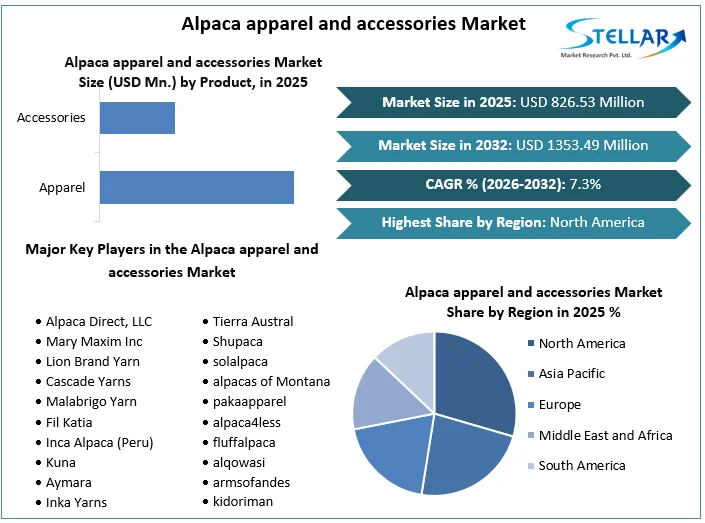
PUNE, India, June 26, 2026 – The Alpaca Apparel and Accessories Market is gaining strong global traction as consumers increasingly shift toward sustainable luxury fashion, natural fiber-based textiles, and ethically sourced premium clothing. According to Stellar Market Research, the global Alpaca Apparel and Accessories Market is projected to grow from USD 826.53 million in 2025 to USD 1.35 billion by 2032, expanding at a CAGR of 7.3% during 2026–2032, driven by rising demand for eco-conscious apparel, luxury knitwear, and high-performance natural fibers.
The market is evolving from niche artisanal production into a structured global fashion segment supported by sustainable sourcing practices, premium branding strategies, and expanding e-commerce distribution networks.
Market Opportunity Overview
The alpaca apparel industry is transitioning into a high-value sustainable fashion category as consumers increasingly prioritize comfort, durability, and environmental responsibility. Alpaca fiber, known for its softness, thermal efficiency, and hypoallergenic properties, is becoming a preferred alternative to synthetic and conventional wool textiles.
Luxury fashion brands and independent designers are expanding alpaca-based collections across sweaters, scarves, ponchos, hats, and accessories, targeting both premium and ethical fashion segments. At the same time, rising disposable incomes and the growth of online fashion marketplaces are expanding global accessibility to alpaca products.
A key market shift is the growing focus on traceability and ethical sourcing, with brands investing in vertical integration—from alpaca farming to finished garments—to ensure fiber authenticity and sustainability compliance.
𝐃𝐨𝐰𝐧𝐥𝐨𝐚𝐝 𝐅𝐫𝐞𝐞 𝐏𝐃𝐅 𝐁𝐫𝐨𝐜𝐡𝐮𝐫𝐞: https://www.stellarmr.com/report/req_sample/Alpaca-apparel-and-accessories-Market/1661
Key Findings from the Report
The Alpaca Apparel and Accessories Market is projected to reach USD 1.35 billion by 2032
The market is expected to grow at a CAGR of 7.3% (2026–2032)
Apparel segment accounts for over 70% of total market share, driven by sweaters, coats, and knitwear
Accessories segment is the fastest-growing category, including scarves, hats, gloves, and socks
Women’s segment dominates demand, accounting for nearly 60%+ market share
Offline retail remains dominant, but online channels are expanding rapidly
North America holds a significant share due to strong sustainable fashion adoption
Asia-Pacific is emerging as the fastest-growing region supported by textile manufacturing growth
Market Drivers and Restraints
Key Drivers
Rising Demand for Sustainable Luxury Fashion
Consumers are increasingly choosing eco-friendly, natural fiber clothing, boosting demand for alpaca-based apparel and accessories.
Growth of Premium and Ethical Fashion Brands
Luxury and independent fashion brands are expanding alpaca collections to meet demand for high-quality, responsibly sourced textiles.
Expansion of E-Commerce Fashion Platforms
Online retail channels are making alpaca apparel more accessible globally, increasing visibility and sales across regions.
Key Restraints
High Production and Sourcing Costs
Limited alpaca fiber supply and small-scale farming operations result in higher production costs compared to synthetic alternatives.
Counterfeit and Quality Inconsistency Issues
Market fragmentation and inconsistent labeling of alpaca content create challenges in product standardization and consumer trust.
Technology, Regulation, and Sustainability Trends
The alpaca apparel market is increasingly influenced by sustainable textile innovation, traceable supply chains, and eco-certified production standards. Brands are investing in blockchain-based sourcing transparency and digital labeling systems to verify fiber authenticity.
Regulatory emphasis on sustainable textiles and ethical sourcing is encouraging manufacturers to adopt environmentally responsible dyeing processes and reduce chemical usage in textile finishing.
Sustainability trends are also driving innovation in blended fabrics, combining alpaca fiber with organic cotton and other natural materials to improve durability and performance.
Regional Insights
North America Leads Demand for Sustainable Fashion
The region shows strong consumer preference for ethical luxury apparel, supporting growth in alpaca-based knitwear and accessories.
Europe Strengthens Premium and Artisan Fashion Segment
European markets emphasize craftsmanship, traceability, and high-end alpaca fashion integration in luxury retail.
Asia-Pacific Emerges as Fastest-Growing Region
Rising textile manufacturing capabilities, growing middle-class consumption, and export-oriented production are driving expansion.
Latin America Remains Core Supply Base
Countries like Peru continue to dominate alpaca fiber production, supporting global supply chains and export markets.
Recent Industry Developments
PAKA Apparel (2025): Expanded traceable alpaca knitwear collections using regenerative agriculture sourcing models to strengthen sustainability positioning.
The Inoue Brothers (2025): Collaborated with Japanese designers to launch premium alpaca-based fashion collections emphasizing ethical production and craftsmanship.
Wild Saint London (2025): Introduced new alpaca scarf collections featuring natural dyes and diversified color ranges to target premium fashion consumers.
Bee & Alpaca (2024): Showcased upcycled alpaca fashion designs promoting circular economy principles in textile production.
Everlane (2025): Expanded alpaca-based knitwear lines within its sustainable fashion portfolio, increasing consumer accessibility through online retail.
Competitive Landscape
The Alpaca Apparel and Accessories Market is moderately fragmented, with participation from luxury fashion houses, sustainable textile startups, and artisanal producers. Key players include PAKA Apparel, The Alpaca Warehouse, Inca Fashions, Kuna, Alpaca 111, Everlane, and various regional manufacturers in Peru and South America. Companies are focusing on sustainable sourcing, premium branding, e-commerce expansion, and product diversification to strengthen global competitiveness.
𝐃𝐨𝐰𝐧𝐥𝐨𝐚𝐝 𝐅𝐫𝐞𝐞 𝐏𝐃𝐅 𝐁𝐫𝐨𝐜𝐡𝐮𝐫𝐞: https://www.stellarmr.com/report/req_sample/Alpaca-apparel-and-accessories-Market/1661
Analyst Commentary
“The alpaca apparel market is steadily transitioning from a niche artisanal category into a globally recognized sustainable luxury segment. The combination of natural performance benefits, ethical sourcing, and premium fashion positioning is driving long-term structural demand across both developed and emerging markets,” said a Senior Research Analyst at Stellar Market Research.
Future Outlook
Through 2032, the Alpaca Apparel and Accessories Market is expected to grow steadily, driven by rising demand for sustainable textiles, premium natural fibers, and ethical fashion consumption. Expansion of online retail platforms, improved supply chain transparency, and increasing investment in eco-friendly textile innovation will further strengthen market penetration across global fashion ecosystems.
About Stellar Market Research
Stellar Market Research is a global market intelligence and consulting firm providing industry research, forecasting, and strategic advisory services across textiles, fashion, consumer goods, healthcare, automotive, energy, and industrial sectors. The company delivers data-driven insights that help organizations identify emerging opportunities, evaluate competitive landscapes, and make informed strategic decisions in rapidly evolving global markets.
Media Contact
Stellar Market Research
Website: https://www.stellarmr.com
Email: sales@stellarmr.com
