Key Highlights
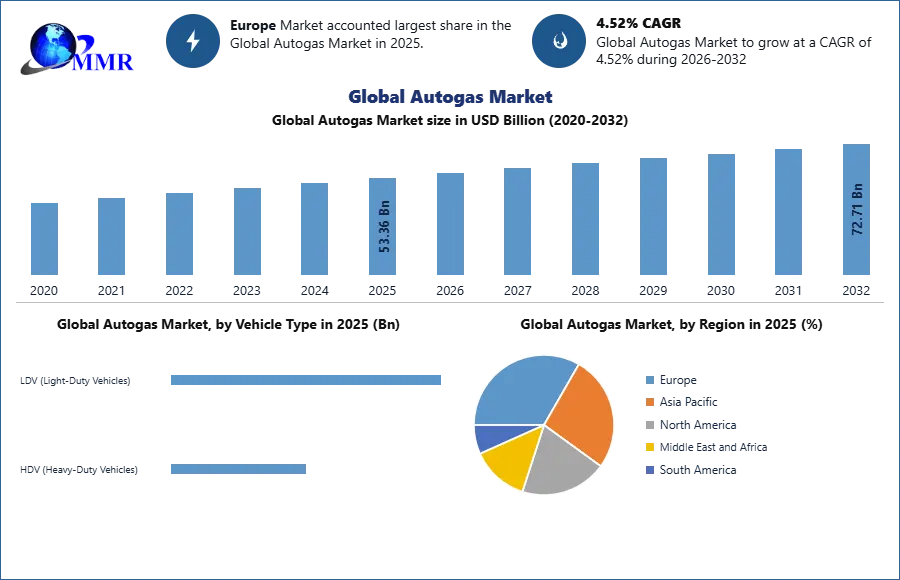
Global Autogas Market size reached USD 53.36 billion in 2025, signaling continued investment in alternative transportation fuels and expanding commercial opportunities.
The market is expected to reach USD 72.71 billion by 2032, growing at a 4.52% CAGR from 2026 to 2032, indicating sustained long-term demand supported by infrastructure expansion and policy support.
Rising emphasis on lower vehicle operating costs and reduced emissions continues to strengthen autogas adoption across passenger and commercial transportation.
Governments are increasingly promoting cleaner transport fuels as part of broader decarbonization and energy security strategies.
Expanding refueling infrastructure is improving accessibility and encouraging wider consumer acceptance.
Fleet operators remain among the strongest adopters as fuel cost optimization becomes a strategic business priority.
Why This Matters Now
Transportation is becoming one of the most competitive fronts in the global energy transition. Governments are seeking practical pathways to reduce transport emissions while maintaining affordability, and businesses are looking for immediate operating cost reductions without waiting for complete fleet electrification.
Autogas is emerging as one of the transition fuels capable of balancing environmental objectives with commercial realities. As fuel diversification gains importance and energy security becomes a national priority across major economies, investment decisions are increasingly extending beyond conventional petroleum fuels toward cleaner and more economical alternatives.
Market Overview
The Autogas Market was valued at USD 53.36 billion in 2025 and is projected to reach USD 72.71 billion by 2032, growing at a 4.52% CAGR during the forecast period. The projected expansion signals sustained business opportunities across fuel distribution, vehicle conversion, infrastructure development, and automotive manufacturing.
Rather than representing a temporary shift, autogas is becoming part of broader transportation diversification strategies. Governments are encouraging cleaner fuels through supportive regulatory frameworks, while consumers continue to seek economically viable alternatives to conventional gasoline and diesel.
Growing urbanization, increasing environmental awareness, and stricter emission regulations are accelerating demand for lower-emission mobility solutions. These developments are strengthening investment across the entire autogas value chain.
Key Trends Driving Growth
The energy transition is reshaping transportation fuel strategies worldwide. While electric vehicles continue expanding, autogas offers an immediately deployable solution for reducing emissions using existing vehicle technologies and established fuel distribution systems.
Fuel affordability remains another major driver. Commercial fleets, logistics companies, taxi operators, and public transportation providers continue evaluating autogas as a practical option to lower operating expenses while meeting environmental compliance requirements.
Governments are also strengthening regulatory frameworks that encourage cleaner transportation fuels. Policies supporting emission reduction and sustainable mobility are creating favorable market conditions for autogas infrastructure expansion.
Infrastructure investment is becoming increasingly important. The expansion of refueling networks reduces one of the traditional barriers to adoption and improves confidence among both fleet operators and private vehicle owners.
Automotive manufacturers and conversion technology providers continue improving vehicle compatibility, supporting broader market adoption across different vehicle categories.
Request a Free Sample Copy or View Report Summary: https://www.maximizemarketresearch.com/request-sample/215529/
Segment Insights
Dominant Segment: The report identifies the Passenger Cars segment as the dominant segment, supported by widespread adoption of autogas-powered passenger vehicles, favorable operating economics, and growing consumer demand for cleaner transportation alternatives.
Fastest-Growing Segment: The report identifies the Commercial Vehicles segment as the fastest-growing segment, driven by increasing fleet conversion, rising logistics activity, and continuous efforts by businesses to reduce fuel expenses and emissions.
Passenger vehicle adoption continues benefiting from lower fuel costs and supportive government initiatives encouraging cleaner transportation.
Commercial fleet operators increasingly view autogas as a practical solution for balancing environmental targets with operational efficiency.
Growing investments in conversion technologies and fueling infrastructure are supporting broader penetration across vehicle categories.
Regional Growth Story
Asia-Pacific continues to play a central role in market development due to expanding vehicle ownership, urbanization, and supportive government initiatives promoting cleaner transportation fuels.
China and India remain important markets as policymakers pursue emission reduction objectives alongside transportation affordability. Expanding infrastructure and growing demand for alternative fuels continue supporting long-term market development.
Europe maintains steady momentum through established autogas infrastructure, environmental regulations, and continued emphasis on lowering transportation emissions. Countries with mature LPG vehicle ecosystems continue demonstrating the commercial viability of autogas.
The United States represents an important opportunity, particularly within commercial transportation and fleet operations where fuel cost optimization remains a strategic priority.
Other developed economies including Germany, Japan, South Korea, and the United Kingdom continue evaluating diversified transportation fuel strategies that complement broader decarbonization initiatives.
Competitive Landscape
Competition is increasingly shifting beyond fuel supply toward integrated mobility ecosystems. Market participants are investing across infrastructure, vehicle technologies, distribution networks, and strategic partnerships to strengthen long-term competitive positioning.
The evolving competitive landscape indicates that future market leadership will depend on the ability to expand refueling accessibility while improving customer economics. Companies capable of integrating infrastructure investment with vehicle conversion solutions are likely to strengthen market share.
Competitive activity also signals greater confidence in long-term transportation fuel diversification. Rather than competing solely on pricing, industry participants are increasingly focusing on service reliability, infrastructure coverage, technology integration, and customer convenience.
This transition suggests the market is moving toward a more mature ecosystem where operational efficiency, distribution capabilities, and regulatory alignment become stronger competitive differentiators.
Recent Developments
Expansion of autogas refueling infrastructure across multiple regions to improve accessibility.
Continued government initiatives supporting cleaner transportation fuels and emission reduction objectives.
Growing investments in vehicle conversion technologies and compatible automotive solutions.
Increasing commercial fleet adoption focused on lowering operating costs and improving environmental performance.
Industry participants strengthening strategic partnerships across fuel supply, infrastructure, and mobility services.
Strategic Implications
For energy companies, autogas represents an opportunity to diversify transportation fuel portfolios while supporting decarbonization objectives. Existing LPG infrastructure provides a foundation for scalable market expansion without requiring entirely new energy ecosystems.
Automotive manufacturers can benefit from increasing demand for alternative-fuel vehicles and conversion technologies. Fleet operators gain opportunities to improve operational economics while complying with increasingly stringent environmental regulations.
Investors should also monitor infrastructure expansion and policy developments, as these factors are likely to determine long-term competitive positioning across regional markets. Governments pursuing energy security and emission reduction strategies may continue supporting cleaner transportation fuels through favorable regulatory frameworks.
Future Outlook
The next phase of the Autogas Market will be shaped less by fuel availability and more by infrastructure deployment, regulatory consistency, and fleet economics. Companies capable of expanding integrated fueling networks while aligning with national decarbonization strategies will be positioned to capture the strongest growth opportunities.
As transportation systems diversify, autogas is expected to remain an important transition fuel that complements broader mobility transformation rather than competing directly with electrification.
The companies investing today in infrastructure, technology integration, and customer accessibility will define tomorrow’s transportation fuel landscape, while slower competitors risk losing relevance as cleaner mobility becomes the industry’s competitive baseline.
Analyst Perspective
“The Autogas Market continues to benefit from the convergence of affordability, environmental priorities, and transportation diversification. As governments strengthen clean mobility policies and businesses seek cost-effective fuel alternatives, autogas is positioned to remain an important component of the global transportation energy mix,” — Neha Nalawade, Analyst
About Maximize Market Research
Maximize Market Research Pvt. Ltd. (MMR) is a global market research and consulting company that provides reliable, data-focused, and practical business insights. The firm serves a wide range of industries, including healthcare, pharmaceuticals, technology, automotive, electronics, chemicals, personal care, and consumer goods. Through market forecasts, competitive analysis, strategic consulting, and industry impact assessments, MMR helps organizations understand changing market conditions, identify growth opportunities, and make informed business decisions for long-term success.
2nd Floor, Navale IT Park Phase 3
Pune Banglore Highway, Narhe
Pune, Maharashtra 411041, India
+91 9607365656
sales@maximizemarketresearch.com
