Key Highlights
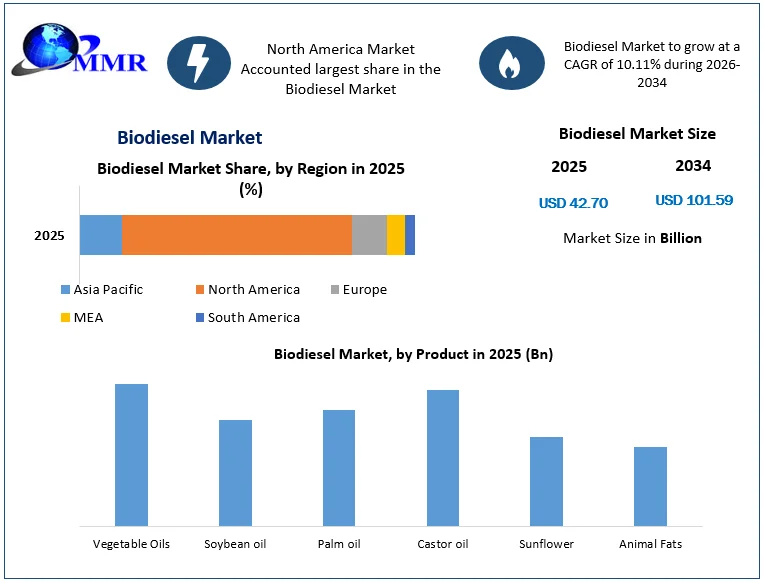
Global Biodiesel Market valued at USD 42.70 billion in 2025.
Market expected to reach USD 101.59 billion by 2034.
Forecast CAGR stands at 10.11% between 2026 and 2034.
Energy security concerns continue accelerating renewable fuel adoption.
Government decarbonization policies remain central to industry expansion.
Transportation remains a major demand center for biodiesel consumption.
Investments across renewable fuel infrastructure continue supporting commercialization.
Why This Matters Now
Energy markets are entering a period where fuel security and carbon reduction are no longer competing priorities. Governments, refiners, logistics operators, and industrial energy users increasingly require renewable liquid fuels that can reduce emissions without replacing existing transportation infrastructure.
This shift places biodiesel at the center of the global energy transition. As renewable fuel mandates strengthen and net-zero commitments expand, biodiesel becomes an immediate solution for lowering transport emissions while enhancing domestic energy resilience. The market valuation of USD 42.70 billion in 2025 demonstrates its established commercial base, while projected growth to USD 101.59 billion by 2034 signals that renewable fuels are becoming a larger strategic component of national energy portfolios rather than a niche alternative.
Market Overview
The Biodiesel Market is evolving alongside structural changes across the global energy sector. Renewable energy deployment is expanding beyond electricity generation into transportation fuels, where liquid biofuels remain essential for sectors that cannot rapidly electrify.
A projected 10.11% CAGR from 2026 to 2034 indicates sustained investment momentum rather than temporary policy-driven demand. For investors, this growth trajectory supports long-term capital deployment into production facilities, feedstock supply chains, blending infrastructure, and distribution networks. For governments, it strengthens energy diversification strategies by reducing dependence on conventional fossil fuel imports while advancing carbon reduction objectives.
The industry also benefits from growing regulatory attention toward lifecycle emissions, creating stronger incentives for renewable fuel production and commercialization.
Key Trends Driving Growth
Decarbonization has become the primary force shaping biodiesel demand. Governments are implementing policies that encourage renewable fuel blending while industries seek practical pathways toward lower greenhouse gas emissions.
Energy security has emerged as an equally significant market catalyst. Volatility across conventional fuel markets has reinforced interest in domestically produced renewable fuels that diversify national energy supplies and improve supply-chain resilience.
Renewable energy strategies are increasingly becoming multi-technology portfolios rather than relying solely on solar and wind generation. Biodiesel complements electrification by addressing applications where battery-electric solutions remain operationally challenging.
Investment across renewable fuel production infrastructure is also strengthening industry competitiveness. Producers continue expanding capacity while improving operational efficiency to meet growing commercial demand.
Digitalization across energy supply chains further supports biodiesel deployment through improved logistics, production optimization, and supply visibility, enabling more reliable fuel distribution networks.
Request a Free Sample Copy or View Report Summary: https://www.maximizemarketresearch.com/request-sample/17390/
Segment Insights
Dominant Segment: The supplied report identifies market segmentation; however, the dominant segment is not available within the provided source information.
Fastest-Growing Segment: The supplied report identifies market segmentation; however, the fastest-growing segment is not available within the provided source information.
Regional Growth Story
Major energy economies continue positioning renewable fuels as part of broader energy transition strategies.
The United States remains focused on expanding renewable fuel deployment through supportive policy frameworks and continued investment across clean energy infrastructure. Biodiesel contributes to emissions reduction while strengthening domestic fuel production capabilities.
European markets, including Germany and the United Kingdom, continue emphasizing carbon reduction through renewable transport fuels as part of wider climate commitments. Regulatory certainty remains an important investment driver for producers operating across the region.
China, India, Japan, and South Korea continue advancing diversified energy strategies that balance economic growth with environmental objectives. Renewable fuels complement investments in electrification, renewable power generation, and broader decarbonization initiatives while supporting long-term energy security priorities.
Across emerging markets, infrastructure investment and growing transportation demand create additional opportunities for biodiesel adoption as governments seek cleaner alternatives without requiring immediate replacement of existing vehicle fleets.
Competitive Landscape
Competition is increasingly shifting beyond production capacity toward integrated renewable fuel ecosystems.
Leading market participants are strengthening positions through investments in production efficiency, feedstock optimization, supply-chain integration, and technology improvements. These strategies signal a transition from volume-based competition toward long-term operational resilience and cost competitiveness.
Capacity expansion also indicates confidence in sustained policy support and growing commercial demand. Companies investing today are positioning themselves to capture future market share as renewable fuel mandates expand and industrial customers prioritize lower-carbon energy solutions.
Technology development is expected to remain a differentiator. Producers capable of improving feedstock flexibility, operational efficiency, and lifecycle carbon performance are likely to strengthen their competitive positions as regulatory standards evolve.
The competitive landscape therefore reflects an industry moving toward greater maturity, larger-scale commercialization, and increasing strategic importance within global energy markets.
Recent Developments
Renewable fuel investments continue supporting commercial biodiesel production.
Government decarbonization initiatives remain influential across major energy markets.
Energy security priorities are strengthening support for domestic renewable fuel production.
Infrastructure investments continue improving renewable fuel distribution capabilities.
Carbon reduction strategies increasingly incorporate biodiesel within broader clean energy portfolios.
Strategic Implications
For utilities, biodiesel expands opportunities to participate in integrated clean energy strategies beyond electricity generation.
For investors, continued market expansion supports long-term investment across renewable fuel production, logistics, infrastructure, and supply chains.
Industrial energy users gain access to commercially available lower-carbon fuels that can support sustainability targets while utilizing existing transportation infrastructure.
Policymakers benefit from biodiesel’s ability to simultaneously address emissions reduction, domestic energy production, and fuel supply diversification without requiring complete transformation of existing transportation systems.
Infrastructure developers also stand to benefit as renewable fuel storage, blending, and distribution networks require continued modernization to accommodate increasing market volumes.
Future Outlook
The Biodiesel Market is moving from policy-supported growth toward strategic integration within global energy systems. Increasing renewable fuel demand, continued decarbonization commitments, infrastructure investments, and energy security priorities are reinforcing biodiesel’s long-term commercial relevance.
As governments pursue net-zero pathways while maintaining reliable transportation energy supplies, biodiesel is expected to remain an important component of diversified renewable fuel portfolios.
The companies that combine scalable production, resilient feedstock strategies, and efficient renewable fuel infrastructure will define the next generation of industry leadership, while competitors that delay investment risk losing relevance as the global energy transition accelerates.
Analyst Perspective
“The Biodiesel Market continues to demonstrate how renewable fuels are becoming increasingly important within global energy transition strategies. Growing investment, supportive regulatory frameworks, and rising demand for lower-carbon transportation fuels are expected to strengthen the industry’s long-term growth trajectory,” says Neha Nalawade, Analyst.
About Maximize Market Research
Maximize Market Research Pvt. Ltd. (MMR) is a global market research and consulting company that provides reliable, data-focused, and practical business insights. The firm serves a wide range of industries, including healthcare, pharmaceuticals, technology, automotive, electronics, chemicals, personal care, and consumer goods. Through market forecasts, competitive analysis, strategic consulting, and industry impact assessments, MMR helps organizations understand changing market conditions, identify growth opportunities, and make informed business decisions for long-term success.
2nd Floor, Navale IT Park Phase 3
Pune Banglore Highway, Narhe
Pune, Maharashtra 411041, India
+91 9607365656
sales@maximizemarketresearch.com
