Key Highlights
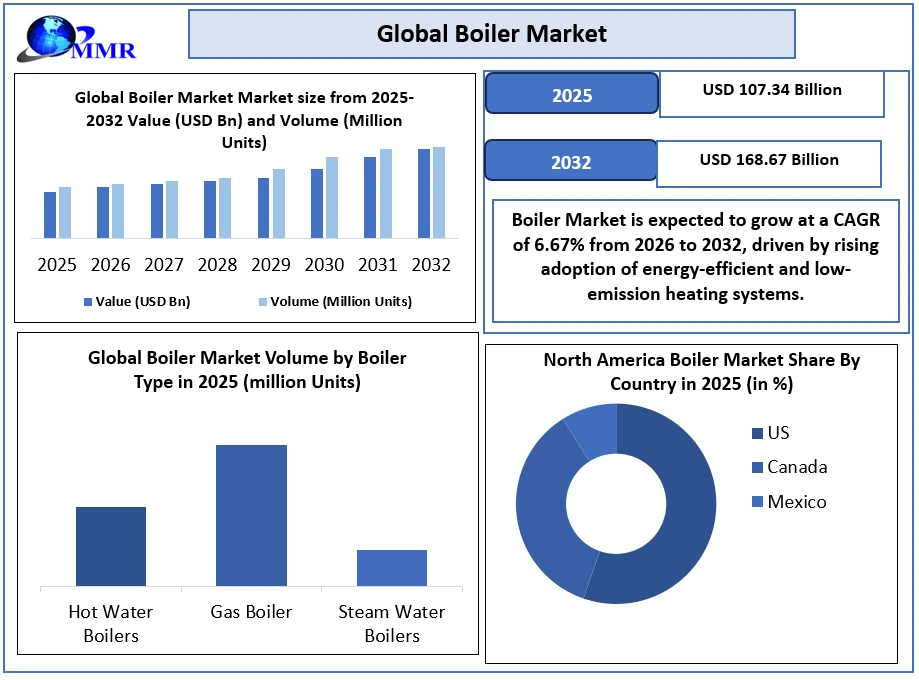
The global boiler market achieved a valuation of USD 107.34 billion in 2025 and is strategically projected to reach USD 168.67 billion by 2032, compounding at a clear CAGR of 6.67%.
Natural gas boilers commanded the primary share of the global fuel mix at 41.56% in 2025 and will lead future expansion with the fastest projected CAGR of 7.05% through 2032.
Industrial production facilities consumed 40% of global final energy in 2025, creating a sustained baseline demand for high-capacity, heavy-duty industrial boilers.
The Asia-Pacific region anchored the global market in 2025 by capturing 39.96% of total revenue and generating over 1.9 million unit installations, representing nearly 45% of total operating units worldwide.
Steam water boilers are maintaining a positive trajectory across chemical and power sectors, with their year-on-year growth rate calculated to reach 5.36% by the year 2032.
North American market volume is positioned for stable development, expanding at a calculated volume CAGR of 5.34% from 2026 to 2032.
Why This Matters Now
Industrial manufacturing and utility power plants are facing immediate, non-negotiable operational disruptions as global regulatory frameworks tighten emissions limits. Industrial sectors consumed 40% of global final energy in 2025, meaning any regulatory adjustments to thermal efficiency instantly threaten the cost structures of energy-intensive industries like mining, manufacturing, and chemical processing. Corporate leadership can no longer delay asset lifecycle decisions; aging infrastructure must be replaced to avoid heavy compliance penalties and soaring operational costs.
At the same time, the broader energy landscape is undergoing a massive capital reallocation toward modern grid infrastructure, electrification, and carbon mitigation. Improving global energy efficiency from 2% to 4% annually by 2030 offers an immediate pathway to hit international net-zero benchmarks. Consequently, the choice of thermal infrastructure has shifted from a routine procurement decision to a core corporate strategy that directly dictates future market competitiveness, asset valuations, and carbon compliance.
Market Overview
The global boiler market Size reached a valuation of USD 107.34 billion in 2025, supported by steady demand across residential, commercial, and industrial verticals. Capital expenditure in this sector is on a clear upward trajectory, with total market revenue projected to reach USD 168.67 billion by 2032. This represents a steady compound annual growth rate (CAGR) of 6.67% over the forecast period from 2026 to 2032.
Global Boiler Market Revenue Growth (USD Billion)
2025: ██████████████ 107.34
2032: ██████████████████████ 168.67
This steady expansion signals a deep, structural replacement cycle taking place within the global industrial architecture. Modern facilities are rapidly retiring obsolete, carbon-heavy legacy boilers and replacing them with highly engineered systems optimized for fuel flexibility and digital integration. As a result, the market is shifting away from low-cost, low-efficiency models toward high-value, digitally connected assets that protect capital investments against volatile energy prices.
Key Trends Driving Growth
Industrial production facilities remain the primary driver of global thermal energy demand. Because the industrial sector accounted for 40% of global final energy consumption in 2025, operators are heavily exposed to shifting fuel prices and environmental penalties. This exposure is forcing a widespread shift toward condensing boiler systems and high-efficiency configurations that extract maximum thermal value from every unit of fuel consumed. This focus on efficiency optimization is a major tailwind for advanced hardware developers.
Concurrently, digitalization is fundamentally changing how industrial utilities manage their day-to-day operations. Plant managers are increasingly specifying smart heating solutions equipped with built-in Internet-of-Things (IoT) sensors, remote monitoring tools, and predictive maintenance algorithms. These connected systems allow operators to spot mechanical wear before it triggers an unscheduled shutdown, maximizing uptime. While a shortage of technicians trained in IoT-enabled equipment creates an adoption bottleneck, the clear financial benefits of smart diagnostics ensure continued investment in digital thermal platforms.
𝐃𝐨𝐰𝐧𝐥𝐨𝐚𝐝 𝐏𝐃𝐅 𝐁𝐫𝐨𝐜𝐡𝐮𝐫𝐞 @ https://www.maximizemarketresearch.com/request-sample/11574/
Segment Insights
Natural Gas Boilers (Dominant Fuel Segment): Held a commanding 41.56% of global market share in 2025, serving as the primary bridge fuel for industrial operators migrating away from heavy fuel oils and coal.
Natural Gas Boilers (Fastest-Growing Fuel Segment): Projected to expand at a leading CAGR of 7.05% from 2026 to 2032, driven directly by government mandates aimed at cutting high pollutant emissions from chemical-heavy thermal plants.
Residential Boilers (Dominant End-User Segment): Secured the largest share of the global boiler market in 2025, fueled by rapid urbanization and steady expansion across worldwide real estate markets.
Steam Water Boilers: Experiencing consistent deployment across high-capacity industrial settings, with its year-on-year growth rate on track to hit 5.36% by 2032 as manufacturing and chemical processing sectors add new capacity.
Regional Growth Story
The Asia-Pacific region dominated the global landscape in 2025, accounting for 39.96% of total market revenue. In terms of physical asset volume, the region saw more than 1.9 million units installed in 2025, which represents nearly 45% of the over 4.1 million commercial and industrial boilers operating worldwide. This massive regional footprint is driven by rapid urbanization and steady expansion across manufacturing zones in China and India. To sustain this momentum, regional developers are leaning heavily into zero-emission building targets and sustainable infrastructure designs, pushing local market revenue to a projected regional CAGR of 7.12% through 2032.
Global Boiler Installations Share (2025)
Asia-Pacific:  ████████████████████ 45% (1.9M+ Units)
Rest of World: ████████████████████████ 55%
In contrast, North America and Europe represent mature, replacement-driven markets characterized by strict regulatory enforcement. The North American boiler market volume is projected to grow at a CAGR of 5.34% between 2026 and 2032, ultimately capturing 23.54% of global value share by 2032. This steady development is driven by infrastructure upgrades in the United States, alongside shifting demographics—such as an aging population requiring specialized healthcare and residential care facilities—which keeps demand for reliable residential heating stable. Meanwhile, Germany is leading European demand by enforcing strict low-emission and energy-efficient product mandates, forcing industrial operators to prioritize advanced hybrid systems that integrate smoothly with existing regional renewable grids.
Competitive Landscape
The global boiler market is highly consolidated at the top tier, led by dominant technology conglomerates including ABB Ltd, Siemens AG, General Electric, and Babcock & Wilcox. These tier-one suppliers leverage deep engineering research budgets, extensive global service networks, and broad product portfolios to lock in long-term maintenance and optimization contracts. To maintain their position against agile local manufacturers, these market leaders are shifting their portfolios away from standard mechanical hardware and focusing on software-defined, highly efficient thermal systems.
This corporate evolution highlights a broader trend: market power is shifting toward companies that can deliver documentable carbon reductions. Industrial buyers are no longer evaluating boilers solely on upfront capital cost; they are evaluating them based on total lifecycle emissions and multi-fuel flexibility. Consequently, leading manufacturers are investing heavily in engineering partnerships to embed smart diagnostics and emissions-tracking software directly into their equipment. This strategy effectively insulates their market position by turning a traditional commodity hardware sale into a long-term, high-margin digital service relationship.
Recent Developments
May 2025: Fujifilm launched an advanced electric boiler engineered to reduce carbon emissions by 26%, providing a scalable electrification pathway for light industrial and commercial operations aiming to cut localized point-source emissions.
September 2024: Thermax Inc introduced an environmentally optimized product portfolio in India featuring specialized bio-grate boilers designed to run efficiently on diverse agricultural biomass inputs.
Strategic Implications
For utility executives and industrial developers, these technical shifts require an immediate re-evaluation of long-term capital allocation strategies. The fact that the natural gas segment is growing at a rapid 7.05% CAGR proves that gas has become the primary bridge fuel for modern industrial operations. Industrial energy managers must accelerate their transition away from legacy solid-fuel boilers to avoid regulatory penalties, volatile carbon costs, and mounting operational inefficiencies.
Furthermore, the introduction of commercial electric and bio-grate systems by innovators like Fujifilm and Thermax signals an accelerating shift toward decentralized, electrified, and fuel-flexible industrial setups. Procurement managers must shift their focus from minimizing initial purchase prices to evaluating total lifecycle costs, factoring in fuel flexibility and automated predictive maintenance capabilities. Investors who back assets that fail to integrate with modern automated grids face a very real risk of holding stranded, non-compliant hardware within the next decade.
Future Outlook
As the global energy transition gathers pace, the boiler market will move further away from fossil-fuel reliance toward hybrid, electric, and smart thermal systems. The ongoing push to double the global rate of energy efficiency improvements will force manufacturing and power generation sectors to step up their investments in high-capacity steam systems, keeping steam water boiler growth on a steady 5.36% annual upward path through 2032. These technology updates will create a distinct divide in industrial profitability, separating companies with optimized, low-emission thermal setups from those burdened by inefficient legacy machinery. Future market dominance belongs exclusively to forward-looking manufacturers and utility operators that rapidly replace legacy hardware with smart, electrified, or fuel-flexible systems, while slow-moving laggards will find themselves squeezed out by soaring carbon compliance costs and frequent, unexpected operational downtime.
Analyst Perspective
“The structural realignment of the global boiler market is no longer driven simply by routine asset replacement cycles, but by an absolute corporate mandate for thermal efficiency and decarbonization. As natural gas solidifies its position as the dominant bridge fuel with a projected 7.05% CAGR, and electric innovations redefine localized emissions profiles, industrial operators must aggressively transition to intelligent, multi-fuel systems or risk immediate regulatory and economic obsolescence.” — Neha Nalawade, Research Analyst, Maximize Market Research
About Maximize Market Research
Maximize Market Research Pvt. Ltd. (MMR) is a global market research and consulting company that provides reliable, data-focused, and practical business insights. The firm serves a wide range of industries, including healthcare, pharmaceuticals, technology, automotive, electronics, chemicals, personal care, and consumer goods. Through market forecasts, competitive analysis, strategic consulting, and industry impact assessments, MMR helps organizations understand changing market conditions, identify growth opportunities, and make informed business decisions for long-term success.
2nd Floor, Navale IT Park Phase 3
Pune Banglore Highway, Narhe
Pune, Maharashtra 411041, India
+91 9607365656
sales@maximizemarketresearch.com
