Key Highlights
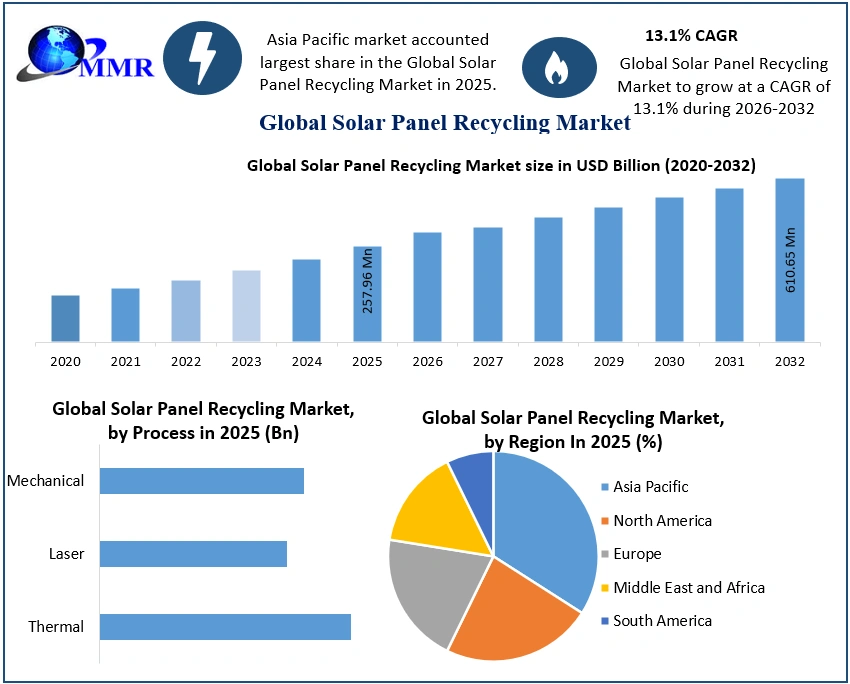
The global solar panel recycling market reached a valuation of USD 257.96 million in 2025 and is projected to scale to USD 610.65 million by 2032, expanding at a compound annual growth rate of 13.1%.
The International Renewable Energy Agency projects accumulated worldwide photovoltaic panel waste to reach between 60 million and 78 million tons by 2050, establishing a massive baseline volume for processing facilities.
Global solar installation volumes are anchored by major regional capacities, including China at 205 GW, Japan at 62 GW, the United States at 60.5 GW, Germany at 48.9 GW, and India at 34.8 GW.
Crystalline silicon represented the dominant technology segment in 2025, driven by the historic dominance of c-Si hardware within the global utility-scale asset base.
The early-loss segment commands the end-of-life structural framework during the forecast period due to mechanical mounting failures and rapid material degradation.
The Asia-Pacific region held the highest market share in 2025 and is projected to sustain the fastest growth rate through 2032 due to accelerating installation numbers.
Why This Matters Now
Utility operators and infrastructure developers face an immediate, unavoidable operational bottleneck as early-generation solar installations approach their structural end-of-life phase. Solar power represents the fastest-rising source of renewable capacity worldwide, but this rapid deployment creates a massive volume of physical waste that threatens to overwhelm existing regional waste management channels. Corporate leaders can no longer look at solar panel disposal as a distant issue; initial installations are already yielding large volumes of decommissioned material that must be legally and sustainably processed to protect corporate liability.
At the same time, regional compliance metrics and localized environmental mandates are raising the financial penalties associated with improper industrial asset disposal. The International Renewable Energy Agency calculates that cumulative worldwide photovoltaic waste will reach between 60 million and 78 million tons by 2050, meaning that asset management teams must construct clear, audited recycling pathways right now. Consequently, choosing a certified recycling partner has changed from a basic corporate social responsibility initiative into a core operational requirement that directly impacts capital security, project insurance, and permitting for future energy projects.
Market Overview
The global solar panel recycling market Size achieved a financial valuation of USD 257.96 million in 2025, reflecting the initial phase of dedicated capital allocation toward specialized clean-energy decommissioning infrastructure. Institutional spending and utility processing agreements are expanding rapidly, with total market revenue projected to reach USD 610.65 million by 2032. This expansion represents a compound annual growth rate of 13.1% over the multi-year forecast window from 2026 to 2032.
Global Solar Panel Recycling Market Growth (USD Million)
2025: ███████████ 257.96
2032: ██████████████████████████ 610.65
This double-digit growth trajectory signals a deep, structural transition from simple glass and metal reclamation plants toward highly automated, specialized chemical and thermal recycling facilities. Early operators relied on basic scrap-metal processors to dismantle modules, which resulted in low material recovery rates and lost value for precious elements. The modern industry requires specialized processing facilities that can isolate high-purity silicon and rare metallic compounds, allowing developers to generate new revenues from reclaimed raw materials.
Key Trends Driving Growth
Accelerating utility-scale deployment represents the primary catalyst for long-term recycling volume growth. Rapidly falling component costs have driven massive installations across key economies, with cumulative operational capacities reaching 205 GW in China, 62 GW in Japan, 60.5 GW in the United States, 48.9 GW in Germany, and 34.8 GW in India. This vast deployment base means that waste streams will expand alongside global photovoltaic deployment, ensuring a steady, long-term supply of feedstock for dedicated recycling facilities.
Simultaneously, specialized research and development efforts are shifting toward capturing valuable materials within older modules. Dedicated programs in France, Germany, Italy, Japan, and the United States are focused heavily on silicon-based panels to reclaim and process pure silicon and rare metal elements. This focus on material reclamation allows processing firms to isolate high-value components that can be sold back into manufacturing supply chains, insulating recycling businesses from shifting waste-disposal tipping fees and volatile commodity markets.
𝐃𝐨𝐰𝐧𝐥𝐨𝐚𝐝 𝐏𝐃𝐅 𝐁𝐫𝐨𝐜𝐡𝐮𝐫𝐞 @ https://www.maximizemarketresearch.com/request-sample/70224/
Segment Insights
Crystalline Silicon (Dominant Technology Segment): Accounted for the largest global market share in 2025, a position driven by the overwhelming historic deployment of advanced c-Si hardware within utility-scale and commercial energy projects.
Early-Loss Assets (Dominant End-Of-Life Segment): Dominates the solar panel recycling market during the forecast period, highlighting premature field failures over standard asset depreciation cycles.
Thermal, Laser, and Mechanical Processing (Process Segments): Transitioning rapidly from traditional glass crushing to automated mechanical separation and thermal processing to maximize individual material purity during reclamation cycles.
Regional Growth Story
The Asia-Pacific region held the highest market share in 2025 and is anticipated to register the fastest compound annual growth rate from 2026 through 2032. This performance is a direct result of the region’s expanding industrial solar installations, which require immediate localized end-of-life infrastructure. To protect these investments, Chinese companies and research institutes maintain the highest number of global patent filings for solar panel recycling technologies. This concentration of intellectual property secures a long-term competitive advantage for regional firms as they prepare to process the massive volumes of waste expected from China’s 205 GW installation base.
Global PV Waste Projection by 2050 (IRENA)
Lower Bound: ████████████████████ 60M Tons
Upper Bound: ██████████████████████████ 78M Tons
Meanwhile, Europe operates as a highly structured, compliance-driven market supported by early technology adoption and broad buyer acceptance across the European Union. Specialized infrastructure development took a major step forward when Veolia opened the first dedicated European plant focused entirely on recycling photovoltaic panels in 2018. Before this facility opened, legacy modules were treated within standard metal or glass recycling plants, which downcycled materials and lost rare metals. Today, government mandates to authorize and standardize the recycling process across Germany and the United Kingdom are forcing utilities to contract directly with dedicated processing facilities, creating a stable, predictable stream of commercial revenue.
Competitive Landscape
The global solar panel recycling market features an integrated competitive mix of tier-one solar manufacturers, specialized waste disposal firms, and technology innovators. Key industry participants include Reiling Glasrecycling Denmark ApS, ECS Refining LLC, Envaris, SunPower Corporation, Morgen Industries, Inc., PV Recycling, and Silcontel Ltd. These entities are joined by specialized groups like Reclaim PV Recycling Pvt. Ltd., First Solar, Recycle Solar Technologies Limited, Total Green Recycling, Trina Solar, Sharp Corporation, JA Solar Co., Ltd., Canadian Solar Inc., and Renesola.
This corporate lineup shows a clear structural trend: major module manufacturers are actively integrating recycling capabilities directly into their long-term service agreements. By building certified recycling networks, tier-one manufacturers can offer comprehensive, cradle-to-grave asset tracking that appeals to risk-averse institutional investors and utility developers. This strategy helps secure future project pipelines by removing decommissioning risks for developers, while also providing manufacturers with a steady source of recycled silicon to protect against future raw material shortages.
Recent Developments
Commercial Facility Operations: The establishment of dedicated facilities, following the model of Veolia’s 2018 specialized European plant, is shifting the industry away from simple metal scrap processing toward high-purity component reclamation.
Advanced Recovery Programs: Research facilities in France, Germany, Italy, Japan, and the United States have deployed targeted silicon extraction methods, increasing the recovery rate of rare metal elements from silicon-based panels.
Strategic Implications
For utility executives and infrastructure developers, these structural changes require an immediate rewrite of project financing and decommissioning models. The dominance of the early-loss end-of-life segment proves that operators cannot build financial models assuming a uniform 25-year lifecycle across all installations. Severe weather, poor installation of mounting structures, and midlife failures caused by the degradation of anti-reflective glass coatings mean that recycling systems must be active throughout the entire life of a project.
Furthermore, aggressive patent filings and technology investments across Asia-Pacific and Europe show that supply chain security is becoming tied to resource circularity. Procurement officers must look beyond the initial purchase price of solar modules and prioritize suppliers that offer clear, verifiable recycling partnerships. Developing these secure recycling pathways helps insulate utilities from changing environmental rules, while avoiding the heavy financial penalties that regulators are preparing to impose on unmanaged industrial waste.
Future Outlook
The solar panel recycling market is transforming from a minor waste-handling niche into a critical segment of the global renewable energy infrastructure. The ongoing push for net-zero carbon operations will force utilities to deploy closed-loop material strategies, pushing total recycling market revenue toward USD 610.65 million by 2032. This rapid growth will reshape project economics across the power sector, turning long-term decommissioning liabilities into predictable sources of reclaimed commodities. Future market dominance belongs exclusively to forward-looking utilities and project developers that secure automated, high-purity recycling capacity early, while slow-moving laggards will face severe project delays, heavy regulatory penalties, and unhedged asset decommissioning costs.
Analyst Perspective
“The massive expansion of global solar capacity has created an immediate need for dedicated recycling infrastructure that can handle millions of tons of upcoming waste. With accumulated photovoltaic panel waste on track to hit up to 78 million tons by 2050, the early-loss segment dominance means operators must deploy comprehensive decommissioning frameworks today to secure their long-term capital investments.” — Neha Nalawade, Research Analyst, Maximize Market Research
About Maximize Market Research
Maximize Market Research Pvt. Ltd. (MMR) is a global market research and consulting company that provides reliable, data-focused, and practical business insights. The firm serves a wide range of industries, including healthcare, pharmaceuticals, technology, automotive, electronics, chemicals, personal care, and consumer goods. Through market forecasts, competitive analysis, strategic consulting, and industry impact assessments, MMR helps organizations understand changing market conditions, identify growth opportunities, and make informed business decisions for long-term success.
2nd Floor, Navale IT Park Phase 3
Pune Banglore Highway, Narhe
Pune, Maharashtra 411041, India
+91 9607365656
sales@maximizemarketresearch.com
