Key Highlights
Steam methane reforming remains the dominant production technology worldwide, accounting for over 95% of global hydrogen generation due to its established scalability.
National governments are accelerating industrial decarbonization by making almost USD 41.14 billion in direct and indirect subsidies available annually for clean hydrogen projects.
The global public sector has budgeted USD 25 billion for hydrogen research, development, demonstration, and deployment through 2030, though analysis reveals USD 90 billion is required to fulfill global transition targets.
Blue hydrogen capacity—driven by integrating carbon capture, utilization, and storage into existing reforming plants—is projected to reach 3.3 million metric tons per year by 2028.
Hydrogen delivers a high gravimetric energy density of 130 megajoules per kilogram, nearly three times the energy content of conventional petrol and diesel.
The global merchant hydrogen market size reached a valuation of USD 100.92 billion in 2024 and is projected to expand to USD 174.71 billion by 2032, compounding at a stable CAGR of 7.1%.
Why This Matters Now
Industrial manufacturing, petroleum refining, and chemical processing operations are facing an immediate structural disruption as strict international emissions limits penalize high-carbon manufacturing methods. Historically, the hydrogen generation market has relied heavily on fossil-fuel feedstocks, producing massive quantities of grey hydrogen that contribute significantly to localized point-source emissions. Corporate executives can no longer maintain these legacy assets without risking heavy financial penalties, making the modernization of industrial thermal and chemical processes an absolute priority for capital allocation.
At the same time, the transition toward carbon-neutral business models is forcing a massive injection of public and private capital into clean energy carriers. With hydrogen possessing a high energy density of 130 megajoules per kg, it offers a viable chemical alternative for decarbonizing heavy industries like steel manufacturing and ammonia production where direct electrification is technically unfeasible. Capital developers and infrastructure investors who secure reliable, low-carbon hydrogen generation assets today will insulate their supply chains from volatile fossil-fuel pricing and position themselves to lead the next multi-decade energy infrastructure cycle.
Market Overview
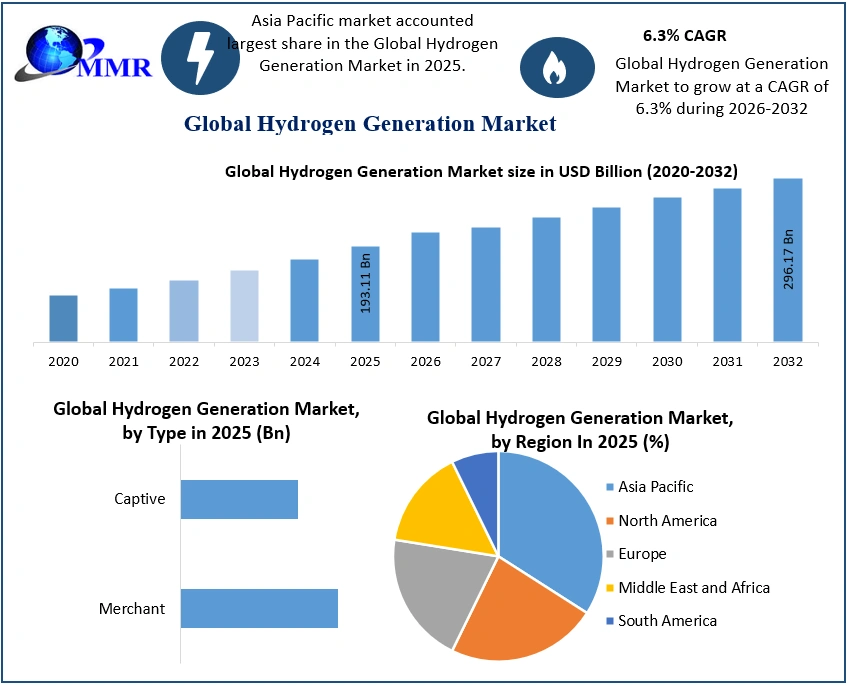
The global hydrogen generation market Size is undergoing a major capacity expansion, supported by deep commercial integration across petrochemical refiners, agricultural fertilizer plants, and metallurgy operations. The merchant hydrogen segment alone represents a major piece of this industrial puzzle, having secured a market valuation of USD 100.92 billion in 2024. Industrial demand and utility-scale projects are on track to expand this single segment to USD 174.71 billion by 2032, calculating out to a steady compound annual growth rate of 7.1%.
Global Merchant Hydrogen Market Value (USD Billion)
2024: ██████████████ 100.92
2032: ████████████████████████ 174.71
This steady growth highlights a major transition in how industrial facilities source essential chemical inputs. Traditional operations relied almost exclusively on captive hydrogen generation assets, which are built on-site and managed by a single facility for internal consumption. The rapid rise of merchant distribution systems allows operators to bypass the massive upfront capital expenditures required to build dedicated on-site generation infrastructure, using third-party supply networks to lower entry barriers and optimize localized operational costs.
Key Trends Driving Growth
The need to manage the variable output of large-scale solar photovoltaic and wind power installations has emerged as a primary driver for modern hydrogen generation technologies. Because renewable energy production fluctuates based on weather conditions, utilities require high-capacity, long-cycle storage media to prevent grid destabilization. Hydrogen generation via water electrolysis provides a flexible solution, absorbing excess grid electricity during peak production periods and converting it into a stable chemical energy carrier that can be stored or used for power generation during periods of low renewable output.
Concurrently, the integration of carbon capture, utilization, and storage technologies into traditional production facilities is creating an immediate commercial pathway for low-carbon blue hydrogen. Transitioning directly to green hydrogen remains limited by high production costs and the severe expense of scaling renewable energy installations. Retrofitting existing steam methane reforming plants with modern carbon capture arrays allows industrial suppliers to hit strict near-term carbon reduction targets while utilizing their existing asset base, driving blue hydrogen capacity to a projected 3.3 million metric tons per year by 2028.
𝐃𝐨𝐰𝐧𝐥𝐨𝐚𝐝 𝐏𝐃𝐅 𝐁𝐫𝐨𝐜𝐡𝐮𝐫𝐞 @ https://www.maximizemarketresearch.com/request-sample/11724/
Segment Insights
Steam Methane Reforming (Dominant Technology Segment): Dominates global hydrogen generation by producing over 95% of the world’s current supply, a position secured by its superior scalability and lower initial production cost compared to alternative technologies.
Captive Hydrogen (Dominant Type Segment): Maintained the largest overall production volume share, driven by its long-term use within ammonia synthesis plants and petroleum refineries that require a continuous, uninterrupted on-site gas supply.
Water Electrolysis (Fastest-Growing Technology Segment): Expanding at the highest compound annual growth rate within the market, fueled directly by utility-scale investments aimed at producing zero-emission green hydrogen.
Merchant Hydrogen (Fastest-Growing Type Segment): Anticipated to expand at the highest CAGR through 2032, supported by water electrolysis and distributed natural gas processes that reduce the need for complex long-distance fuel transportation.
Regional Growth Story
The Asia-Pacific region is positioned to register the fastest compound annual growth rate through 2032, driven by massive investments in refining infrastructure and petrochemical production trains across emerging economies. India and China are anchoring this regional development, using increased hydrogen consumption to lower their reliance on imported petroleum products and improve national energy self-sufficiency. This expansion is further supported by heavy investments in East Asian nations; for instance, Japan has committed substantial capital to steam methane reforming technologies and stands at the forefront of global fuel cell vehicle development, while South Korea continues to roll out utility-scale fuel cell arrays for decentralized urban power generation.
In Western markets, development is heavily guided by structured policy frameworks and targeted public funding. North America held a major market share of 38.45% for steam methane reforming hydrogen generation, supported by a mature industrial base and an extensive network of hydrogen-related intellectual property, with the United States holding 8,955 patents in hydrogen technologies. To maintain this regional leadership, Canadian and American developers are focusing heavily on carbon capture and utilization to scale up low-carbon blue hydrogen infrastructure. Meanwhile, Germany leads European demand by deploying extensive public-private partnerships, utilizing a portion of the region’s shared environmental funding to build out large-scale hydrogen distribution networks that connect coastal wind farms with southern industrial hubs.
Competitive Landscape
The global hydrogen generation market features intense competition among an elite group of international industrial gas providers and engineering conglomerates. Dominant market participants include Air Liquide SA, Linde AG, Praxair Inc, Air Products and Chemicals Inc, Airgas Inc, Hydrogenics Corp, Messer Group, Showa Denko, Ally Hi-Tech, Caloric, and Claind. These tier-one suppliers maintain their market leadership by controlling long-cycle supply agreements and deploying extensive pipeline infrastructure that connects production hubs directly to major industrial consumers.
This corporate environment indicates a major shift toward technology-led partnerships and strategic geographic positioning. For example, industrial gas leaders are investing heavily in advanced manufacturing capabilities to construct high-capacity electrolyzer lines, preparing for the shift toward green hydrogen production. At the same time, traditional equipment suppliers are forming joint ventures with specialized software firms to integrate digital monitoring tools across their infrastructure, transforming a basic commodity gas sale into an optimized energy-management contract that insulates their market position from low-cost regional competitors.
Recent Developments
Sub subsidy Allocations: National governments have formalized approximately USD 41.14 billion in annual subsidies to support the commercialization of complete hydrogen value chains and accelerate public-private infrastructure projects.
Industrial Pump Acquisitions: Ingersoll Rand acquired Del PD Pumps and UT Pumps for a combined USD 285 million, directly targeting high-pressure rotary pump deployment across India’s Green Hydrogen Mission and petrochemical investment pipelines.
Strategic Implications
For utility executives and industrial developers, these changing dynamics require an immediate updates to long-term asset management and procurement strategies. The fact that steam methane reforming produces over 95% of current hydrogen volumes confirms that fossil-fuel inputs remain necessary for near-term industrial operations. Energy managers must prioritize the integration of advanced carbon capture systems to insulate their current manufacturing setups from escalating emissions penalties and carbon asset depreciation.
Furthermore, the persistent gap between current public funding and actual technology needs highlights a major challenge for the industry. While global governments have budgeted USD 25 billion for hydrogen research and development through 2030, comprehensive data reveals that USD 90 billion is required to build a fully functional, low-carbon hydrogen economy. Procurement teams must look past policy announcements and prioritize projects that remain financially viable under current market conditions, using flexible merchant sourcing agreements to hedge against shifting regulatory timelines and volatile raw material costs.
Future Outlook
The global hydrogen generation market is moving toward a highly diversified, lower-carbon production ecosystem that connects renewable energy generation directly with heavy industrial manufacturing. The ongoing deployment of utility-scale electrolyzers and carbon capture systems will continue to reshape project economics across the power sector, pushing blue hydrogen capacity to a substantial 3.3 million metric tons per year by 2028. This infrastructure shift will create a clear operational divide, separating companies with flexible, low-emission generation systems from those tied to unhedged fossil-fuel assets. Future market leadership belongs exclusively to forward-looking utilities and industrial producers that rapidly scale up fuel-flexible hydrogen assets and secure automated distribution pipelines, while slow-moving laggards will face declining asset values, strict regulatory penalties, and uncompetitive manufacturing cost structures.
Analyst Perspective
“The transformation of the global hydrogen generation market is driven by a critical need for structural decarbonization across heavy industry. With steam methane reforming maintaining its massive 95% production baseline, the rapid integration of carbon capture systems and the accelerating rise of merchant water electrolysis prove that operators must deploy multi-layered asset strategies today to secure their position in the clean energy economy.”
— Neha Nalawade, Research Analyst, Maximize Market Research
About Maximize Market Research
Maximize Market Research Pvt. Ltd. (MMR) is a global market research and consulting company that provides reliable, data-focused, and practical business insights. The firm serves a wide range of industries, including healthcare, pharmaceuticals, technology, automotive, electronics, chemicals, personal care, and consumer goods. Through market forecasts, competitive analysis, strategic consulting, and industry impact assessments, MMR helps organizations understand changing market conditions, identify growth opportunities, and make informed business decisions for long-term success.
2nd Floor, Navale IT Park Phase 3
Pune Banglore Highway, Narhe
Pune, Maharashtra 411041, India
+91 9607365656
sales@maximizemarketresearch.com
