Key Highlights
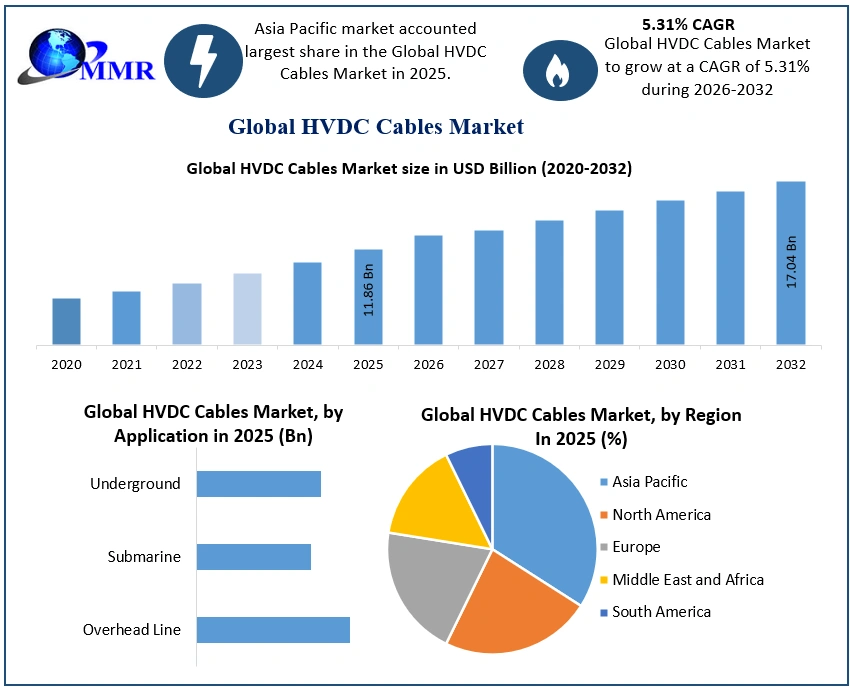
The global high-voltage direct current (HVDC) cables market size is projected to reach USD 17.04 billion by 2032, increasing from USD 11.86 billion in 2025 at a compound annual growth rate (CAGR) of 5.31%.
The submarine application segment established clear market dominance, accounting for 51.3% of the total market share in 2025.
The Asia-Pacific region emerged as the primary geographical market, capturing a 38.3% market share in 2025, driven by massive grid expansions in China and India.
Europe is established as a highly dynamic growth theater, expanding at a dedicated CAGR of 5.17% over the forecast period due to large-scale North Sea wind integration and international interconnectors.
United States subsea wind energy installations are poised to attract over US$ 70 billion in capital investments by 2032, altering long-term infrastructure pipelines.
Ultra-high voltage direct current (UHVDC) cable technology is rapidly expanding, with the specialized market segment expected to reach a valuation of US$ 530 million by the conclusion of the forecast period.
Why This Matters Now
The global power sector is facing a severe structural bottleneck as traditional alternating current (AC) transmission networks fail to efficiently transmit bulk electricity across vast geographical distances without substantial energy dissipation. Utilities, infrastructure developers, and institutional investors are rapidly pivoting capital toward high-voltage direct current (HVDC) systems, which serve as the essential baseline technology for long-distance, low-loss bulk electric power transmission. This technological transition is no longer a elective efficiency upgrade; it is an immediate prerequisite for connecting remote utility-scale renewable generation sites to high-demand urban centers. As carbon reduction initiatives and national electrification mandates accelerate, the capacity to safely link asynchronous power grids operating at different frequencies—such as 50 Hz and 60 Hz networks—is redefining sovereign energy security strategies and regional asset allocation.
Market Overview
The global high-voltage direct current (HVDC) cables market Size achieved a valuation of USD 11.86 billion in 2025. Driven by systemic utility investments and macro grid upgrades, the industry is on a trajectory to reach nearly USD 17.04 billion by 2032, demonstrating a steady CAGR of 5.31% from 2026 to 2032. Structurally, an HVDC cable comprises a highly engineered conductor and specialized insulation material, configured for underwater, underground, or overhead installation. The core economic justification for this technology lies in its operational superiority over conventional AC systems across long distances. It eliminates capacitive losses inherent in subsea AC transmission and provides a streamlined right-of-way footprint. Furthermore, these systems are increasingly deployed to energize offshore oil and gas facilities, including floating production storage and offloading (FPSO) units and permanent marine platforms, typically operating within a voltage spectrum of 100 kV to 800 kV.
Key Trends Driving Growth
What changed in the market is the massive scaling of operating voltages and the commercialization of advanced polymeric materials. Why now? The rapid development of mega-scale remote generation projects, particularly offshore wind farms in the North Sea and deepwater blocks in East Asia, requires a dramatic escalation in transmission voltage to preserve system efficiency. This has triggered a significant spike in demand for Ultra-High Voltage Direct Current (UHVDC) cables, which minimize line losses over thousands of kilometers. For example, the specialized UHVDC cable segment is projected to achieve a market value of US$ 530 million by the end of the forecast period.
Simultaneously, the industry is witnessing a structural shift toward cross-linked polyethylene (XLPE) extruded insulation systems. Historically, paper-insulated mass-impregnated cables dominated high-voltage applications. However, modern XLPE polymer-insulated cables are significantly lighter, physically easier to manipulate during complex maritime operations, and feature higher allowable conductor temperatures. This higher thermal threshold enables a smaller cable cross-section and more compact installation profiles. The operational flexibility of XLPE systems is enhanced by the integration of performance additives, including specialized antioxidants, cross-linking agents, lubricants, and scorch-resistant compounds, which directly extend the operating life of subsea and underground assets.
Segment Insights
Submarine Cables (Dominant Segment): This application segment held the largest share of the market, capturing 51.3% of global revenue in 2025. The segment is propelled by accelerating capital expenditures for offshore wind farms and multi-national island linkages requiring secure, high-capacity underwater interconnections.
Overhead Line Cables (Fastest-Growing Terrestrial Segment): Driven by intense industrialization and urbanization in emerging markets, overhead installations are expanding rapidly due to their lower civil engineering costs and ease of maintenance across complex, non-urban topographies.
Underground Cables: This segment is increasingly utilized in densely populated urban zones where overhead rights-of-way are legally or physically impossible, and where municipal regulations mandate hidden utility infrastructure.
Extruded XLPE Cables: Within the product taxonomy, extruded insulation represents a highly active technology segment due to its lightweight profile, structural simplicity, and superior thermal handling compared to legacy paper-insulated alternatives.
Mass Impregnated (MI) Cables: This technology maintains a reliable, established position in ultra-deepwater and extra-high-voltage applications where long-term hydrostatic pressure resistance and field-proven reliability are paramount.
Regional Growth Story
The Asia-Pacific region dominated the global landscape, securing a 38.3% market share in 2025. This geographical dominance is directly tied to the urgent requirement for reliable, uninterrupted electricity to fuel rapid industrialization and comprehensive rural electrification initiatives. In India, the state-backed POWERGRID corporation has deployed extensive Extra High Voltage Alternating Current (EHVAC) networks up to 765 kV alongside +800 kV and +500 kV HVDC transmission lines to facilitate bulk power transfers between power-surplus generation hubs and major consumption centers. As of June 30, 2021, POWERGRID’s asset base reached 172,154 circuit kilometers of transmission lines, backed by a transformation capacity of 446,940 Mega Volt Amperes (MVA) managed across 262 substations. Concurrently, China’s State Grid Corporation is executing monumental infrastructure projects, including the construction of 3,200 kilometers of high-voltage direct current cable lines to transfer remote inland renewable energy to coastal economic zones. In Japan, clean energy network investments are shifting toward advanced submersible cables for offshore wind integration and inter-island links.
Europe represents a critically strategic market, expanding at a documented CAGR of 5.17% over the forecast period. The region’s growth is anchored by extensive cross-border interconnection projects designed to balance regional generation volatility. The United Kingdom announced the Icelink project, a 1,200-kilometer subsea HVDC link connecting the UK grid with Iceland’s geothermal and hydroelectric generation assets. Additionally, the EuroAfrica Interconnector project is establishing a 1,396-kilometer submarine HVDC link divided into two operational sections, connecting the transmission networks of Egypt, Cyprus, and Greece; the first phase achieved completion in 2020, with the subsequent phase advancing through 2021. In Germany, market dynamics are heavily influenced by federal energy transition policies, necessitating major wind farm connections and substation upgrades. Key domestic initiatives include the DolWin5 project in the North Sea—located 100 kilometers offshore, which achieved its targeted milestones in 2025—and the massive land-based high-voltage corridors designed to move northern wind power to southern industrial clusters.
In North America, the market is positioned for an infrastructure surge centered in the United States, where the subsea wind energy sector alone is projected to attract more than US$ 70 billion in capital investments by 2032. These commitments are transforming the domestic supply chain and forcing regulatory adjustments to clear inter-state transmission bottlenecks.
Competitive Landscape
The competitive structure of the global HVDC cables market is characterized by high technical barriers to entry, severe manufacturing qualification processes, and capital-intensive production assets. Top-tier cable manufacturers are heavily expanding their higher-voltage product lines to secure early positions in multi-billion-dollar utility pipelines. This corporate behavior signals that technology leadership, particularly in the extruded insulation space, is the primary mechanism for maintaining market share.
In May 2021, NKT launched its 525 kV HVDC XLPE subterranean cable system, a commercial introduction targeted directly at Germany’s strategic high-voltage underground corridor projects. This technical development confirms that the market is moving past legacy voltage limits, forcing competitors to validate higher-voltage polymer formulations. Similarly, Prysmian Group secured a major contractual agreement with the German grid operator Amprion GmbH to supply the comprehensive 525 kV HVDC cable system for the critical A-Nord corridor project, cementing the industry trend toward underground high-capacity direct-current corridors.
Engineering, procurement, and construction (EPC) contract sizes are also scaling rapidly. In June 2020, Siemens Gas & Power secured a contract valued at over USD 450 million to engineer and construct a 300-kilometer HVDC link connecting mainland Greece to regional network assets, demonstrating the high-value nature of integrated system deliveries. Furthermore, large-scale multi-national grid integrations are moving from concept to execution. The BRITIB project represents a massive 1,330-kilometer undersea HVDC installation explicitly designed to link the transmission systems of the United Kingdom, Spain, and France, highlighting how regional grid operators are integrating separate national networks to optimize resource sharing.
Recent Developments
NKT commercialized its 525 kV HVDC XLPE underground cable system, specifically positioned to fulfill technical criteria for German high-voltage corridor projects.
Prysmian Group executed a formal contract with Amprion GmbH for the delivery of the 525 kV HVDC cable infrastructure dedicated to the A-Nord transmission corridor.
Siemens Gas & Power won a USD 450 million contract for the 300-kilometer HVDC interconnection project across mainland Greece.
The multi-national BRITIB project advanced engineering plans for a 1,330-kilometer subsea direct-current transmission asset connecting France, Spain, and the United Kingdom.
Russia and Japan finalized bilateral planning frameworks to develop a joint Russia-Japan transmission grid utilizing advanced undersea HVDC cables.
Germany advanced the construction of its DolWin5 offshore grid connection system located 100 kilometers into the North Sea, completing the infrastructure framework in 2025.
Strategic Implications
For utility executives and infrastructure investors, the expansion of the HVDC cables market demands an immediate re-evaluation of long-term capital allocation strategies. The business implication of the transition to submarine and underground HVDC technology is a fundamental change in project risk profiles. While initial capital expenditure for HVDC cable manufacturing and terminal substation construction remains significantly higher than conventional HVAC alternatives, the long-term operational savings realized from minimized transmission losses and reduced reactive power compensation directly improve project internal rates of return (IRRs). Power producers who align their generation pipelines with planned HVDC landing stations will benefit from priority grid access and reduced curtailment risks. Conversely, developers relying on legacy AC infrastructure face severe risks of grid congestion and regulatory penalties as modern grid codes mandate tighter control over power flows and systemic stability.
Analyst Perspective
“The structural transformation of the global power grid is moving at an unprecedented pace, with high-voltage direct current technology operating at the center of this transition,” noted Neha Nalawade, Research Analyst at Maximize Market Research. “The shift toward 525 kV XLPE systems and mega-scale subsea interconnectors proves that utilities are no longer just expanding local capacity; they are re-engineering entire continental energy architectures to accommodate the realities of distributed, utility-scale renewable generation.”
About Maximize Market Research
Maximize Market Research Pvt. Ltd. (MMR) is a global market research and consulting company that provides reliable, data-focused, and practical business insights. The firm serves a wide range of industries, including healthcare, pharmaceuticals, technology, automotive, electronics, chemicals, personal care, and consumer goods. Through market forecasts, competitive analysis, strategic consulting, and industry impact assessments, MMR helps organizations understand changing market conditions, identify growth opportunities, and make informed business decisions for long-term success.
2nd Floor, Navale IT Park Phase 3
Pune Banglore Highway, Narhe
Pune, Maharashtra 411041, India
+91 9607365656
sales@maximizemarketresearch.com
