Key Highlights
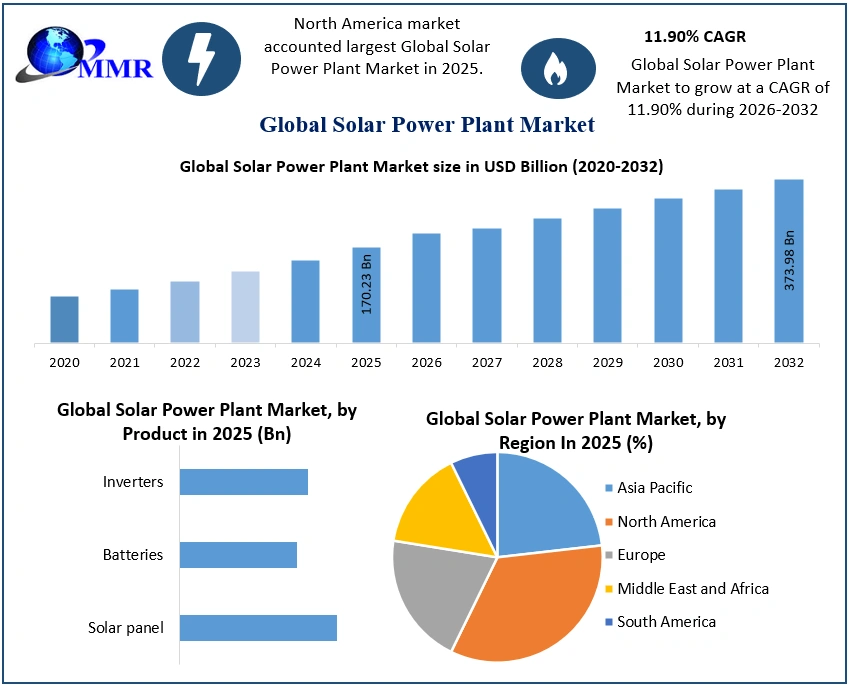
The global solar power plant market size was valued at USD 170.23 billion in 2025 and is projected to reach nearly USD 373.98 billion by 2032.
Market revenue is expanding at a compound annual growth rate (CAGR) of 11.90% over the forecast period from 2025 to 2032.
Solar energy accounts for approximately half of all new planned generation capacity globally, cementing its status as a primary technology for grid modernization.
The Asia-Pacific region dominates the global landscape, highlighted by a surge in solar photovoltaic installations exceeding 70 GW in regional deployment.
Technology manufacturing capacity for solar photovoltaics is expanding rapidly, positioned to surpass projected 2030 demand under the Net Zero Scenario.
Utility-scale entry barriers remain high, underscored by substantial capital investments such as the US$ 1.4 billion required to develop India’s Bhadla Solar Park.
Why This Matters Now
The global power generation sector is undergoing an structural transformation, driven by an immediate need to replace legacy fossil-fuel assets with low-carbon alternatives. Utilities and industrial power users no longer view solar generation as an experimental supplement; it has become the central baseline technology for new capacity deployment. This shift is forced by aggressive net-zero carbon reduction targets and a sudden focus on energy security across major economies. As corporations like Google commit to operating entirely on 100% renewable energy, the commercial pressure to secure stable clean power lines is accelerating capital allocations toward grid-scale solar infrastructure. Organizations that fail to secure long-term renewable generation pipelines face rising exposure to fossil-fuel commodity volatility and tightening carbon penalties.
Market Overview
The global solar power plant market Size achieved a valuation of USD 170.23 billion in 2025. According to the data, the sector is on a trajectory to expand to USD 373.98 billion by 2032, maintaining a strong CAGR of 11.90%. This market includes massive utility-scale installations, centralized solar parks, and distributed energy systems designed to feed power networks or localized industrial clusters. The economic justification for solar power plants has changed due to a continuous decline in solar panel prices, which has seen the cost of photovoltaic modules plummet. This price drop, combined with performance improvements in photovoltaic cells and energy storage systems, makes solar generation highly cost-competitive against conventional thermal plants. However, large solar power plants require vast land areas, which creates secondary challenges related to land use, localized habitat disruption, and substantial capital expenditures for initial grid interconnection.
Key Trends Driving Growth
What changed in the global power sector is that solar energy now accounts for approximately half of all new planned generation capacity. Why now? The combination of plummeting photovoltaic panel prices and manufacturing overcapacity has removed the historical cost barriers to large-scale deployment. Global solar PV manufacturing capacity expansion is on track to surpass 2030 demand targets established under the Net Zero Scenario, ensuring a stable and cost-competitive component supply chain for developers. Who benefits from this shift are forward-thinking utility operators and heavy industrial consumers who can lock in low levelized costs of energy (LCOE). For instance, India’s 2.2 GW Bhadla Solar Park in Rajasthan, spanning 5,700 hectares, has achieved an operational cost efficiency of ₹2.44 (3.4¢ US) per kWh, demonstrating the massive economies of scale available to mega-scale projects.
What happens next is a mandatory pivot toward integrated energy storage systems to counter grid instability. The intermittent nature of solar generation, which remains inconsistent at night and during adverse weather conditions, creates operational challenges for grid stability. Consequently, energy storage systems have become crucial for ensuring a continuous energy supply and preventing grid curtailment. Solutions such as Tesla’s Powerwall for smaller installations and utility-scale battery systems are being integrated directly into project designs to store excess solar energy for later use. This technological integration changes solar power plants from intermittent generation sources into reliable, dispatchable baseload power assets.
𝐃𝐨𝐰𝐧𝐥𝐨𝐚𝐝 𝐏𝐃𝐅 𝐁𝐫𝐨𝐜𝐡𝐮𝐫𝐞 @ https://www.maximizemarketresearch.com/request-sample/194196/
Segment Insights
Utility-Scale Solar Parks (Dominant Segment): Mega-scale centralized installations represent the dominant market segment, commanding the largest portion of global capital expenditure. These projects leverage vast land areas and optimized engineering profiles to drive down the levelized cost of energy to record lows.
Distributed Energy Systems (Fastest-Growing Segment): Distributed installations are increasingly crucial in global solar PV deployment. This segment is expanding rapidly because it circumvents long-distance transmission line constraints and places generation assets directly at commercial, residential, and industrial points of consumption.
Photovoltaic (PV) Technology Component: High-efficiency solar panels, pioneered by companies like SunPower, remain the core technology component driving efficiency gains, offering better thermal performance and higher energy production per square meter.
Grid-Scale Energy Storage Integration: Battery storage systems are transitioning from an optional add-on to a standard project component, serving as the primary tool to manage solar intermittency and ensure stable injection into high-voltage transmission networks.
Regional Growth Story
The Asia-Pacific region has taken a definitive lead in the global transition, characterized by a massive surge in solar photovoltaic installations that recently surpassed 70 GW. India and China are the primary engines of this regional expansion, driven by state-directed infrastructure programs and aggressive utility investments. India’s market strategy is anchored by mega-scale infrastructure deployments, exemplified by the Bhadla Solar Park project, which required a substantial USD 1.4 billion investment to establish its 2.2 GW operational footprint. These capital commitments underscore the scale of investment flowing into the country’s clean energy frameworks. Concurrently, China is scaling both its domestic deployment pipelines and its industrial manufacturing base, ensuring the country controls a major share of global component supply lines.
In Western economies, ambitious policies and targets are driving capacity growth in line with international climate milestones. The United States market is seeing a major influx of corporate and utility capital, spurred by decarbonization mandates and procurement commitments from technology companies and industrial manufacturers. In Europe, Germany leads the deployment curve as it re-engineers its power mix to replace nuclear and fossil-fuel baseloads with distributed and utility-scale solar assets. Across these developed markets, the focus is shifting from simple capacity addition to comprehensive smart grid modernization, enabling existing transmission lines to handle multi-directional power flows from expanding solar networks.
Competitive Landscape
The competitive structure of the solar power plant market is defined by a intense race for technology leadership, manufacturing scale, and vertical integration. Major hardware suppliers and project developers are expanding capacity rapidly to secure long-term pipeline commitments from global utilities. This active environment signals that cost competitiveness, combined with high-efficiency module technology, dictates who secures market share in multi-megawatt tenders.
Prominent global players including Adani Green Energy Limited, JinkoSolar Holding Co., Ltd., Tongwei Solar Co., Ltd., JA Solar Technology Co., Ltd., LONGi Green Energy Technology Co., Ltd., Trina Solar Limited, Canadian Solar Inc., and First Solar, Inc. are driving industry standards through continuous technological innovation. In the manufacturing sector, companies like SunPower have focused on high-efficiency panel production, delivering superior performance metrics that lower the overall land-to-power ratio for developers.
Concurrently, technology integration is blurring traditional industry boundaries. Tesla’s foray into solar energy with its solar roof tiles represents a structural move to integrate generation capacity directly into residential and commercial building structures, combining aesthetics with energy efficiency. Furthermore, Tesla’s deployment of battery storage systems confirms that market leaders must offer integrated generation-plus-storage platforms to remain competitive as utilities place stricter grid-balancing requirements on solar developers.
Recent Developments
India expanded the operational capacity of the Bhadla Solar Park in Rajasthan to 2.2 GW, establishing it as a global benchmark for cost efficiency at 3.4¢ US per kWh.
Global solar photovoltaic deployment in the Asia-Pacific region achieved a new milestone, with annual regional installations surpassing 70 GW.
SunPower advanced the commercial deployment of its high-efficiency solar panel lines, raising the standard for utility-scale energy yields.
Tesla expanded its building-integrated solar footprint through commercial deployments of its solar roof tile technology alongside Powerwall storage units.
Global solar manufacturing capacity expanded beyond projected short-term requirements, ensuring an abundant supply of photovoltaic modules for global project pipelines.
Strategic Implications
For utility executives, power sector decision-makers, and infrastructure investors, the expansion of the solar power plant market requires an immediate change in project risk assessment. The business implication of falling photovoltaic panel prices is that the upfront capital cost is no longer the primary hurdle; instead, project success depends on securing grid interconnection capacity and managing generation profiles. Developers who continue to propose standalone solar plants without integrated battery storage will face high commercial risks, including grid curtailment during peak production hours and depressed merchant power prices. Conversely, infrastructure investors who deploy capital into hybrid solar-plus-storage assets will capture premium power pricing and secure long-term utility power purchase agreements (PPAs).
Future Outlook
Over the next decade, the solar power plant market will move from a phase of rapid deployment into an era of comprehensive grid integration and management. As manufacturing capacity continues to outpace demand, module prices will remain low, forcing developers to focus on operational efficiency, digitalization, and intelligent asset management. The integration of advanced power electronics and automated grid-balancing software will transform regional solar clusters into self-healing components of the wider smart grid framework.
Ultimately, the structure of the power sector will be decided by grid flexibility and storage capacity, separating the industry into clear winners and losers: market leaders who control integrated, dispatchable solar-plus-storage portfolios will dominate wholesale electricity markets, while laggards tied to unbuffered, intermittent generation assets will see their projects become economically unviable.
Analyst Perspective
“The solar power plant market is no longer driven solely by government subsidies; it is driven by superior project economics and industrial demand,” stated Neha Nalawade, Research Analyst at Maximize Market Research. “With solar accounting for nearly half of all new planned global capacity, the challenge has shifted from manufacturing affordable panels to building the intelligent grid infrastructure and energy storage systems needed to manage this clean energy influx.”
About Maximize Market Research
Maximize Market Research Pvt. Ltd. (MMR) is a global market research and consulting company that provides reliable, data-focused, and practical business insights. The firm serves a wide range of industries, including healthcare, pharmaceuticals, technology, automotive, electronics, chemicals, personal care, and consumer goods. Through market forecasts, competitive analysis, strategic consulting, and industry impact assessments, MMR helps organizations understand changing market conditions, identify growth opportunities, and make informed business decisions for long-term success.
2nd Floor, Navale IT Park Phase 3
Pune Banglore Highway, Narhe
Pune, Maharashtra 411041, India
+91 9607365656
sales@maximizemarketresearch.com
