Key Highlights
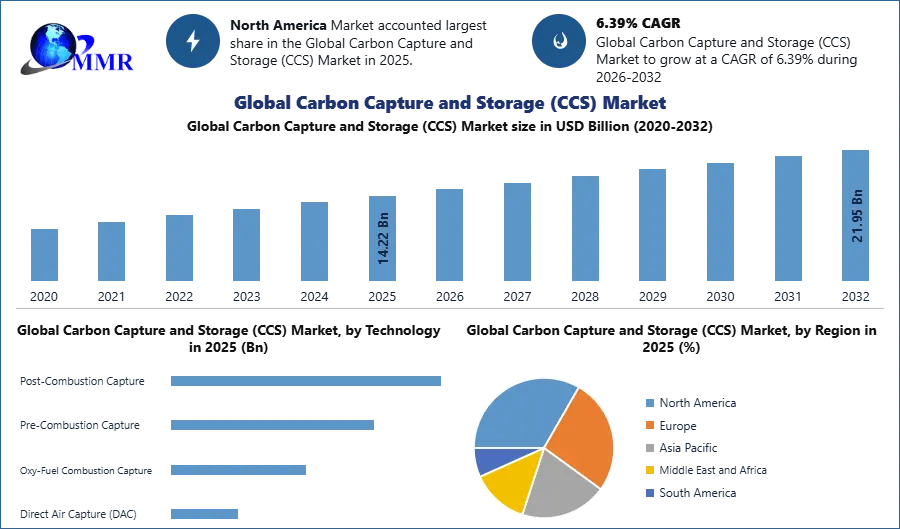
The global carbon capture and storage (CCS) market size is projected to expand to USD 21.95 billion by 2032, rising from a baseline valuation of USD 14.22 billion in 2025.
The market operates at a steady compound annual growth rate (CAGR) of 6.39% over the forecast period from 2026 to 2032.
Permanent geological storage establishes absolute dominance among end-use segments, driven by national decarbonization mandates and binding corporate net-zero targets.
Power generation remains the largest historical capture source by volume, though heavy industrial processes across cement, steel, and chemicals represent the fastest-growing source segments.
Commercial operations have advanced significantly, highlighted by the commissioning of Equinor’s Northern Lights transport and storage network in the North Sea in early 2025.
Industrial-scale technical viability was solidified in mid-2025 by Heidelberg Materials opening the world’s first net-zero cement facility in Brevik, Norway, engineered to isolate 400,000 tons of carbon dioxide annually.
Why This Matters Now
Heavy industrial operators, utility executives, and infrastructure investors are facing an immediate structural disruption as emission penalties transition from regulatory friction into terminal balance-sheet liabilities. Traditional efficiency optimization and electrification initiatives are mathematically insufficient to eliminate process emissions from hard-to-abate sectors such as cement manufacturing, steel forging, and chemical synthesis. This reality has shifted carbon capture and storage (CCS) from an optional corporate sustainability initiative into an immediate operational prerequisite for industrial asset preservation. As sovereign carbon borders tighten and institutional capital penalizes unmitigated industrial carbon intensity, the capacity to capture, transport, and permanently sequester carbon dioxide has become a core determinant of corporate survival and localized energy security.
Market Overview
The global carbon capture and storage (CCS) market Size achieved a market valuation of USD 14.22 billion in 2025. Driven by aggressive compliance frameworks and systemic capital expenditure across energy-intensive industries, the market is on a trajectory to reach nearly USD 21.95 billion by 2032, advancing at a CAGR of 6.39% from 2026 to 2032. Mechanically, the CCS workflow separates concentrated carbon dioxide emissions at the source of production, purifies the captured gas stream, compresses it into a dense fluid state, and transports it via specialized pipelines, tanks, or maritime vessels to deep geological formations for permanent isolation. While legacy applications primarily monetized carbon streams via Enhanced Oil Recovery (EOR) within the oil and gas sector, modern market architecture is heavily weighted toward dedicated open-access storage networks that decouple industrial manufacturing locations from physical sequestration sites.
Key Trends Driving Growth
What changed in the market is the commercial evolution from isolated, single-source capture installations into centralized, multi-user infrastructure hubs. Why now? The extreme capital expenditure required to construct dedicated compression, transport, and storage networks makes independent, standalone projects economically unviable for individual industrial plants. By grouping multiple high-emission facilities around shared pipeline networks and offshore storage fields, developers drastically reduce individual project capital intensity. Who benefits are localized industrial clusters, which can purchase carbon management as a standardized utility service without operating proprietary disposal wells.
What happens next is the gradual integration of Direct Air Capture (DAC) systems and carbon utilization frameworks (CCUS) into the wider infrastructure mix. While post-combustion and pre-combustion systems dominate current retrofits due to higher source concentrations, DAC represents the next-generation technological boundary for localized atmospheric carbon removal. Despite its elevated baseline operational costs, DAC development is accelerating because it provides absolute neutrality independent of point-source generation infrastructure, attracting substantial corporate procurement from entities seeking high-integrity carbon mitigation assets.
𝐃𝐨𝐰𝐧𝐥𝐨𝐚𝐝 𝐏𝐃𝐅 𝐁𝐫𝐨𝐜𝐡𝐮𝐫𝐞 @ https://www.maximizemarketresearch.com/request-sample/14210/
Segment Insights
Permanent Storage (Dominant Segment): This end-use segment commands the largest share of market revenue as governments and corporations align infrastructure spending with strict net-zero timelines that require permanent geological elimination over short-term utilization.
Industrial Processes (Fastest-Growing Segment): Driven by intense regulatory pressure on hard-to-abate sectors, the capture source segments for cement, steel, and chemicals are expanding rapidly, as these industries possess no alternative chemical pathways to eliminate process emissions.
Power Generation: This segment remains the largest volume contributor to the global capture pipeline, driven by utility investments aimed at retrofitting existing fossil-fuel baseload plants to prevent premature asset stranding.
Oil & Gas Sector: The industry continues to act as an essential baseline anchor for the market, deploying established subsurface engineering expertise to scale enhanced oil recovery and deep aquifer storage systems.
Post-Combustion Capture: This technology holds a primary position within the engineering landscape due to its high adaptability for retrofitting existing industrial chimneys and exhaust stacks without altering core furnace designs.
Regional Growth Story
The European theater has emerged as a highly active, commercially mature market for open-access carbon infrastructure, driven by high carbon pricing and structural state support. The North Sea has become the geographical epicenter of subsea storage, highlighted by Equinor successfully commencing operations of its Northern Lights transport and storage infrastructure in January 2025. This project establishes an open-source model, allowing cross-border industrial emitters to ship captured carbon dioxide to a centralized maritime terminal for offshore injection. Further south, Eni and Snam advanced regional decarbonization frameworks by initiating Phase 1 of the Ravenna CCS project in Italy in late 2024. This installation initially targets the capture of 25,000 tons of carbon dioxide annually, positioning Italy as a primary hub for carbon sequestration across the Mediterranean basin. This momentum was sustained in June 2025, when Heidelberg Materials officially opened the world’s first net-zero cement plant in Brevik, Norway, featuring full-scale carbon capture technology designed to isolate 400,000 tons of carbon dioxide per year directly from kiln gases.
In North America, the United States is driving massive commercial scale through targeted tax incentives and long-term commercial agreements. The domestic market has shifted toward high-volume bilateral contracts that de-risk multi-million-dollar capture installations. This trend was emphasized in January 2026, when ExxonMobil finalized a long-term commercial agreement with CF Industries to provide comprehensive carbon capture and storage services for their massive ammonia complex in Mississippi. This transaction demonstrates how major energy suppliers are transforming their business models to act as integrated carbon service providers for heavy manufacturing entities.
Across the Asia-Pacific region, China and India are laying the groundwork for large-scale grid and industrial retrofits. China’s State Grid and major industrial consortiums are evaluating large-scale storage configurations to protect legacy industrial assets, while Japan has accelerated drilling exploration wells for the Tomakomai CCS project in Hokkaido, pointing toward a final investment decision within the 2026 fiscal year to secure domestic energy security and climate goals.
Competitive Landscape
The competitive landscape of the carbon capture and storage market is consolidating around major oil and gas majors, global engineering consortiums, and specialized industrial gas suppliers. Corporate activity confirms that technology leadership and subsurface storage asset ownership are the critical factors for market dominance. The market structure is shifting from simple equipment supply toward fully integrated “Carbon-as-a-Service” models, where a single provider handles everything from source capture to final geological verification.
Strategic partnerships reflect this push for scale and end-to-end service capabilities. In early 2025, SLB completed the acquisition of an 80% stake in Aker Carbon Capture, paying GBP 312 million in net cash. This merger accelerates the commercialization of cost-effective carbon capture solutions across high-emission industrial sectors globally by pairing Aker’s proprietary amine capture technology with SLB’s massive global engineering and project delivery footprint.
Key players including Shell plc, ExxonMobil, Equinor ASA, Occidental Petroleum Corporation, Linde plc, Mitsubishi Heavy Industries Ltd. (MHI), Siemens Energy, and Fluor Corporation are aggressively competing to anchor regional infrastructure networks. MHI and Siemens Energy are focusing on lowering the parasitic energy loads associated with chemical solvent regeneration, which remains the primary operational cost bottleneck for post-combustion systems. Meanwhile, companies like Occidental and ExxonMobil are focusing on acquiring and characterising deep saline aquifers and depleted reservoirs to secure the storage volumes required to back long-term utility and industrial offtake agreements.
Recent Developments
SLB finalized the acquisition of an 80% majority stake in Aker Carbon Capture for GBP 312 million, combining advanced amine technology with global oilfield service engineering capacity.
Equinor successfully initiated commercial operations at the Northern Lights carbon transport and storage hub in the North Sea, marking the launch of cross-border maritime carbon shipping.
Eni and Snam brought Phase 1 of the Ravenna CCS project online in Italy, establishing a centralized Mediterranean carbon sequestration anchor targeting 25,000 tons per year.
Heidelberg Materials launched full-scale commercial operations at its Brevik facility in Norway, creating the world’s first industrial cement plant featuring integrated 400,000-ton annual carbon capture capacity.
ExxonMobil executed a definitive long-term commercial agreement with CF Industries to engineer and operate carbon capture and sequestration services for their Mississippi ammonia complex.
Japan progressed its domestic storage network strategy by initiating exploratory well drilling for the Tomakomai CCS infrastructure project in Hokkaido.
Strategic Implications
For heavy industrial executives and power producers, the formal commercialization of regional carbon networks changes the economics of asset depreciation. The business implication of projects like Northern Lights and Brevik is that emissions are no longer a diffuse operational byproduct; they are a quantifiable commodity that must be captured or heavily penalized. Industrial firms that position their facilities near expanding carbon transport pipelines or maritime hubs will preserve their asset values and secure access to green premium product markets. Conversely, manufacturers operating in regions lacking integrated carbon infrastructure face severe asset stranding as supply chains reject carbon-intensive materials and regulatory penalties erode traditional operational margins.
Future Outlook
Over the next decade, the carbon capture and storage market will mature from an unbundled collection of pilot installations into an interconnected global utility sector. As shared infrastructure networks expand across the North Sea, the Gulf Coast, and East Asia, carbon management will mirror traditional midstream natural gas logistics, with standardized tariff structures for transport and volume injection. The deployment of multi-client storage fields will establish a transparent commodity market for verified sequestration capacity, turning carbon storage into a standard corporate utility cost.
Ultimately, the future of industrial manufacturing will be decided by access to verified geological storage, creating a permanent divergence between market leaders who integrate early into regional carbon networks and laggards whose unmitigated emissions render their production assets economically obsolete.
Analyst Perspective
“The carbon capture and storage market has passed its theoretical validation phase and entered a period of intense infrastructure execution,” stated Neha Nalawade, Research Analyst at Maximize Market Research. “The massive capital flowing into multi-user hubs like Northern Lights and large-scale commercial contracts like the ExxonMobil-CF Industries agreement proves that major energy and industrial players are no longer treating carbon management as a compliance cost, but as a critical baseline infrastructure asset for the net-zero economy.”
About Maximize Market Research
Maximize Market Research Pvt. Ltd. (MMR) is a global market research and consulting company that provides reliable, data-focused, and practical business insights. The firm serves a wide range of industries, including healthcare, pharmaceuticals, technology, automotive, electronics, chemicals, personal care, and consumer goods. Through market forecasts, competitive analysis, strategic consulting, and industry impact assessments, MMR helps organizations understand changing market conditions, identify growth opportunities, and make informed business decisions for long-term success.
2nd Floor, Navale IT Park Phase 3
Pune Banglore Highway, Narhe
Pune, Maharashtra 411041, India
+91 9607365656
sales@maximizemarketresearch.com
