Key Highlights
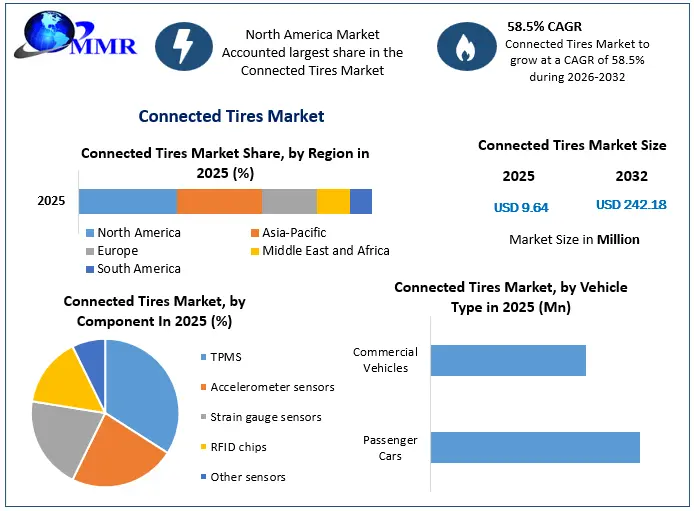
The global connected tires market is projected to scale from USD 9.64 million in 2025 to USD 242.18 million by 2032, expanding at an explosive compound annual growth rate (CAGR) of 58.5%.
Original Equipment Manufacturers (OEMs) represent the dominant distribution channel as tire makers sign direct, long-term technical integration partnerships with premium automotive developers.
Software-Defined Vehicle (SDV) integration and autonomous delivery platforms constitute the fastest-growing market segments through the forecast matrix.
Embedded sensor deployments optimize internal operating pressure levels, directly reducing commercial fuel and power consumption by up to 2% while boosting baseline tire lifespan by 20%.
North America maintains the dominant market share position, supported by dense commercial freight corridors, while the Asia-Pacific region is emerging as the fastest-growing geographic infrastructure zone.
Why This Matters Now
The rapid transformation of transport infrastructure places an unprecedented strain on corporate fleet margins, turning minor operational inefficiencies into major financial liabilities. Fleet operators, utility asset managers, and heavy industrial logistics providers face escalating pressure to squeeze maximum efficiency out of every mile traversed by their electric and autonomous assets. This regulatory and commercial tightening transforms the humble tire from a wear-and-tear component into an essential source of real-time operational data.
For utility executives, energy infrastructure investors, and power sector decision-makers, grid modernization and large-scale industrial transport electrification change the nature of asset tracking. High-torque electric vehicle (EV) fleets accelerate tread wear and introduce severe energy management issues if tire pressure fluctuates. Utilizing connected, sensor-driven wheel assemblies provides immediate access to dynamic telemetry, allowing infrastructure developers to protect their capital equipment investments, optimize fleet rolling resistance, and lower the net grid draw of massive delivery grids.
Market Overview
The global connected tires market Size is entering a phase of rapid institutional expansion, transitioning from a niche performance-tracking product into a core asset-management tool for commercial fleets. Valued at USD 9.64 million in 2025, the total market value is expected to grow at an extraordinary CAGR of 58.5% from 2026 to 2032, culminating in a projected global valuation of USD 242.18 million by 2032. This growth curve is tied to the expansion of connected and autonomous vehicles, where continuous tire health management is required to support complex automated navigation algorithms.
The commercial transport sector has shifted from reactive maintenance routines to active, automated asset management, viewing tire telemetry as an direct lever to control operational costs. Intelligent tires leverage built-in sensors, including Tire Pressure Monitoring Systems (TPMS), accelerometers, strain gauges, and radio-frequency identification (RFID) chips, to continuously stream physical road data into vehicle control networks. This real-time data stream gives institutional operators the visibility required to prevent catastrophic failures, stabilize heavy logistics networks, and establish an audit trail for vehicle operating metrics.
Key Trends Driving Growth
Industrial fleet logistics is undergoing a thorough modernization process, driven by the integration of tire data with vehicle software platforms. In early 2026, Michelin demonstrated this trend by collaborating with software provider Sonatus at the CES 2026 event to showcase its SmartLoad and SmartWear predictive maintenance tools running on the Sonatus AI Director platform. This integration facilitates direct, in-vehicle delivery of real-time tire performance insights, allowing corporate fleets to automate service scheduling and improve on-road safety. By utilizing predictive analytics, fleet operations can identify minor tire structural imbalances before they escalate into expensive roadside breakdowns.
Concurrently, the rollout of advanced telecommunications infrastructure acts as a major driver for the broad deployment of intelligent tire systems. The deployment of high-speed 5G networks across major transport corridors provides the low-latency connectivity needed to process massive volumes of sensor data in real time. This digital framework allows tire manufacturers to move beyond basic pressure warnings and offer deep, cloud-based data analysis. As a result, operations can optimize internal pressure levels dynamically, which cuts commercial fuel consumption by up to 2% and extends general tire lifespans by 20%.
𝐃𝐨𝐰𝐧𝐥𝐨𝐚𝐝 𝐏𝐃𝐅 𝐁𝐫𝐨𝐜𝐡𝐮𝐫𝐞 @ https://www.maximizemarketresearch.com/request-sample/209393/
Segment Insights
Original Equipment Manufacturers (OEMs) (Dominant Segment): Holding a major market share in 2025, this segment benefits from direct technical integration during the vehicle design phase. Major tire producers are partnering directly with automotive brands to embed hardware deep within the wheel assemblies of new connected fleets.
Aftermarket (Fastest-Growing Segment): Driven by the expanding global vehicle parc and aging fleet configurations, this sector presents rapid upgrade opportunities for commercial retailers and specialized fleet service providers looking to modernize existing vehicles.
Hardware & Components (Dominant Product Type): Comprising integrated TPMS, strain gauges, accelerometers, and embedded RFID chips, this segment commands the largest share of initial project spending due to the physical requirements of sensor deployment.
Software-Defined Platforms (Fastest-Growing Product Type): Growing rapidly alongside cloud analytics, this segment includes AI-driven predictive maintenance applications that transform raw pressure and wear data into actionable fleet scheduling inputs.
Regional Growth Story
The regional deployment of connected tire technologies reflects the distribution of advanced freight infrastructure and autonomous vehicle testing hubs. North America maintains the leading position in the global landscape, holding the largest market share in 2025. This position is sustained by an extensive commercial logistics network, early institutional adoption of telematics, and strict regional freight safety mandates. Fleet operators in this region utilize intelligent tire platforms to offset high labor costs, mitigate strict driver hours-of-service limitations, and ensure maximum route efficiency across transcontinental shipping corridors.
In contrast, the Asia-Pacific region represents the fastest-growing market for smart tire integration through 2032. Rapidly modernizing economies like China and India are investing heavily in nationwide 5G infrastructure, creating a favorable environment for the deployment of intelligent vehicle networks. Furthermore, the region’s massive manufacturing capacity and surging electric vehicle production lines offer a strong foundation for domestic OEM partnerships. This infrastructure growth allows regional fleet networks to scale digital tire tracking systems quickly, lowering the total cost of ownership across major delivery operations.
Competitive Landscape
The commercial structure of the connected tires market is consolidating around long-term development partnerships, software compatibility, and rigorous data security. High initial development costs and specialized sensor integration requirements represent significant entry barriers, rewarding established manufacturers who can fund multi-year research and development programs. This structural reality has led to intense competition among top-tier tire producers to establish exclusive technical agreements with leading commercial vehicle developers.
To maintain their market position, major players are focusing on the integration of smart hardware with vehicle control software. Recent product developments show that competitive advantage is no longer determined by mechanical tread patterns alone, but by how effectively a tire can deliver clear data to a vehicle’s central computer. Additionally, as vehicles become more reliant on wireless telemetry, tire developers are forced to invest in advanced cybersecurity practices to prevent data manipulation and secure the information flowing between wheel sensors and cloud storage networks.
Recent Developments
Michelin and Sonatus teamed up at CES 2026 to integrate SmartLoad and SmartWear predictive diagnostic software into automated vehicle management platforms.
Tire developers deployed combined RFID and sensor systems that verify component authenticity while continuously streaming operational tread wear metrics.
Fleet management companies launched cloud dashboards that translate temperature and pressure data into real-time rolling resistance metrics to maximize electric vehicle driving ranges.
International logistics networks standardized automated tire tracking across their operations, achieving documentable 2% fuel savings and a 20% reduction in total tire waste.
Strategic Implications
The transition to intelligent wheel networks requires commercial operators and logistics managers to fundamentally update their asset procurement frameworks. Tires can no longer be viewed as interchangeable, low-tech commodities bought purely on unit price. Instead, procurement teams must treat them as an integrated sensor tier that directly affects fuel efficiency, vehicle uptime, and automated maintenance tracking.
Furthermore, the data generated by connected tires provides a direct financial lever for industrial energy management. By maintaining optimal tire inflation through real-time telemetry, heavy fleet operations can significantly lower their total fuel and energy consumption. This optimization directly reduces greenhouse gas emissions, enabling organizations to meet strict corporate ESG goals and insulate their logistics operations against volatile fuel and power markets.
Future Outlook
The global connected tires market will see clear consolidation as transport networks move toward fully autonomous, software-driven vehicle configurations. The phase-out of traditional, unmonitored tires across commercial operations will accelerate as fleet networks seek to eliminate unscheduled maintenance downtime and maximize energy efficiency. High-value logistics and industrial distribution grids will increasingly require the use of digitally tracked, sensor-equipped tire assets to maintain safety certifications and satisfy data-driven compliance mandates.
Ultimately, this market will create a sharp divide based on software integration and data analytics capabilities. Future market leaders will be the companies that build open, highly secure telemetry platforms that fit seamlessly into global fleet management software ecosystems. Conversely, tire manufacturers that remain focused solely on basic mechanical production, without developing integrated sensor capabilities, will be pushed out of profitable commercial fleet supply chains and left to compete in low-margin consumer retail sectors.
Analyst Perspective
“The integration of intelligent sensors into commercial tire platforms represents a major shift in industrial fleet management,” states Gaurav Deshmukh, Research Analyst at Maximize Market Research. “As fleet operations face strict mandates to improve energy efficiency and lower total operating costs, real-time tire data tracking is transitioning from an optional technology upgrade into a required operational tool to ensure vehicle safety and maximize fleet uptime.”
About Maximize Market Research
Maximize Market Research Pvt. Ltd. (MMR) is a global market research and consulting company that provides reliable, data-focused, and practical business insights. The firm serves a wide range of industries, including healthcare, pharmaceuticals, technology, automotive, electronics, chemicals, personal care, and consumer goods. Through market forecasts, competitive analysis, strategic consulting, and industry impact assessments, MMR helps organizations understand changing market conditions, identify growth opportunities, and make informed business decisions for long-term success.
2nd Floor, Navale IT Park Phase 3
Pune Banglore Highway, Narhe
Pune, Maharashtra 411041, India
+91 9607365656
sales@maximizemarketresearch.com
