Key Highlights
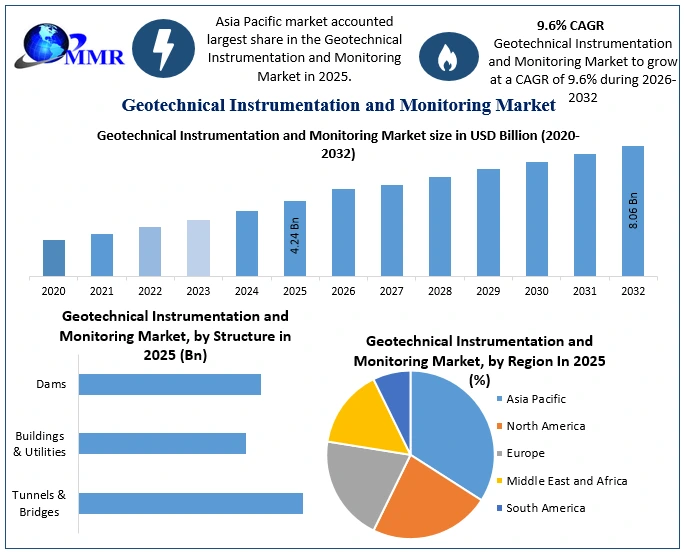
The global geotechnical instrumentation and monitoring market was valued at USD 4.24 billion in 2025 and is projected to reach USD 8.06 billion by 2032, growing at a compound annual growth rate (CAGR) of 9.6%.
High upfront capital allocation requirements for automated IoT networks and extended regulatory approval timelines represent the primary hurdles to swift market penetration.
The Asia-Pacific region commands the premier global market share position, catalyzed by megaprojects such as China’s USD 900 billion Belt and Road Initiative and large-scale industrial expansions in India.
Wireless network technology represents the fastest-growing technology segment, capturing market share from legacy wired installations due to cost efficiencies and ease of deployment in remote terrains.
The Buildings & Infrastructure sector remains the dominant end-user category, while the Energy & Power and Oil & Gas segments are driving high-margin demand for continuous, automated asset tracking.
Why This Matters Now The rapid rollout of high-capacity energy storage facilities, cross-border transmission networks, and massive hydroelectric installations places an unprecedented physical strain on underlying geological structures, turning subsurface stability into a critical factor for capital preservation. Power producers, grid developers, and infrastructure investors face severe operational and financial liabilities if slope failures, seismic shifts, or foundation settling damage major generation assets. This baseline operational exposure elevates geotechnical instrumentation from a routine engineering check into an essential risk-mitigation layer that protects multi-billion-dollar energy networks.
For utility executives, regulators, and energy policymakers, structural integrity directly dictates grid reliability and community safety. As extreme weather events increase localized geological volatility, legacy manual monitoring frameworks are proving insufficient to prevent catastrophic structural breaches. Implementing automated, real-time monitoring solutions allows asset managers to detect micro-strain changes instantly, execute preventative maintenance before physical failure occurs, and satisfy strict government directives for mandatory structural health architecture.
Market Overview The global geotechnical instrumentation and monitoring market Size is entering a phase of rapid institutional deployment, moving past localized construction monitoring to become an integral element of digital asset management. Valued at USD 4.24 billion in 2025, the total market value is on track to reach USD 8.06 billion by 2032, expanding at a steady CAGR of 9.6%. This growth curve is driven by an ongoing global infrastructure boom and the widespread adoption of advanced telemetry systems engineered to measure stress, strain, displacement, pore pressure, temperature, and vibration under severe field conditions.
What changed is the fundamental integration profile of these sensors within the global power generation and distribution architecture. Modern energy developments—ranging from deep-underground utility tunnels and massive hydroelectric dams to offshore wind foundations—rely on these instruments to verify design assumptions during construction and track real-time performance throughout the asset lifecycle. Financial institutions and insurance underwriters are driving this transition by requiring automated, continuous data tracking as a prerequisite for securing project financing and low-cost liability coverage.
Key Trends Driving Growth Industrial asset monitoring is undergoing a major digital upgrade driven by the convergence of the Internet of Things (IoT), cloud computing, and AI-powered predictive analytics. Traditional monitoring relies on technicians manually collecting data from isolated data loggers, a process that introduces reporting delays and human error. Modern systems replace this workflow with automated, low-power sensor arrays that continuously stream geotechnical variables directly to secure, cloud-hosted engineering platforms. This digital architecture provides operators with immediate visibility into subsoil movements and structural alignment changes.
Concurrently, the miniaturization and multifunctionality of modern sensors are lowering installation barriers and expanding the scope of structural health monitoring. Engineering teams can now embed compact, highly integrated instruments deep within concrete foundations, rock faces, and subterranean tunnels without compromising structural strength. These advanced instruments combine multiple measurement functions into a single housing, allowing operators to track complex environmental and structural interactions simultaneously while minimizing deployment costs and field maintenance requirements.
𝐃𝐨𝐰𝐧𝐥𝐨𝐚𝐝 𝐏𝐃𝐅 𝐁𝐫𝐨𝐜𝐡𝐮𝐫𝐞 @https://www.maximizemarketresearch.com/request-sample/34247/
Segment Insights
Wired Network Technology (Dominant Segment): Holding a major share of active installations, this architecture remains standard for high-security, high-interference environments such as deep subsea tunnels and heavy industrial power complexes due to its uninterrupted data connections and reliable power supply.
Wireless Network Technology (Fastest-Growing Segment): Expanding rapidly due to advancements in low-power, wide-area network protocols, this technology is capturing substantial market share by eliminating expensive cabling layouts and simplifying deployment across vast, remote renewable energy sites.
Dams (High-Value Structure Segment): Representing a vital focus area within the utility sector, this segment demands high-density sensor networks to track hydrostatic pressure, internal seepage, and concrete deformation to prevent catastrophic infrastructure failure.
Energy & Power (High-Growth End-User Segment): Driven by massive investments in wind farms, solar fields, and energy storage facilities, this sector leverages automated geotechnical tracking to safeguard generation capacity and optimize site selection parameters.
Regional Growth Story The regional distribution of geotechnical market activity highlights a massive concentration of capital expenditure within the Asia-Pacific region, which stands as the global infrastructure growth hotspot. The region dominates global market share, supported by large-scale government infrastructure investments and rapidly expanding manufacturing hubs in China and India. China’s massive USD 900 billion Belt and Road Initiative, along with India’s extensive regional sustainable development programs, creates a continuous pipeline of high-stakes engineering projects that require advanced, real-time geological risk monitoring.
In North America, market expansion is propelled by deep institutional investments in industrial infrastructure modernization and rapid adoption of cutting-edge AI and IoT technologies. The United States is projecting a massive USD 2 trillion allocation toward upgrading roads, bridges, highways, and electrical transmission corridors, creating a strong market for precision surveying and continuous structural health assessment. This funding framework ensures that North American asset developers have the financial and regulatory support necessary to integrate automated monitoring platforms into core infrastructure networks.
Competitive Landscape The commercial structure of the global geotechnical instrumentation market is consolidating around advanced data integration capabilities, hardware reliability under extreme conditions, and end-to-end software analytics. Leading engineering services and instrument providers, including Fugro (Netherlands), Keller Group (United Kingdom), Nova Metrix LLC (United States), Geokon Incorporated (United States), Geocomp Corporation (United States), and Sisgeo SRL (Italy), are competing intensely to move beyond basic hardware manufacturing and offer complete digital analytics solutions.
This competitive shift signals a structural change in how large-scale project pipelines are secured and maintained. Top-tier players are actively acquiring niche software developers and cloud-computing platforms to build unified systems that combine raw physical data with advanced machine learning models. Companies that control the entire data supply chain—from high-precision sensor manufacturing to AI-driven predictive alert dashboards—are capturing premium contracts from risk-averse utility operators and infrastructure developers looking to reduce operational risk and optimize future grid investments.
Recent Developments
Engineering consortia are deploying automated slope monitoring systems across high-altitude renewable energy corridors, using wireless sensors to eliminate manual data-gathering routines.
Leading manufacturers have integrated advanced machine learning algorithms directly into cloud-based monitoring suites, enabling automated anomaly detection and reducing false alarms by up to 40%.
Strategic partnerships between sensor developers and telecom providers are expanding, utilizing localized cellular and satellite networks to maintain continuous telemetry feeds from remote hydro dam installations.
Regulatory frameworks across major energy markets have updated structural safety criteria, making real-time pore pressure and displacement monitoring a mandatory standard for new large-scale utility construction.
Strategic Implications The transition to continuous, automated geotechnical tracking requires energy developers and asset management teams to update their long-term procurement and risk management frameworks. Subsurface sensors can no longer be viewed as temporary tools used only during the early construction phase. Instead, procurement teams must treat these sensor arrays as permanent, digital components of the asset’s operational infrastructure that remain active throughout its entire commercial lifespan.
Furthermore, the data streams generated by these intelligent instruments provide a direct financial lever for utility capital management. By combining continuous subsoil telemetry with predictive maintenance schedules, operators can precisely identify structural degradation long before it leads to emergency shutdowns. This proactive approach lowers emergency repair costs, optimizes insurance risk profiles, and provides verifiable data that protects long-term energy generation capacity against escalating environmental volatility.
Future Outlook The global geotechnical instrumentation and monitoring market will undergo clear technological consolidation as energy infrastructure networks move toward fully integrated, self-diagnostic asset ecosystems. The reliance on manual, retroactive data gathering will contract rapidly as tightening government safety directives and strict ESG investment mandates penalize unmonitored infrastructure assets. High-value energy generation facilities and grid transmission networks will increasingly rely on automated, real-time wireless telemetry to guarantee structural stability and protect institutional investments.
Ultimately, this industry will enforce a sharp divide based on software analytical capabilities and the integration of advanced sensors. The future will belong to agile market participants who build highly secure, interoperable wireless sensor networks that turn raw geological metrics into clear, actionable engineering insights. Conversely, hardware manufacturers that remain focused solely on basic mechanical sensor production, without developing integrated cloud analytics and predictive AI capabilities, will be pushed out of major industrial energy supply chains and left to compete in low-margin, highly commoditized local commercial markets.
Analyst Perspective “The combination of automated IoT sensor networks and cloud-hosted predictive analytics is fundamentally correcting the historical blind spots in structural asset monitoring,” states Gaurav Deshmukh, Research Analyst at Maximize Market Research. “As utility operators face strict mandates to guarantee the long-term safety of high-value energy installations against growing geological and environmental volatility, real-time geotechnical telemetry is transforming from an isolated project checkpoint into a required operational layer for risk management.”
About Maximize Market Research
Maximize Market Research Pvt. Ltd. (MMR) is a global market research and consulting company that provides reliable, data-focused, and practical business insights. The firm serves a wide range of industries, including healthcare, pharmaceuticals, technology, automotive, electronics, chemicals, personal care, and consumer goods. Through market forecasts, competitive analysis, strategic consulting, and industry impact assessments, MMR helps organizations understand changing market conditions, identify growth opportunities, and make informed business decisions for long-term success.
2nd Floor, Navale IT Park Phase 3
Pune Banglore Highway, Narhe
Pune, Maharashtra 411041, India
+91 9607365656
sales@maximizemarketresearch.com
