Key Highlights
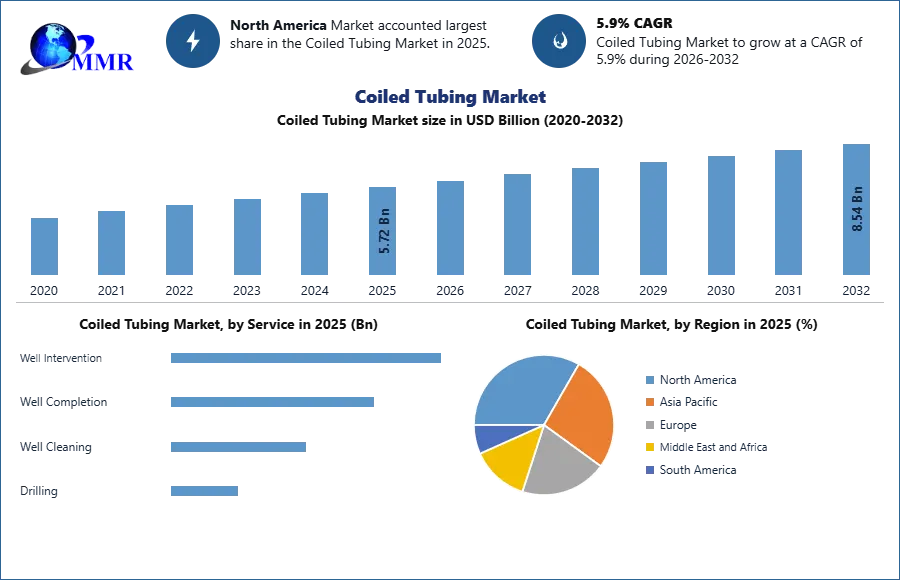
Market valuation expanding from USD 5.72 Billion in 2025 to USD 8.54 Billion by 2032.
A steady compound annual growth rate (CAGR) of 5.9% sustained from 2026 to 2032.
Well intervention services command the largest segment share, holding 66.5% of the market in 2025.
Onshore applications remain the dominant segment, accounting for a 61.5% market share in 2025.
North America leads global regional demand, capturing 46.2% of the total revenue share in 2025.
String failures caused by mechanical or corrosion issues historically represent 80% to 90% of equipment losses.
Why This Matters Now
The industrial sector faces an urgent mandate to eliminate structural equipment failures and enhance operational safety while navigating a changing labor market. Coiled tubing strings operate under intense internal pressures and cyclical bending forces, creating an environments where unmonitored fatigue leads to catastrophic operational disruptions. Because historical data indicates that between 80% and 90% of all string failures result from corrosion, mechanical damage, human error, or manufacturing flaws, standard manual operations are no longer sufficient.
To mitigate these severe high-pressure hazards and systemic operational risks, infrastructure operators are aggressively shifting toward advanced process control frameworks. The modernization of legacy equipment with digital twins, edge-computing telemetry, and real-time fatigue monitoring represents an essential evolutionary step for the industry. Operators who integrate these automated systems can significantly extend material lifespans, optimize fluid dynamics, and protect critical capital investments from unexpected downtime.
Market Overview
The global Coiled Tubing Market achieved a valuation of USD 5.72 Billion in 2025 and is on an upward trajectory to reach approximately USD 8.54 Billion by 2032, expanding at a compound annual growth rate (CAGR) of 5.9%. This steady financial expansion is fundamentally driven by rising global demand for energy, which has forced national oil companies (NOCs) and integrated enterprises to increase upstream exploration. Because traditional shallow-water and easily accessible reserves are diminishing, extraction projects require deeper drilling profiles and more sophisticated structural operations.
However, executing deep well operations introduces severe mechanical complexities, including high-pressure fluid losses, restricted rotational capabilities, and complex logistics during transport. To overcome these logistical barriers, oilfield service organizations are rapidly adopting specialized automation solutions to ensure process optimization. Integrating Programmable Logic Controllers (PLCs) and Supervisory Control and Data Acquisition (SCADA) systems into modern coiled tubing units allows field teams to manage bottom-hole pressure and reel velocity with high precision.
Key Trends Driving Growth
The primary catalyst altering the current operational landscape is the systemic implementation of predictive maintenance frameworks to address structural degradation before a critical failure occurs. Historically, detecting micro-fractures or inner-wall corrosion required manual inspections that halted field operations. Today, modern industrial IoT sensors continuously stream stress, temperature, and wall-thickness data into centralized monitoring systems, converting physical asset management into a digital workflow.
Furthermore, the introduction of automated fluid-pumping systems has minimized human error and reduced dangerous pressure spikes during complex circulation procedures. Real-time analytics platforms calculate precise hydraulic variables, dynamically adjusting fluid viscosity and pump rates to maintain equilibrium within the wellbore. This shift toward autonomous process execution directly insulates expensive down-hole safety valves from structural damage while maximizing extraction yields.
Get a free sample:https://www.maximizemarketresearch.com/request-sample/118821/
Segment Insights
Well Intervention (Dominant Segment): Holding a commanding 66.5% revenue share in 2025, this segment drives the majority of technology investment as operators prioritize maximizing productivity from existing aging assets over drilling new wells.
Coiled Tubing Drilling (Fastest-Growing Segment): Projected to expand at a 5.9% CAGR through 2032, this category benefits from growing demand for under-balanced and highly directional drilling where precise electronic navigation is required.
Circulation operations: Captured a 17.5% revenue share in 2023, utilizing automated nitrogen pumping to safely displace kill fluids and stimulate production.
Pumping operations: Forecasted to sustain a 5.9% CAGR, leveraging automated cement and solution delivery systems to protect vital down-hole infrastructure.
Onshore Applications: Contributed 61.5% of total market revenue in 2025 due to the dominant global position of conventional land-based production infrastructures.
Offshore Applications: Gaining significant momentum due to advances in subsea exploration technologies and the increasing commercial viability of remote deepwater projects.
Regional Growth Story
North America established definitive market leadership in 2025, capturing a 46.2% revenue share driven by intensive tight oil developments within the United States and Canada. The regional landscape benefits from an established ecosystem of highly skilled technical personnel, cutting-edge equipment manufacturing plants, and aggressive capital investments in smart factory automation. This robust foundation allows North American operators to rapidly field-test and scale advanced technologies, such as digital twin architectures and real-time string monitoring software.
Concurrently, European markets are seeing steady modernization, with Russia leading regional activity as oilfield service providers adopt cost-effective coiled tubing alternatives to optimize North Sea exploration. In the Middle East and Africa, massive multi-year capital injections from National Oil Companies, such as the Abu Dhabi National Oil Company, are transforming the region’s infrastructure. These investments aim to boost production capacity by an additional 1 million barrels per day, driving a massive regional demand for highly automated, high-capacity coiled tubing units.
Competitive Landscape
The global market is characterized by intense technological competition among established providers, including Schlumberger Ltd, Halliburton, Baker Hughes, Weatherford, and NOV Inc. These entities are shifting their focus away from pure manufacturing toward developing end-to-end software integration and autonomous hardware deployment systems. This competitive transition highlights a broader industry shift: long-term market leadership belongs to companies that can combine heavy metallurgy with advanced digital architecture.
To secure their market positions, these leading organizations are forming strategic alliances, modernizing field assets, and scaling up their specialized underbalanced drilling fleets. The aggressive commercial deployment of advanced injector heads, smart bottom-hole assemblies (BHAs), and automated logging tools reflects a sector-wide push to minimize human exposure in high-risk zones. This structural evolution forces component manufacturers to re-engineer their production lines to deliver smart, sensor-ready tubing solutions.
Recent Developments
June 25, 2025: Tenaris delivered an engineered 2 7/8-inch BlueCoil string measuring 30,250 feet to Cudd Pressure Control, setting a new industry record for large-diameter heat-treated tubing designed for extended-reach shale operations.
March 27, 2025: Baker Hughes secured a multi-year contract for integrated coiled-tubing drilling services at the Margham Gas storage project in Dubai, deploying advanced CoilTrak BHA technology to improve sub-surface accuracy.
May 27, 2025: Halliburton deployed its largest coiled tubing intervention system, utilizing the V135HP injector at its New Iberia facility to target deepwater high-pressure, high-temperature operations in the Gulf of Mexico.
April 03, 2025: Alleima introduced an on-site coiled tubing solution in Canada tailored for hydrogen refueling infrastructure, permitting immediate, precise straightening and cutting to streamline local supply chains.
October 15, 2025: Baker Hughes expanded its operational fleet for Saudi Aramco from four to ten specialized Underbalanced Coiled Tubing Drilling units, utilizing advanced cloud analytics to maximize gas field drilling efficiency.
February 03, 2026: Weatherford finalized open-hole logging runs in highly deviated Norwegian wells using specialized coiled-tubing delivery systems, proving that automated CT conveyance yields superior data accuracy compared to conventional wirelines.
Strategic Implications
For manufacturing executives, plant managers, and system integrators, these rapid changes demand an immediate re-evaluation of current equipment architectures. Relying on legacy, unmonitored mechanical machinery introduces extreme legal, financial, and operational liabilities into high-pressure field projects. System integrators must design control rooms capable of processing high-frequency data streams, ensuring edge computing modules can execute emergency shutdown protocols without relying on manual oversight.
Furthermore, specialized tubing manufacturers must adapt their manufacturing lines to handle advanced heat-treated alloys that can withstand severe cyclic fatigue. This shift requires factories to integrate automated machine vision inspection systems to catch microscopic surface flaws during production, avoiding downstream product failures. Investing in advanced quality control technologies protects manufacturing margins and aligns suppliers with the rigorous safety standards of modern industrial buyers.
Future Outlook
Looking ahead, the coiled tubing market will continue its transition toward fully autonomous industrial operations, reducing human intervention to remote supervisory oversight. The successful integration of automated logging systems, specialized drilling units, and long-range strings will unlock unprecedented efficiencies in challenging, highly deviated wells. As deepwater and unconventional shale projects grow more complex, the economic penalties for operational downtime will rise exponentially.
The division between modern market participants will ultimately be defined by their speed of technology adoption. Organizations that fail to transition from standard manual hardware to intelligent, sensor-driven systems will find themselves locked out of major exploration contracts. Ultimately, forward-thinking enterprises that implement automated process control, predictive data analytics, and robust cybersecurity protocols will capture the market, while slower-moving competitors risk obsolescence in an increasingly automated energy landscape.
Analyst Perspective
“We are witnessing an unyielding push toward full field digitization across the upstream energy services sector. The integration of advanced process control technologies with traditional coiled tubing operations is no longer an optional efficiency play; it has become a fundamental requirement to prevent catastrophic string failures and protect operating margins in increasingly volatile environments.”
— Gaurav Deshmukh, Principal Automation Analyst, Maximize Market Research
About Maximize Market Research
Maximize Market Research Pvt. Ltd. (MMR) is a global market research and consulting company that provides reliable, data-focused, and practical business insights. The firm serves a wide range of industries, including healthcare, pharmaceuticals, technology, automotive, electronics, chemicals, personal care, and consumer goods. Through market forecasts, competitive analysis, strategic consulting, and industry impact assessments, MMR helps organizations understand changing market conditions, identify growth opportunities, and make informed business decisions for long-term success.
2nd Floor, Navale IT Park Phase 3
Pune Banglore Highway, Narhe
Pune, Maharashtra 411041, India
+91 9607365656
sales@maximizemarketresearch.com
