Key Highlights
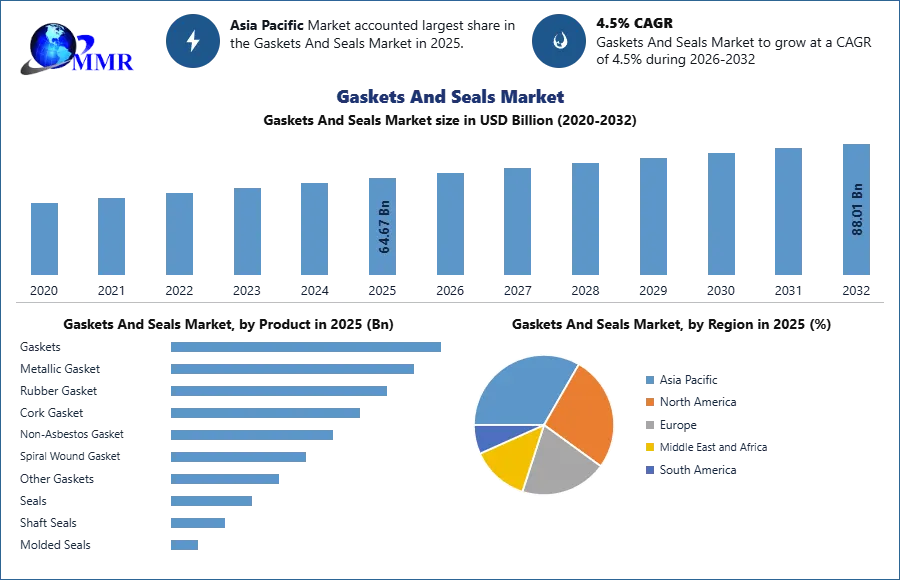
Market Scale Expansion: The global gaskets and seals market is on track to grow from USD 64.67 billion in 2025 to USD 88.01 billion by 2032.
Dominant Market Segment: Automotive applications represent the largest market share, controlling 35.1% of the total industry value.
Technological Inflection: The penetration of 3D printing technology and liquid silicone rubber (LSR) automation is redefining low-volume custom component fabrication.
Geographic Powerhouse: Asia Pacific remains the dominant regional economy, driven by chemical manufacturing scale and expanding inter-country pipeline infrastructure in China.
Sustainability Advancements: Coaxial separation seals engineered for rotating equipment reduce nitrogen consumption by up to 80% to lower processing overheads.
Why This Matters Now
Unplanned industrial downtime costs global manufacturers billions annually, with fluid leakage and pressure containment failures serving as primary catalysts for machinery stoppage. As processing plants transition toward continuous autonomous operations, sealing technologies are shifting from passive rubber and graphite components into intelligent, high-performance systems. Industrial technology buyers can no longer treat fluid containment as a commoditized maintenance item; instead, it is a core pillar of operational uptime and asset protection.
The convergence of rigorous emissions legislation and modern process automation places immense stress on traditional mechanical seals. Factories operating with automated distributed control systems (DCS) require components that can tolerate extreme thermal cycles and corrosive processing chemistries without manual intervention. Plant managers must deploy modern sealing designs to mitigate fugitive emissions, secure environmental compliance, and maximize the mean time between failures (MTBF) in automated lines.
Market Overview
The global Gaskets and Seals Market reached a valuation of USD 64.67 billion in 2025. This specialized sector is expanding at a steady CAGR of 4.5%, placing the industry path toward USD 88.01 billion by 2032 according to Maximize Market Research. The underlying growth reflects a structural baseline shift in how heavy processing and manufacturing infrastructure manage fluid containment and component isolation.
Gaskets function as static sealing barriers compressed between non-mobile flat flanges, utilizing specialized material elasticity to seal uneven metal gaps. Conversely, seals handle dynamic applications to contain pressurized media between moving interfaces such as rotating shafts, pumps, and reciprocating engine components. Together, these elements form the fundamental defense layer for hydraulic lines, power transmission systems, and chemical processing blocks worldwide.
Key Trends Driving Growth
Stringent industrial emission rules globally are forcing chemical processors and manufacturing facilities to overhaul their legacy containment systems. Regulatory compliance mandates absolute zero-leakage profiles, transforming high-performance non-metallic and composite gaskets into operational necessities. This regulatory pressure shifts sealing selection from basic material cost metrics to full lifecycle emissions avoidance capabilities.
Progress in asset health monitoring is introducing radio-frequency identification (RFID) tracking directly into mechanical seals to establish smart manufacturing initiatives. RFID-enabled seals store historical maintenance data, pressure limits, and installation dates locally on the component. This allows operations teams to scan equipment wirelessly using industrial IoT devices, ensuring correct parts matching and eliminating human error during high-speed turnarounds.
The rapid adoption of industrial additive manufacturing changes how spare parts logistics operate across the supply chain. Companies are deploying specialized 3D printing platforms to produce customized, highly complex gasket geometries directly at the factory edge. This development eliminates long lead times for custom tooling molds, allowing plant managers to print tailored prototypes and low-volume industrial gaskets on demand.
Get a free sample:https://www.maximizemarketresearch.com/request-sample/105380/
Segment Insights
Dominant Segment: Automotive applications lead the global market, commanding 35.1% of total value due to heavy consumption across engine blocks, vehicle body seals, and onboard electronic enclosures.
Accelerating Product Line: The gaskets segment, which was valued at USD 23.2 billion in 2018, is witnessing substantial expansion across pipeline networks and heat exchangers due to industrial anti-leakage mandates.
Fastest-Growing Segment: Non-metallic gaskets are emerging as the fastest-growing sub-segment, propelled by advanced lightweight composite materials and expanding automotive electronics architectures.
Specialized Deepwater Technology: Heavy-duty dynamic seals designed for subsea oil finds are capturing rising investment as operators deploy deepwater extraction infrastructure requiring extreme pressure resistance.
Regional Growth Story
The Asia Pacific region maintains absolute dominance in the global gaskets and seals market, powered by massive industrialization and deep chemical processing concentration. China sits at the center of this regional dominance, functioning as a global chemical manufacturing powerhouse that absorbs massive volumes of chemical-resistant gaskets. Furthermore, China’s aggressive domestic infrastructure investments are expanding its inter-country pipeline network, which includes major oil and gas lines running through Heilongjiang province to link central Asia and Russia.
Beyond petrochemicals, the rising electrical and electronics manufacturing hubs across India and ASEAN nations create a continuous demand loop for precision non-metallic gaskets. In parallel, the United States market is sustained by high-value aerospace and defense manufacturing sectors. This specialized domestic demand requires premium-grade sealing components for commercial aerospace engines, spacecraft structures, internal cabins, and complex galley assemblies.
Competitive Landscape
The competitive landscape of the gaskets and seals market indicates a clear shift from basic material engineering toward holistic technology ecosystems. Market leaders are acquiring automation specialists to integrate advanced materials with digital manufacturing methods, reinforcing their position within the Industry 4.0 value chain. This consolidation trend highlights that future market leadership belongs to companies controlling both material formulations and specialized production tooling.
The strategic focus is changing from general-purpose components to specialized applications, particularly for electric vehicle (EV) battery packs and rotating process equipment. Industry participants are building dedicated technology portfolios to address the specific cooling and insulation demands of electric drivetrains. In the process control sector, competitive differentiation relies on reducing secondary energy consumption, such as minimizing barrier gas waste in high-speed rotating systems.
Recent Developments
January 29, 2026: Trelleborg Sealing Solutions launched its Innovation Days 2026 in Stuttgart, introducing AI-integrated sealing systems and advanced Industry 4.0 manufacturing workflows.
January 12, 2026: Trelleborg Group finalized the acquisition of Nexus Elastomer Molds GmbH, securing specialized Austrian tooling technology for automated liquid silicone rubber (LSR) processing.
December 01, 2025: Freudenberg Sealing Technologies acquired Alto Products Corp to expand its Corteco aftermarket brand portfolio across independent distribution channels.
September 22, 2025: Boyd Corporation introduced new IP68-rated battery pack sealing solutions designed for electric vehicles to optimize thermal management and prevent environmental contamination.
July 01, 2025: Stratasys and Shin-Etsu partnered to introduce P3 Silicone 25A, a specialized 3D printing material optimized for direct fabrication of custom gaskets and seals.
June 05, 2025: John Crane launched the Type 93AX Coaxial Separation Seal, a rotating equipment solution that reduces process plant nitrogen gas consumption by 80%.
Strategic Implications
For operations leaders, the modern evolution of sealing technology requires a transition from reactive replacement to data-driven predictive maintenance advancements. Relying on fixed maintenance calendars often leads to premature replacement of functional seals or, conversely, catastrophic failures before the scheduled service window. Integrating component-level data with modern plant SCADA and asset management platforms allows operations teams to track structural wear indicators based on real-world processing stresses.
System integrators and automation providers must view sealing components as vital data protection points within the wider plant ecosystem. If a seal fails on a high-speed robotic assembly line or automated valve manifold, the entire digital control layer loses its operational utility. Ensuring that material properties match actual factory operating conditions helps technology buyers secure the returns expected from their smart factory investments.
Future Outlook
The trajectory of the gaskets and seals industry is tied directly to the progress of autonomous manufacturing and factory digitization. As plants reduce human staffing on the factory floor, physical hardware components must achieve the same level of reliability as digital control software. Sealing systems will increasingly incorporate advanced composite materials capable of self-healing or reporting real-time wear metrics directly to edge computing units.
Industrial operators who integrate advanced sealing systems into their overall predictive maintenance and smart factory architectures will protect their production uptime and reduce emission compliance risks. Conversely, lagging organizations that treat sealing components as simple, low-tech hardware commodities will continue to face unexpected asset failures and expensive production stoppages.
Analyst Perspective
“We are witnessing a profound structural change where advanced material science intersects directly with industrial automation,” states Gaurav Deshmukh, Lead Analyst at Maximize Market Research. “The modern industrial sector no longer looks at gaskets and seals as simple rubber consumables. Instead, operations leaders view them as critical operational technology assets that are essential for securing factory uptime, achieving stringent environmental compliance, and driving smart manufacturing efficiency.”
About Maximize Market Research
Maximize Market Research Pvt. Ltd. (MMR) is a global market research and consulting company that provides reliable, data-focused, and practical business insights. The firm serves a wide range of industries, including healthcare, pharmaceuticals, technology, automotive, electronics, chemicals, personal care, and consumer goods. Through market forecasts, competitive analysis, strategic consulting, and industry impact assessments, MMR helps organizations understand changing market conditions, identify growth opportunities, and make informed business decisions for long-term success.
2nd Floor, Navale IT Park Phase 3
Pune Banglore Highway, Narhe
Pune, Maharashtra 411041, India
+91 9607365656
sales@maximizemarketresearch.com
