Key Highlights
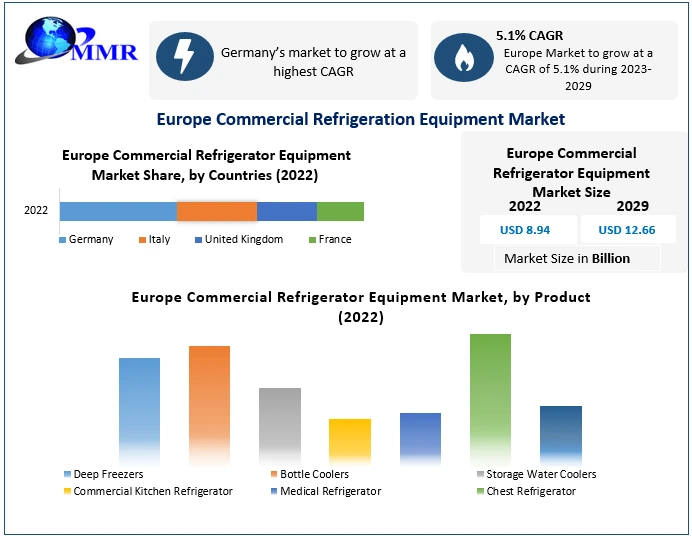
Market Valuation Expansion: The market scale is ascending from USD 8.94 billion in 2022 to an anticipated USD 12.66 billion by 2029, demonstrating a consistent 5.1% compound annual growth rate.
Industry 4.0 Acceleration: Integration of smart manufacturing initiatives and advanced process optimization technologies is fundamentally reshaping product design, moving from legacy mechanical setups to connected assets.
Energy Efficiency Demands: Strict European environmental regulations and energy costs are forcing plant managers to deploy intelligent control architectures to reduce carbon footprints.
Predictive Maintenance Era: Industrial IoT adoption and edge computing systems are shifting the industry standard from reactive fixes to proactive, zero-downtime maintenance cycles.
Why This Matters Now
The Europe Commercial Refrigeration Equipment Market manufacturing ecosystem faces unprecedented regulatory pressure and escalating operating costs. Industrial technology buyers cannot rely on legacy cooling infrastructure while trying to meet stringent regional net-zero mandates. Production lines must evolve rapidly, utilizing advanced automation to prevent high-cost system failures and food waste.
This disruption opens critical windows for system integrators, automation engineers, and technology investors. High-efficiency components equipped with intelligent communication modules are no longer premium alternatives; they are foundational requirements. Enterprises failing to implement these systems face compounding operational penalties and rapid market obsolescence.
Market Overview
The Europe Commercial Refrigeration Equipment Market achieved a baseline valuation of USD 8.94 billion in 2022. Driven by a 5.1% compound annual growth rate from 2023 to 2029, the industry is on track to hit USD 12.66 billion by the close of the forecast period. This trajectory is tied directly to the modernization of commercial cold-chain pipelines and food retail infrastructure across major European industrial hubs.
Legacy commercial refrigeration manufacturing relied on isolated thermodynamic loops managed by simple mechanical thermostats. Today, the sector is experiencing a deep technological convergence, merging industrial automation with thermal dynamics. Factories are retooling production facilities to manufacture smarter cooling systems that can interface with master building management systems (BMS) and distributed control networks.
Key Trends Driving Growth
Regulatory pressure under the European Green Deal is the primary catalyst driving the adoption of advanced process optimization technologies. Plant operators are utilizing next-generation programmable logic controllers (PLCs) and supervisory control and data acquisition (SCADA) platforms to gain real-time transparency into thermodynamic loops. These digital systems adjust compressor speeds and electronic expansion valves dynamically based on variable environmental variables.
Industrial IoT adoption is expanding rapidly across European cold storage networks. By deploying arrayed sensor networks, equipment operators track pressure variations, ambient humidity, and vibration anomalies continuously. This sensor data routes to centralized edge computing gateways, translating raw telemetry into actionable metrics that minimize power spikes and extend component lifecycles.
Simultaneously, predictive maintenance advancements are eliminating unplanned system downtime. Traditional service paradigms depended on rigid calendar schedules or catastrophic failure responses. Modern AI-driven automation trends leverage continuous machine vision and thermal analytics to catch insulation degradation and refrigerant micro-leaks before they trigger a system shutdown.
Get a free sample:https://www.maximizemarketresearch.com/request-sample/103899/
Segment Insights
Dominant Segment: Refrigerator and Freezer Cabinets hold the dominant market share, driven by extensive procurement from large-scale supermarkets, hypermarkets, and centralized distribution warehouses requiring continuous multi-zone temperature regulation.
Fastest-Growing Segment: Smart Connected Refrigeration Systems represent the fastest-growing market vector, expanding as operators upgrade facilities with variable-speed compressors, embedded IoT telemetry modules, and intelligent controllers.
Application Focus: Commercial food retail and specialized processing units remain the primary capital spend categories, with pharmaceutical and chemical cold-chain demands emerging as high-precision growth sub-sectors.
Regional Growth Story
Germany continues to maintain its position as the premier manufacturing and technological center within the European commercial refrigeration sector. German production operations are highly automated, investing heavily in smart manufacturing initiatives to offset rising localized domestic labor costs. These facilities rely heavily on robotics integration for automated cabinet welding, high-precision foam-in-place insulation injections, and automated quality testing loops.
Concurrently, countries like France, Italy, and the UK are accelerating factory modernization efforts to comply with strict regional energy performance certificates. Western European logistics networks are building highly automated cold storage mega-hubs that utilize digital twin deployment to simulate thermal loading patterns. This enables operators to predict power demands and balance grids during peak tariff windows.
In Southern and Eastern European markets, development focuses on expanding modern cold chain transport infrastructure. Integrating modern telemetry and supervisory control networks ensures compliance with strict European food safety laws during cross-border transit.
Competitive Landscape
The competitive environment in the Europe Commercial Refrigeration Equipment Market is shifting from traditional mechanical engineering toward software-defined hardware capabilities. Leading manufacturers are forming strategic alliances with industrial software developers to embed edge computing and advanced cybersecurity protocols directly into their controller hardware. This evolution redefines technology leadership around ecosystem connectivity rather than physical box capacity.
Market consolidation is accelerating as larger conglomerates acquire niche automation providers to gain access to proprietary AI-driven optimization algorithms. These corporate actions signal a clear shift: future market dominance belongs to organizations that can transform raw thermodynamic equipment into highly communicative industrial data points. System integrators are becoming critical gatekeepers, translating complex multi-vendor component languages into unified, secure SCADA structures.
Furthermore, defensive industrial cybersecurity initiatives are becoming a key competitive differentiator. As refrigeration networks connect directly to enterprise resource planning (ERP) systems, protecting these endpoints from operational technology (OT) vulnerabilities is vital. Companies offering integrated, encrypted communication frameworks are winning major enterprise supply contracts over legacy equipment vendors.
Recent Developments
Next-Gen PLC Architectures: Automation providers have introduced specialized refrigeration controllers featuring native OPC UA communication protocols, allowing direct integration into factory-wide automation frameworks without external protocol converters.
Advanced Eco-Design Compliance: Manufacturers are introducing updated lines of hydrocarbon-based cooling systems that use predictive algorithm modules to cut energy consumption and stay ahead of tightening EU F-gas phase-out schedules.
Cloud-Based Telemetry Platforms: Top-tier refrigeration brands are launching dedicated remote monitoring packages that provide operational leaders with clear visibility into multi-site energy performance and system health metrics.
Strategic Implications
For manufacturing executives and plant managers, the transition to connected refrigeration infrastructure requires an immediate upgrade of field-level operational technology. Equipment procurement teams must look past upfront purchase costs and evaluate the total lifecycle cost of ownership, which is heavily influenced by energy draw and maintenance overhead. Investing in smart systems reduces long-term operational expenses by lowering energy usage and optimizing technician dispatch schedules.
System integrators must build stronger skill sets in bridging the gap between traditional refrigeration mechanics and modern enterprise software systems. Deploying modern multi-compressor racks requires expertise in setting up complex fieldbus networks, calibrating automated electronic expansion valves, and securing wireless data paths. This technical shift changes the role of the installer from a mechanical technician to a specialized automation architect.
Ultimately, investors evaluating this space must focus on companies that prioritize software-defined infrastructure. Capital allocations should favor manufacturers that possess robust digital twin capabilities and agile product lines designed for rapid integration into wider smart factory frameworks.
Future Outlook
The market will continue to evolve through deep integration with broader smart city initiatives and decentralized energy grids. Commercial refrigeration systems will shift from passive electricity consumers to active participants in automated demand-response programs, dynamically adjusting cooling cycles to capitalize on shifting power prices.
As machine-to-machine communication becomes the default standard, industrial operations will increasingly depend on self-optimizing thermal networks. The division between market leaders and struggling operators will stem from how effectively they leverage their equipment data. The future belongs to agile organizations utilizing integrated, automated ecosystems to drive continuous efficiency gains, while legacy operators relying on disconnected hardware face compounding energy costs and terminal operational decline.
Analyst Perspective
“The European commercial refrigeration equipment market has crossed an automated tipping point. We are observing an operational shift where thermodynamic efficiency is optimized via predictive software architectures and intelligent edge devices rather than basic mechanical upgrades. Manufacturers who integrate advanced PLC/SCADA connectivity and robust industrial cybersecurity frameworks directly into their product portfolios will capture the next wave of high-margin capital investments across Europe’s food and logistics sectors.”
— Gaurav Deshmukh, Lead Automation Analyst, Maximize Market Research
About Maximize Market Research
Maximize Market Research Pvt. Ltd. (MMR) is a global market research and consulting company that provides reliable, data-focused, and practical business insights. The firm serves a wide range of industries, including healthcare, pharmaceuticals, technology, automotive, electronics, chemicals, personal care, and consumer goods. Through market forecasts, competitive analysis, strategic consulting, and industry impact assessments, MMR helps organizations understand changing market conditions, identify growth opportunities, and make informed business decisions for long-term success.
2nd Floor, Navale IT Park Phase 3
Pune Banglore Highway, Narhe
Pune, Maharashtra 411041, India
+91 9607365656
sales@maximizemarketresearch.com
