Key Highlights
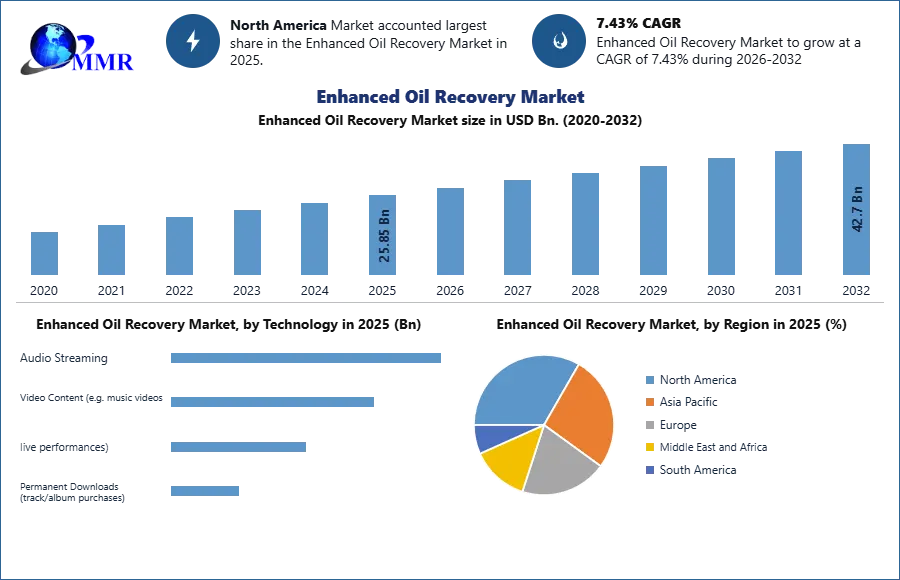
- Global Enhanced Oil Recovery Market was valued at USD 25.85 billion in 2025.
- The market is projected to reach nearly USD 42.7 billion by 2032, growing at a CAGR of 7.43% from 2026 to 2032.
- Mature oilfield redevelopment is becoming a strategic priority for energy producers seeking to maximize existing assets.
- Carbon management initiatives are increasing interest in CO2-based Enhanced Oil Recovery projects.
- Technological innovation is improving production efficiency while supporting long-term energy security.
Why This Matters Now
Energy markets are entering a new investment cycle where maximizing existing hydrocarbon resources has become as important as discovering new reserves. Governments and producers are balancing energy security with decarbonization, creating new opportunities for Enhanced Oil Recovery (EOR) technologies that extend field life while supporting carbon management strategies.
The Global Enhanced Oil Recovery Market, valued at USD 25.85 billion in 2025, is expected to reach nearly USD 42.7 billion by 2032, expanding at a 7.43% CAGR. That growth signals more than rising revenues. It reflects increasing capital allocation toward mature asset optimization, operational efficiency, and infrastructure that can generate additional production without relying solely on new field discoveries.
Market Overview
Oil producers face a structural challenge. Many of the world’s largest producing assets have entered mature production stages, where natural reservoir pressure declines and conventional extraction methods recover only a portion of available hydrocarbons. Enhanced Oil Recovery technologies are increasingly becoming part of long-term production strategies rather than short-term operational improvements.
The market’s projected expansion illustrates how producers are responding to volatile commodity cycles, tighter capital discipline, and growing expectations around emissions management. Rather than abandoning mature fields, operators are investing in technologies that increase recovery rates, improve reservoir performance, and maximize returns from existing infrastructure.
At the same time, governments continue prioritizing energy security amid geopolitical uncertainty. Stable domestic production has become a strategic objective for many economies, reinforcing investment in Enhanced Oil Recovery across established producing regions.
Key Trends Driving Growth
One of the strongest market drivers is the growing emphasis on maximizing recovery from existing oilfields. Redeveloping mature assets often offers lower exploration risk than greenfield projects while utilizing established production infrastructure.
Carbon management is also reshaping the industry’s investment priorities. CO2-based Enhanced Oil Recovery is increasingly viewed as a pathway that aligns oil production with carbon capture initiatives, allowing producers to improve recovery while utilizing captured carbon dioxide within reservoir operations.
Digital technologies are further improving project economics. Advanced reservoir modeling, real-time monitoring, artificial intelligence, and predictive analytics enable operators to optimize injection strategies, improve recovery efficiency, and reduce operational uncertainty.
Another important trend is capital discipline. Energy companies are increasingly directing investment toward projects capable of delivering higher recovery from existing assets instead of pursuing higher-risk exploration campaigns. This shift supports more predictable production profiles and stronger asset utilization.
𝐃𝐨𝐰𝐧𝐥𝐨𝐚𝐝 𝐏𝐃𝐅 𝐁𝐫𝐨𝐜𝐡𝐮𝐫𝐞 @https://www.maximizemarketresearch.com/request-sample/11401/
Segment Insights
- Dominant Segment: As identified in the Maximize Market Research report.
- Fastest-Growing Segment: As identified in the Maximize Market Research report.
- Enhanced Oil Recovery technologies continue evolving through improvements in reservoir characterization, injection optimization, and production monitoring.
- Technology selection increasingly depends on reservoir conditions, recovery objectives, operational costs, and environmental considerations.
- Digital integration is improving project performance by enabling more accurate reservoir management and production forecasting.
Regional Growth Story
The United States remains one of the most significant markets for Enhanced Oil Recovery due to its extensive portfolio of mature oilfields, advanced oilfield service ecosystem, and ongoing investment in carbon management technologies. CO2 utilization initiatives continue supporting long-term EOR deployment across major producing basins.
China continues investing in production optimization as it seeks greater domestic energy security. Improving recovery from mature reservoirs has become increasingly important as the country balances growing energy demand with reduced dependence on imported crude.
India is also strengthening upstream investment to maximize production from existing assets while improving long-term energy resilience. Enhanced recovery technologies provide an opportunity to extend field productivity and improve resource utilization.
Across Europe, countries such as Germany and the United Kingdom continue evaluating carbon capture integration alongside industrial decarbonization strategies. Although renewable energy deployment remains a policy priority, maintaining reliable domestic production through advanced recovery technologies supports broader energy security objectives.
Japan and South Korea continue investing in advanced energy technologies, engineering expertise, and carbon management initiatives that may create future opportunities for Enhanced Oil Recovery collaboration and technology development.
Competitive Landscape
Competition is shifting beyond production volumes toward technology leadership and operational efficiency. Companies capable of combining reservoir engineering, digital analytics, carbon management expertise, and cost-effective recovery techniques are strengthening their competitive positions.
Technology providers are increasingly focusing on integrated solutions rather than standalone recovery methods. Reservoir simulation, automation, monitoring systems, and data analytics are becoming essential components of successful EOR projects.
Strategic partnerships between energy producers, oilfield service companies, and carbon management specialists also indicate an evolving market structure. These collaborations reduce project risk, accelerate technology deployment, and improve long-term recovery economics while supporting broader emissions management strategies.
As carbon capture infrastructure expands globally, companies with established expertise in CO2 injection and reservoir management could benefit from growing demand for integrated carbon utilization solutions.
Recent Developments
- Growing investment in mature oilfield redevelopment projects.
- Increased adoption of digital reservoir management technologies.
- Expansion of carbon capture and CO2 utilization initiatives supporting EOR applications.
- Continued investment in production optimization across major upstream markets.
- Stronger focus on operational efficiency, emissions reduction, and long-term asset productivity.
Strategic Implications
Enhanced Oil Recovery is increasingly becoming part of a broader energy transition strategy rather than simply a production enhancement technology. Operators are seeking solutions that simultaneously improve recovery, strengthen energy security, optimize capital expenditure, and support carbon management objectives.
For investors, the market’s expansion reflects growing confidence in technologies capable of generating higher returns from existing infrastructure. For utilities and industrial energy users, stronger domestic production contributes to supply stability during periods of market volatility.
Policy makers also recognize that improving recovery from existing assets can complement renewable energy expansion by supporting stable energy supplies during the transition toward lower-carbon systems. Infrastructure investment, digitalization, and carbon utilization are therefore becoming interconnected priorities rather than independent initiatives.
Future Outlook
The next phase of market development will be shaped by technology integration rather than production expansion alone. Digital oilfields, advanced reservoir analytics, carbon capture utilization, and intelligent injection systems are expected to define future competitiveness.
As governments pursue both energy security and net-zero ambitions, Enhanced Oil Recovery will increasingly occupy the intersection of hydrocarbon production and carbon management. Companies that combine operational efficiency with emissions reduction strategies will be positioned to lead the next generation of upstream investment, while organizations that delay technology adoption risk losing competitiveness as mature assets become progressively more challenging to develop.
Analyst Perspective
“Enhanced Oil Recovery is evolving from a traditional production optimization tool into a strategic technology supporting both energy security and carbon management. Companies investing in advanced recovery methods alongside digital innovation and carbon utilization will be better positioned to maximize asset value in an increasingly complex energy landscape,” says Neha Nalawade, Analyst, Maximize Market Research.
About Maximize Market Research
Maximize Market Research Pvt. Ltd. (MMR) is a global market research and consulting company that provides reliable, data-focused, and practical business insights. The firm serves a wide range of industries, including healthcare, pharmaceuticals, technology, automotive, electronics, chemicals, personal care, and consumer goods. Through market forecasts, competitive analysis, strategic consulting, and industry impact assessments, MMR helps organizations understand changing market conditions, identify growth opportunities, and make informed business decisions for long-term success.
2nd Floor, Navale IT Park Phase 3
Pune Banglore Highway, Narhe
Pune, Maharashtra 411041, India
+91 9607365656
sales@maximizemarketresearch.com
