Key Highlights
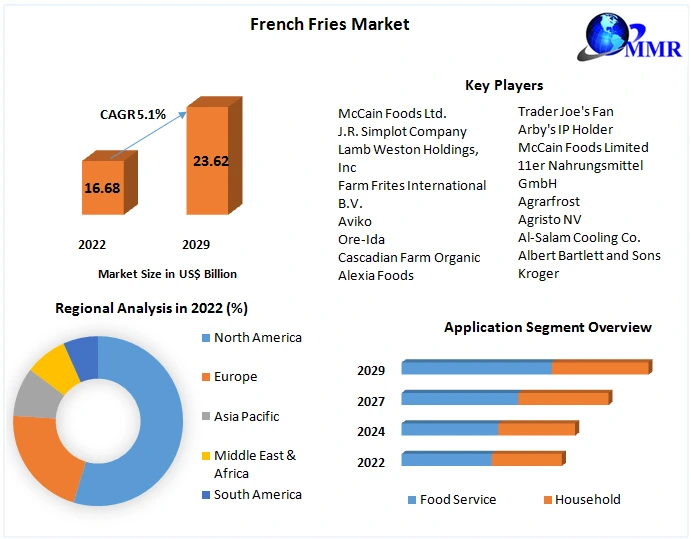
Global French Fries Market was valued at USD 28.04 billion in 2025 and is projected to reach USD 40.34 billion by 2032, growing at a 5.33% CAGR.
Every percentage point of market expansion increases investment opportunities across frozen food manufacturing, cold-chain infrastructure, and foodservice supply networks.
Rising consumption of ready-to-eat foods continues to accelerate demand across both retail and foodservice channels.
Frozen French fries remain the dominant product category because of shelf-life advantages and operational consistency.
Online retail and digital grocery channels are expanding distribution beyond traditional supermarkets.
AI-driven agriculture, packaging innovation, and regional manufacturing strategies are emerging as competitive differentiators.
Why This Matters Now
The French fries business has moved beyond being a simple fast-food category. It is becoming a strategic indicator of how consumers buy convenience, how restaurants protect margins, and how food manufacturers build resilient supply chains.
The market is forecast to grow from USD 28.04 billion in 2025 to nearly USD 40.34 billion by 2032 at a CAGR of 5.33%. That steady expansion signals reliable long-term demand rather than short-term consumption spikes, making operational efficiency increasingly valuable. Every investment in processing, freezing technology, and logistics now has greater strategic importance.¹
Market Overview
French fries remain one of the world’s most consumed potato-based foods, supported by strong demand across quick-service restaurants, retail stores, convenience outlets, and online grocery platforms. Their widespread acceptance gives manufacturers a diversified customer base across commercial foodservice and household consumption.
Market growth is being driven by increasing demand for ready-to-eat foods and expanding quick-service restaurant networks. These trends create recurring purchasing patterns instead of seasonal demand, improving production planning for processors and distributors.¹
The report also highlights growing pressure from energy costs and cold-chain logistics. Higher operational expenses are encouraging processors to improve production efficiency while investing in technologies that protect margins rather than relying solely on pricing power.¹
Key Trends Driving Growth
Convenience continues to define purchasing decisions. Consumers increasingly favor frozen products that deliver consistent quality while reducing meal preparation time. This shifts competitive advantage toward manufacturers capable of delivering reliability at scale.
Digital commerce is becoming a more important distribution channel. Alongside supermarkets and convenience stores, online grocery platforms are extending product availability and increasing consumer access. That creates additional demand for packaging formats optimized for e-commerce fulfillment.¹
Sustainability is also moving closer to the center of competitive strategy. The report highlights biomaterial packaging initiatives alongside AI-driven precision agriculture. These investments are no longer limited to corporate responsibility—they are becoming operational tools for reducing waste, improving efficiency, and protecting profitability during periods of supply volatility.
Request a Free Sample Copy or View Report Summary: https://www.maximizemarketresearch.com/request-sample/148519/
Segment Insights
Dominant Segment: Frozen French Fries dominate the market due to longer shelf life, consistent cooking performance, and strong demand from foodservice operators and retail consumers. This leadership gives processors greater production efficiency while supporting international distribution.¹
Fastest-Growing Segment: Not specified in the report.
Foodservice remains a major end-use market, supported by continued expansion of quick-service restaurant chains.
Distribution continues to diversify across hypermarkets, supermarkets, convenience stores, online channels, distributors, and direct purchasing, reducing dependence on any single sales route.¹
Regional Growth Story
The report identifies global demand supported by mature foodservice markets alongside expanding retail consumption. Large-scale restaurant operators continue to generate stable purchasing volumes, while modern retail and online grocery channels widen household consumption.
Regional competitiveness is increasingly tied to manufacturing location and supply-chain resilience. The report highlights growing attention toward near-shored processing facilities as companies seek to reduce logistics costs, improve responsiveness, and limit exposure to geopolitical disruptions.¹
Rather than relying solely on production scale, future regional leaders are likely to compete through supply reliability, energy efficiency, and proximity to customers.
Competitive Landscape
Competition is shifting from product availability to operational excellence.
The report identifies companies including McCain, Lamb Weston, and J.R. Simplot as important participants in the market ecosystem, particularly through quality management and supply relationships. McDonald’s extensive purchasing network further illustrates how major foodservice customers influence supplier standards and production consistency.¹
The emphasis on AI-driven precision agriculture signals that future competition will increasingly begin at the farm rather than inside processing facilities. Companies investing in agricultural analytics gain stronger control over raw material quality, reducing operational variability throughout manufacturing.
Similarly, biomaterial packaging initiatives indicate that sustainability is becoming a commercial advantage rather than a branding exercise. Manufacturers capable of lowering packaging waste while improving logistics efficiency will strengthen relationships with both retailers and institutional buyers.
Over the next 12–24 months, rivalry is likely to intensify around production efficiency, regional manufacturing capacity, and supply-chain resilience instead of aggressive pricing alone. Companies that modernize operations should widen profitability gaps even in a moderate-growth market.
Recent Developments
AI-driven precision agriculture is being deployed to improve potato quality and production efficiency.¹
Biomaterial packaging initiatives are emerging to strengthen sustainability and operational performance.¹
Companies are evaluating near-shored processing facilities to reduce logistics exposure and improve supply resilience.¹
Industry participants are responding to higher energy and cold-chain costs with greater emphasis on operational efficiency.¹
Strategic Implications
Stable market growth does not reduce competitive pressure—it increases it.
Manufacturers must balance investments across agricultural sourcing, processing efficiency, logistics, packaging, and digital distribution simultaneously. Companies relying only on production capacity risk losing ground to competitors that integrate technology throughout the value chain.
Retailers should expect frozen products to remain central to category performance, while foodservice operators will increasingly value suppliers capable of delivering consistent quality despite supply-chain disruptions.
Future Outlook
The French Fries Market is evolving from a volume-driven category into a supply-chain performance business where manufacturing efficiency, sustainability, and digital distribution increasingly determine competitive advantage.
Organizations that invest early in resilient sourcing, advanced processing technologies, and efficient logistics will strengthen profitability, while those relying on legacy operating models risk falling behind as operational excellence becomes the industry’s primary competitive currency.
Analyst Perspective
“The French Fries Market continues to evolve beyond traditional foodservice demand, with technology, supply-chain resilience, and operational efficiency becoming increasingly important drivers of long-term competitiveness.” — Siddhi Dole, Analyst
About Maximize Market Research
Maximize Market Research Pvt. Ltd. (MMR) is a global market research and consulting company that provides reliable, data-focused, and practical business insights. The firm serves a wide range of industries, including healthcare, pharmaceuticals, technology, automotive, electronics, chemicals, personal care, and consumer goods. Through market forecasts, competitive analysis, strategic consulting, and industry impact assessments, MMR helps organizations understand changing market conditions, identify growth opportunities, and make informed business decisions for long-term success.
2nd Floor, Navale IT Park Phase 3
Pune Banglore Highway, Narhe
Pune, Maharashtra 411041, India
+91 9607365656
sales@maximizemarketresearch.com
