Key Highlights
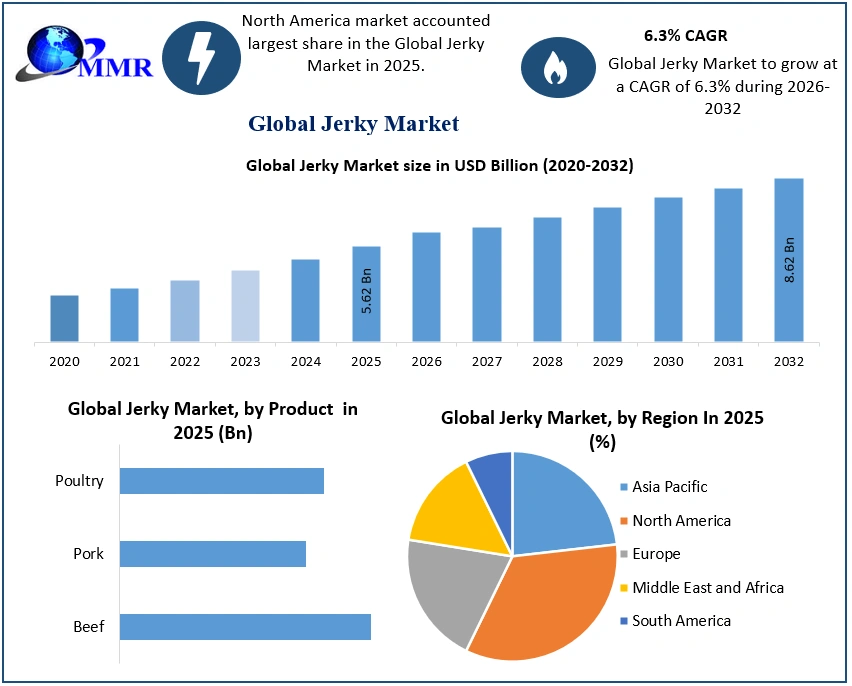
Valuation Projections: The global market reached USD 5.62 billion in 2025 and is projected to scale to USD 8.62 billion by 2032, demonstrating a compound annual growth rate (CAGR) of 6.3%.
Segment Dominance: The beef jerky segment commands half of the total industry revenue, leveraging its traditional savory profile to control 50% of the market share in 2025.
Geographic Leadership: North America maintains absolute market dominance, capturing over 40% of global revenue in 2025 and projecting a 6.5% CAGR through the forecast period.
Growth Accelerators: Poultry-based alternatives, specifically turkey and chicken formulations, are capturing market share as premium, lean-protein options for calorie-conscious consumer demographics.
Why This Matters Now
Legacy savory snack manufacturers who fail to capture the premium meat snacks category face immediate shelf space rationalization as consumer capital moves permanently toward high-protein alternatives. Institutional food and beverage investors must realize that a 6.3% baseline CAGR represents a critical reallocation of capital away from carbohydrate-heavy snacks toward portable, functional nutrition. The expansion of the global jerky market size to USD 8.62 billion by 2032 proves that dried meat products have successfully escaped their historical gas-station retail boundaries to anchor modern supermarket snack layouts.
For brand executives and retail buyers, these metrics mandate an immediate restructuring of product development pipelines. The dominant position of beef jerky proves the resilience of traditional flavor profiles, yet it leaves unhedged brands vulnerable to shifting health trends if they do not diversify. Category leaders who ignore the rise of alternative, low-fat protein segments will lose their highest-margin, wellness-oriented demographics to rapid-scaling agile entrants. Capital deployment must pivot toward clean-label, low-sodium formulations to defend corporate market share before retail channels reach complete competitive saturation.
Market Overview
The Jerky Market landscape is undergoing a structural transition from a generic impulse buy into a highly premium, wellness-focused category. Jerky’s primary commercial appeal lies in its inherent physical characteristics: it is a portable, shelf-stable, and densely packed protein snack that aligns with active consumer lifestyles. As global consumption patterns prioritize metabolic health and quick nutrition, dried meat products are taking direct market share from traditional potato chips, crackers, and confectionery lines.
However, the category is actively navigating a core tension regarding processing methods, sodium loads, and artificial additives. While natural, unsweetened dried meats offer clean macronutrient ratios, mass-market commercial iterations frequently rely on synthetic preservatives, heavy nitrates, and elevated sugar contents to extend shelf life and optimize palatability. This composition risks drawing regulatory scrutiny and pushback from health-conscious buyers concerned with cardiovascular impacts and clean-label integrity. Consequently, jerky manufacturers are forced to reformulate their core products, balancing traditional robust textures against an urgent corporate requirement to introduce organic and low-sodium options.
Key Trends Driving Growth
The primary engine of current market expansion is the rapid diversification of flavor architecture and the incorporation of international taste profiles. Brands are moving past basic smoky and hickory offerings, introducing complex profiles like sweet chili, sriracha, teriyaki, and regional spice blends to attract adventurous millennial and Gen Z consumers. This flavor innovation expands the total addressable market by converting casual snackers into recurring buyers who view the category as a culinary experience rather than a simple convenience food.
Simultaneously, health and wellness trends are forcing brands to adopt strict clean-label manufacturing standards. Companies are leveraging consumer feedback loops to strip artificial nitrates and monosodium glutamate (MSG) from their production lines, replacing them with sea salt, celery powder, and natural fruit juices. Furthermore, brands are expanding their omni-channel distribution networks, utilizing specialized e-commerce platforms and direct-to-consumer subscription models to bypass traditional brick-and-mortar bottlenecks and capture higher gross margins.
𝐃𝐨𝐰𝐧𝐥𝐨𝐚𝐝 𝐏𝐃𝐅 𝐁𝐫𝐨𝐜𝐡𝐮𝐫𝐞 @ https://www.maximizemarketresearch.com/request-sample/221260/
Segment Insights
An evaluation of the jerky market segment overview highlights clear delineations based on animal protein sources, ingredient formatting, and growth trajectories:
Dominant Product Segment (Beef Jerky): Held the largest market share of approximately 50% in 2025. This segment is expected to grow at a CAGR of 6.8% during the forecast period, sustained by its deep-rooted association with the snack category, robust flavor profiles, and established consumer purchasing habits.
Fastest-Growing Product Segment (Poultry Jerky): Emerging rapidly as chicken and turkey formulations capture market share from traditional red meat options. This segment capitalizes on the widespread consumer perception of poultry as a leaner, lower-calorie protein source.
Component & Flavor Variations: The industry is segmenting into premium organic, low-sodium, and grass-fed lines, with alternative artisanal formulations commanding the highest retail price premiums.
Packaging Dynamics: Resealable pouch architectures dominate the landscape, providing the physical portability and product freshness required by modern on-the-go consumer demographics.
Regional Growth Story
North America represents the leading geographical market, capturing a dominant share of over 40% in 2025. The region is projected to expand at a CAGR of 6.5% through 2032, maintaining its global leadership position. This sustained performance is driven by deeply institutionalized meat-snacking habits across the United States and Canada, coupled with aggressive product placement across convenience stores, gas stations, and major hypermarket networks.
Concurrently, international markets are displaying notable growth as global distribution channels expand. In regions across Europe and Asia-Pacific, rising disposable incomes and changing westernized snacking habits are creating predictable, new revenue streams for multinational brands. Western snack giants are leveraging their existing retail partnerships in these territories to introduce localized jerky flavors, establishing an initial market presence before regional independent producers can scale their own production facilities.
Competitive Landscape
The global competitive landscape is defined by a sharp division between legacy consumer packaged goods (CPG) conglomerates and highly agile, premium craft brands. Mass-market giants use their unmatched supply chain scale and massive distribution networks to secure prime eye-level shelf placement across mass-merchandise retail channels. These incumbents rely on high-volume production efficiencies to protect their operating margins during periods of raw material price volatility.
To challenge this dominance, premium craft operators are leveraging clean-label transparency and specialized ingredient sourcing. Independent brands are successfully capturing higher-income demographics by emphasizing grass-fed, pasture-raised, and non-GMO meat sources. This strategic positioning forces corporate incumbents to either re-engineer their own product lines or actively seek brand acquisitions to prevent long-term erosion of their premium market share.
Recent Developments
Conagra Brands Portfolio Optimization: Conagra Brands expanded its presence in the savory snack sector by optimizing production efficiency across its meat snack lines, focusing on high-velocity packaging formats to counter rising logistics costs.
Jack Link’s Global Supply Chain Expansion: Jack Link’s Beef Jerky increased capital expenditure to upgrade its international distribution networks, aiming to accelerate product delivery into underserved European retail channels.
Country Archer Clean-Label Expansion: Country Archer Jerky Co. secured expanded shelf space across major organic grocery chains by rolling out zero-sugar, grass-fed beef variants to address the clean-label consumer trend.
Oberto Snacks Regional Focus: Oberto Snacks Inc. restructured its regional distribution strategy, focusing on high-density urban convenience networks to maximize immediate inventory turnover.
Boston Jerky Co. Artisanal Scaling: Boston Jerky Co. LLC expanded its specialized product portfolio, introducing small-batch international flavor infusions to capture younger, adventurous consumer demographics.
Strategic Implications
The operational data from recent quarters indicates that supply chain integrity and ingredient transparency are the primary drivers of brand equity. Country Archer’s successful expansion into organic channels proves that consumers will pay a premium for verifiable ingredient sourcing. For competing brands, this means that relying on low-cost, heavily processed formulations offers diminishing returns as retail buyers allocate more shelf space to natural alternatives.
Furthermore, the aggressive international expansion by category leaders like Jack Link’s signals that domestic market consolidation in North America is reaching a mature phase. To sustain high growth rates, tier-one operators must utilize their financial scale to build processing and distribution hubs in international territories. Smaller regional players must fortify their local retail relationships and emphasize authentic, localized brand storytelling to protect their market share from incoming multinational distribution networks.
Future Outlook
The global industry is moving toward an operational split determined by raw material sourcing and manufacturing adaptability. Brands that successfully secure long-term contracts for grass-fed, sustainable proteins while executing clean-label reformulations will command premium pricing and capture secular market growth. Conversely, mass-market brands unable to break their reliance on synthetic additives and high-sodium preservation methods will face intense margin pressure and potential shelf space reductions. The future belongs to vertically integrated snack providers capable of scaling clean-label meat items through automated production, while rigid brands stuck with unoptimized processing pipelines will face inventory stagnation and steady market irrelevance.
Analyst Perspective
“The evolution of the jerky market highlights a permanent shift in how modern consumers view convenience food. Jerky has transitioned from a basic impulse purchase into a functional, high-density nutrition product, forcing major CPG corporations to fundamentally clean up their ingredient profiles to retain premium retail positioning.”
— Siddhi Dole, Research Analyst, Maximize Market Research
About Maximize Market Research
Maximize Market Research Pvt. Ltd. (MMR) is a global market research and consulting company that provides reliable, data-focused, and practical business insights. The firm serves a wide range of industries, including healthcare, pharmaceuticals, technology, automotive, electronics, chemicals, personal care, and consumer goods. Through market forecasts, competitive analysis, strategic consulting, and industry impact assessments, MMR helps organizations understand changing market conditions, identify growth opportunities, and make informed business decisions for long-term success.
2nd Floor, Navale IT Park Phase 3
Pune Banglore Highway, Narhe
Pune, Maharashtra 411041, India
+91 9607365656
sales@maximizemarketresearch.com
