Key Highlights
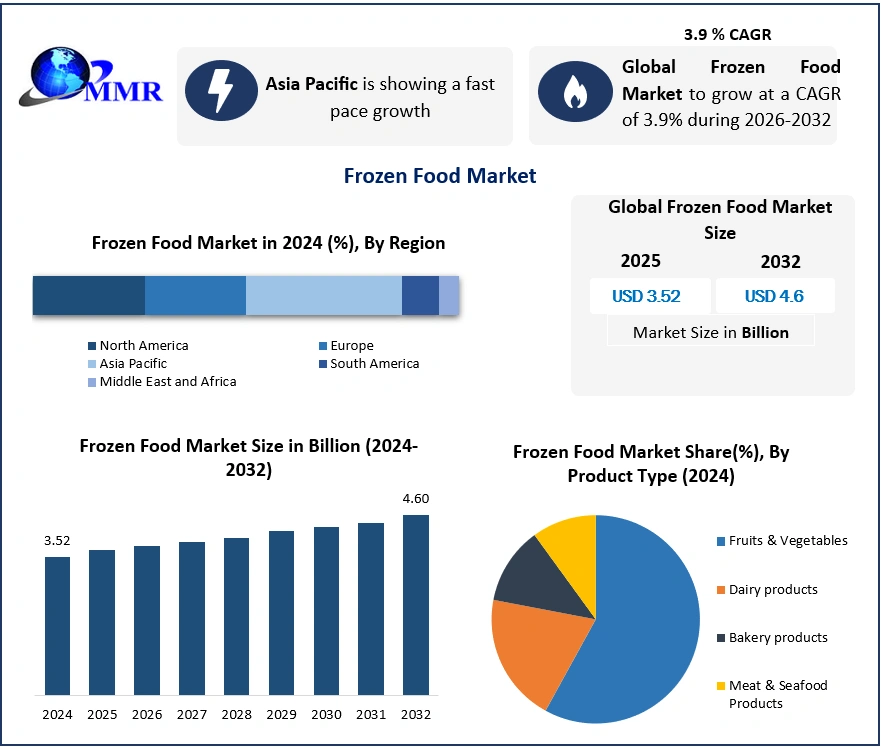
- Frozen Food Market valued at USD 3.52 Billion in 2025 signals a stable FMCG segment anchored in urban consumption cycles.
- Market projected to reach USD 4.6 Billion by 2032, reflecting moderate but sustained category expansion.
- CAGR of 3.9% (2025–2032) indicates incremental rather than explosive demand acceleration.
- Growth trajectory points to structural reliance on convenience-driven food consumption patterns.
- Expansion reflects continued relevance of frozen formats in modern retail ecosystems.
Why This Matters Now
FMCG executives are no longer debating whether frozen food will grow. The sharper question is where marginal growth will come from in a low-CAGR environment. At USD 3.52 Billion in 2025, the category is large enough to matter strategically but not fast enough to forgive inefficiencies.
The projected rise to USD 4.6 Billion by 2032 signals disciplined expansion, not volume surges. This forces retailers and manufacturers to compete on margin optimization, shelf efficiency, and cold-chain precision rather than pure distribution scale.
Market Overview
The Frozen Food Market is positioned within a steady FMCG consumption corridor, anchored by predictable household demand cycles. The valuation of USD 3.52 Billion in 2025 reflects established penetration across urban retail ecosystems.
The forecast to USD 4.6 Billion by 2032, at a CAGR of 3.9%, signals a controlled growth environment where incremental consumption gains outweigh disruptive category expansion. This indicates a market increasingly driven by replacement demand rather than first-time adoption.
The growth structure suggests maturity dynamics are beginning to shape competitive behavior, where efficiency and retention matter more than aggressive category creation.
Key Trends Driving Growth
The supplied MMR source does not explicitly enumerate trend drivers. However, the market’s valuation and growth pattern indicate a category operating under stable FMCG demand cycles with incremental expansion.
The 3.9% CAGR signals a market shaped by gradual consumption normalization rather than rapid structural disruption. Growth consistency suggests frozen food remains integrated into mainstream purchasing baskets rather than being a discretionary luxury or niche category.
The transition toward USD 4.6 Billion implies that future gains will depend on sustained household-level consumption continuity and retail channel efficiency improvements.
Get a free sample:https://www.maximizemarketresearch.com/request-sample/11588/
Segment Insights
The supplied report URL does not specify dominant or fastest-growing segments within the Frozen Food Market.
However, the absence of granular segmentation data indicates that strategic decision-making is likely shifting from product-category expansion toward channel and operational optimization. In such environments, FMCG players typically prioritize portfolio balancing across frozen formats to stabilize revenue curves.
- Dominant Segment: Not specified in the supplied report
- Fastest-Growing Segment: Not specified in the supplied report
This lack of segmentation clarity itself signals a market increasingly evaluated at aggregate consumption level rather than fragmented product performance narratives.
Regional Growth Story
The provided report URL does not include region-wise breakdown data.
However, the projected rise from USD 3.52 Billion to USD 4.6 Billion suggests geographically distributed demand rather than regionally concentrated spikes. In such scenarios, growth typically reflects synchronized urban consumption expansion across multiple developed and emerging retail ecosystems.
Absence of regional concentration data implies that competitive advantage is less about geography and more about supply chain resilience and retail penetration consistency.
Competitive Landscape
The supplied MMR report URL does not list specific companies or competitive share data.
This absence is strategically significant. It suggests the Frozen Food Market may be operating in a fragmented or widely distributed competitive environment where no single player dominates reported visibility.
In such structures, competition shifts from brand dominance to execution efficiency. Market participants likely compete on cold-chain integration, SKU turnover rates, and retail placement density rather than aggressive consolidation narratives.
The lack of named competitive benchmarks implies that future leadership will depend on operational scalability and cost discipline rather than headline-driven expansion strategies.
Over the next 12–24 months, such a structure typically rewards firms capable of optimizing logistics economics while maintaining consistent retail availability across frozen categories.
Recent Developments
The supplied report URL does not provide specific recent developments such as partnerships, acquisitions, or expansions.
- No disclosed M&A activity in the supplied source
- No listed partnerships or joint ventures
- No documented product launches or regulatory shifts
The absence of disclosed events reinforces the interpretation that this is a structurally stable FMCG category, where growth is driven more by steady consumption patterns than disruptive corporate actions.
Strategic Implications
The Frozen Food Market’s trajectory toward USD 4.6 Billion forces FMCG leaders to operate under constrained growth logic. At 3.9% CAGR, scale expansion alone is insufficient to outperform competitors.
Value creation shifts toward:
- Cold-chain cost optimization
- Inventory turnover efficiency
- Retail space utilization intensity
- Demand forecasting accuracy
For retailers, frozen aisles become productivity zones rather than passive storage categories. For manufacturers, margin protection depends on minimizing wastage and improving distribution precision.
The absence of strong segmentation and competitive concentration data signals a market where execution capability outweighs product differentiation in determining leadership positions.
Future Outlook
Frozen Food Market will expand steadily to USD 4.6 Billion by 2032, but the winners will not be defined by growth participation alone—they will be defined by operational efficiency in a structurally moderate-growth FMCG environment, while laggards will be squeezed out by cost and logistics pressure.
Analyst Perspective
“The Frozen Food Market is entering a phase where incremental growth masks a deeper shift in competitive logic. At a 3.9% CAGR, leadership will depend less on expansion and more on execution discipline across the cold-chain ecosystem,” says Siddhi Dole, Analyst at Maximize Market Research.
About Maximize Market Research
Maximize Market Research Pvt. Ltd. (MMR) is a global market research and consulting company that provides reliable, data-focused, and practical business insights. The firm serves a wide range of industries, including healthcare, pharmaceuticals, technology, automotive, electronics, chemicals, personal care, and consumer goods. Through market forecasts, competitive analysis, strategic consulting, and industry impact assessments, MMR helps organizations understand changing market conditions, identify growth opportunities, and make informed business decisions for long-term success.
2nd Floor, Navale IT Park Phase 3
Pune Banglore Highway, Narhe
Pune, Maharashtra 411041, India
+91 9607365656
sales@maximizemarketresearch.com
