Key Highlights
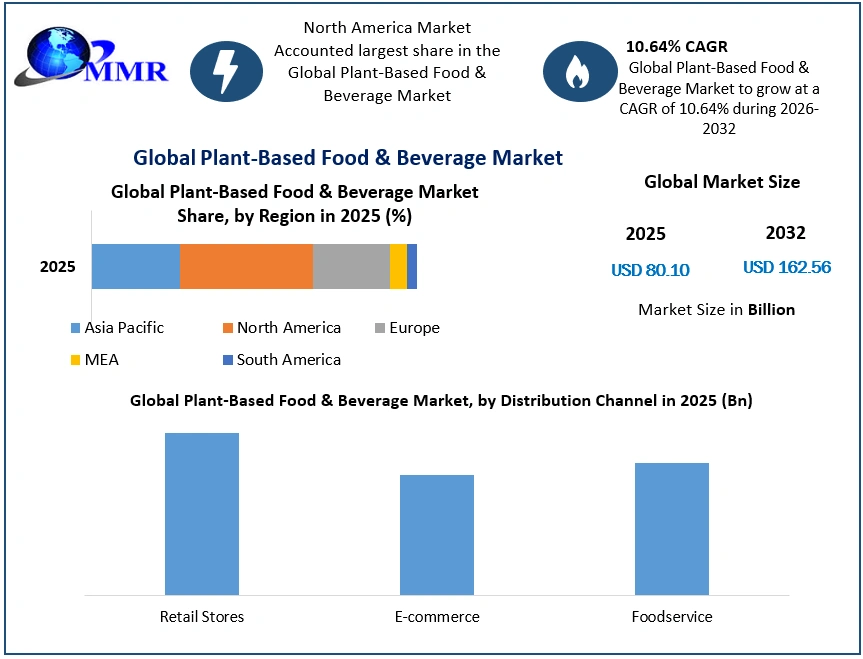
- The Plant-Based Food & Beverage Market was valued at USD 80.10 Billion in 2025.
- The market is projected to reach USD 162.56 Billion by 2032.
- It is expected to expand at a CAGR of 10.64% from 2026 to 2032.
- Growth reflects accelerating commercialization of plant-based food and beverage categories.
- FMCG players are increasingly repositioning portfolios toward plant-forward offerings.
Why This Matters Now
Food category disruption is no longer incremental. It is structural. A USD 80.10 Billion baseline in 2025 scaling to USD 162.56 Billion by 2032 signals a category that is doubling within a single planning cycle.
For FMCG executives, this is not optional diversification. It is portfolio rebalancing under demand pressure. A 10.64% CAGR places plant-based food and beverages firmly ahead of traditional packaged food growth curves, forcing incumbents to defend shelf space while innovators scale distribution aggressively.
Capital allocation decisions made today will determine whether brands participate in the 2032 value pool or remain trapped in legacy protein and dairy categories.
Market Overview
The Plant-Based Food & Beverage Market is transitioning from niche positioning to mass-market penetration. Valued at USD 80.10 Billion in 2025, the category is expanding on a sustained high-growth trajectory, reaching an expected USD 162.56 Billion by 2032.
The 10.64% CAGR from 2026 to 2032 reflects compounding demand rather than cyclical spikes. This growth rate signals structural adoption across retail, foodservice, and packaged FMCG ecosystems.
The market’s scale-up trajectory indicates deeper integration into daily consumption patterns, rather than isolated substitution behavior. However, segment-specific breakdowns, regional leadership distribution, and product category dominance are not detailed in the provided report data.
Key Trends Driving Growth
The report confirms strong upward momentum but does not provide segmented drivers. Within this context, the expansion reflects sustained category-level adoption.
The shift from experimental consumption to repeat purchase behavior is central to sustaining a double-digit CAGR. At this scale, even marginal improvements in product accessibility, pricing parity, and distribution density can materially impact revenue expansion curves.
FMCG ecosystems are increasingly treating plant-based offerings as core SKUs rather than innovation-line extensions, accelerating commercialization cycles.
The valuation trajectory suggests that demand is not isolated to one product class but distributed across plant-based food and beverage categories as a whole.
Get a free sample:https://www.maximizemarketresearch.com/request-sample/111733/
Segment Insights
- Dominant Segment: Not specified in the provided report data.
- Fastest-Growing Segment: Not specified in the provided report data.
- The report does not disclose detailed segmentation by product type, application, or distribution channel in the available excerpt.
- Market growth therefore reflects aggregate category expansion rather than isolated segment-led acceleration.
- This indicates broad-based demand expansion across multiple plant-based product verticals.
Regional Growth Story
The provided report does not include explicit regional breakdowns or geographic leadership data.
However, the global valuation trajectory—from USD 80.10 Billion in 2025 to USD 162.56 Billion by 2032—indicates widespread international scaling rather than geographically concentrated growth.
Such expansion typically requires simultaneous adoption across mature and emerging FMCG markets, suggesting that demand is not restricted to a single consumption geography.
In the absence of region-specific insights, the market should be interpreted as globally diffused in its growth profile.
Competitive Landscape
The report does not specify named companies, mergers, acquisitions, or competitive benchmarking data in the provided excerpt.
However, a market expanding at a 10.64% CAGR inevitably intensifies competitive entry pressure. At this growth rate, incumbents face a dual challenge: defending traditional food categories while investing in plant-based innovation pipelines.
The implied competitive signal is clear: category leadership will increasingly depend on speed-to-market in reformulation, private-label expansion, and strategic retail partnerships.
Over the next 12–24 months, competitive advantage is likely to shift toward companies that can scale production efficiency while maintaining price parity with conventional food products.
Recent Developments
- The Plant-Based Food & Beverage Market is valued at USD 80.10 Billion in 2025.
- Market is projected to reach USD 162.56 Billion by 2032.
- CAGR of 10.64% expected during 2026–2032.
- No additional company-specific or product-specific developments are provided in the report excerpt.
- Growth remains category-driven rather than event-driven in the available dataset.
Strategic Implications
The expansion to USD 162.56 Billion signals a structural shift in FMCG portfolio economics. Companies operating in traditional dairy, meat, and packaged beverage categories face sustained substitution risk.
At a 10.64% CAGR, incremental innovation is insufficient. Players must rethink sourcing, formulation, and distribution architecture to remain competitive within evolving consumer baskets.
Retailers will increasingly allocate shelf space based on growth velocity rather than legacy brand positioning. This shifts bargaining power toward high-growth plant-based categories.
Supply chain integration becomes a strategic differentiator as scaling production without margin erosion becomes critical in maintaining category competitiveness.
Future Outlook
The Plant-Based Food & Beverage Market is entering a phase where growth is no longer driven by awareness, but by system-wide adoption across FMCG ecosystems. As the market doubles to USD 162.56 Billion by 2032, competitive separation will sharpen between scalable innovators and slow-moving incumbents unable to adapt cost structures or product portfolios.
Winners will control both formulation and distribution velocity; losers will struggle to justify relevance in a rapidly consolidating demand landscape.
Analyst Perspective
“An expansion from USD 80.10 Billion in 2025 to USD 162.56 Billion by 2032 reflects more than growth—it signals a structural realignment of global food consumption patterns. The 10.64% CAGR indicates sustained category integration into mainstream FMCG demand cycles rather than short-term adoption spikes.”
— Siddhi Dole, Analyst
About Maximize Market Research
Maximize Market Research Pvt. Ltd. (MMR) is a global market research and consulting company that provides reliable, data-focused, and practical business insights. The firm serves a wide range of industries, including healthcare, pharmaceuticals, technology, automotive, electronics, chemicals, personal care, and consumer goods. Through market forecasts, competitive analysis, strategic consulting, and industry impact assessments, MMR helps organizations understand changing market conditions, identify growth opportunities, and make informed business decisions for long-term success.
2nd Floor, Navale IT Park Phase 3
Pune Banglore Highway, Narhe
Pune, Maharashtra 411041, India
+91 9607365656
sales@maximizemarketresearch.com
