Key Highlights
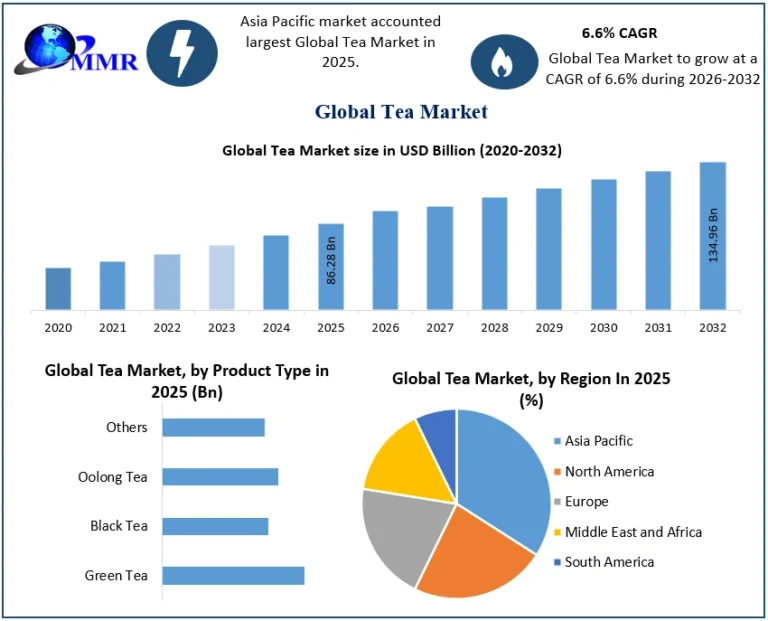
- Market size reached USD 86.28 billion in 2025
- Expected to reach USD 134.96 billion by 2032
- Forecast CAGR stands at 6.6% (2025–2032)
- Health-conscious consumers continue expanding premium tea demand
- Sustainability initiatives are becoming competitive differentiators
- E-commerce is widening market access and product visibility
- Product innovation remains central to brand differentiation
Why This Matters Now
The tea industry is moving through a structural transition rather than a cyclical recovery. Consumers increasingly evaluate beverages through the lenses of wellness, ingredient transparency, sustainability, and convenience.
That changes investment priorities. Growth increasingly depends on product portfolios, digital distribution, responsible sourcing, and premium positioning instead of relying solely on production scale.
Market Overview
The Tea Market remains one of the world’s most widely consumed beverages, yet today’s market dynamics differ significantly from historical consumption patterns. Consumer demand is shifting toward products that combine familiar taste with measurable health benefits.
The projected expansion from USD 86.28 billion to USD 134.96 billion demonstrates that value creation is outpacing traditional consumption growth. For producers and FMCG companies, this means stronger opportunities in premium offerings, specialty blends, organic products, and functional tea categories rather than competing only on price.
The industry also benefits from increasing product diversification. Manufacturers continue introducing new flavors, herbal combinations, and wellness-oriented formulations designed to meet changing consumer lifestyles.
Key Trends Driving Growth
Health and wellness have become major purchase drivers across global beverage categories. Tea naturally aligns with this shift, particularly as consumers seek beverages associated with antioxidants, natural ingredients, and reduced sugar consumption.
Premiumization is creating another important growth engine. Consumers are increasingly willing to pay higher prices for specialty varieties, origin-specific teas, and premium packaging that communicates authenticity and quality.
Clean-label demand is influencing product development. Buyers increasingly favor products containing recognizable ingredients with minimal processing, encouraging manufacturers to simplify formulations and improve ingredient transparency.
Sustainability has evolved from a corporate responsibility initiative into a commercial advantage. Responsible sourcing, environmentally conscious packaging, and sustainable cultivation practices increasingly influence purchasing decisions among environmentally aware consumers.
Digital commerce is expanding market accessibility. Online platforms allow tea companies to introduce premium collections, subscription models, and niche products that previously depended on limited retail shelf space. E-commerce also enables direct consumer engagement and faster product launches.
Get Your Free Sample Report and Discover Key Market Insights
Segment Insights
- Dominant Segment: Not specified in the supplied MMR report.
- Fastest-Growing Segment: Not specified in the supplied MMR report.
- Consumer demand continues shifting toward premium and wellness-oriented tea products.
- Product innovation across flavors and functional offerings is supporting category expansion.
- Digital retail channels are improving product availability and customer reach.
Regional Growth Story
Tea continues to maintain strong global demand across both developed and emerging economies. Mature markets increasingly emphasize premiumization, specialty products, and wellness positioning, while developing markets continue benefiting from expanding consumption and improving retail infrastructure.
Regional growth patterns also reflect differences in consumer priorities. Some markets focus on traditional consumption, while others increasingly adopt premium, herbal, organic, and functional tea products. This diversification creates opportunities for multinational companies to tailor product portfolios according to regional demand rather than pursuing a single global strategy.
Competitive Landscape
Competition is moving beyond pricing toward innovation capability.
Leading companies are investing in premium products, healthier formulations, sustainable sourcing, and stronger digital engagement. These initiatives signal that future market leadership will depend less on production capacity and more on brand differentiation and consumer trust.
For competitors, the message is significant. Brands that delay investments in sustainability, wellness-focused innovation, or digital commerce risk losing relevance as purchasing behavior evolves. Over the next 12–24 months, competitive intensity is likely to increase around premium positioning, direct-to-consumer channels, product transparency, and environmentally responsible operations rather than conventional volume expansion.
Recent Developments
- Growing emphasis on wellness-focused tea offerings
- Continued expansion of premium tea portfolios
- Greater focus on sustainable sourcing initiatives
- Rising adoption of environmentally responsible packaging
- Increasing investment in digital and e-commerce sales channels
Strategic Implications
Tea is becoming a higher-value category rather than simply a higher-volume market.
FMCG companies should prioritize portfolio diversification, premium brand development, digital customer engagement, and supply-chain sustainability. Companies capable of combining health positioning with authentic sourcing stories are likely to command stronger pricing power.
Retailers also have an opportunity to strengthen category performance by expanding premium assortments and improving online discovery through personalized recommendations and subscription-based purchasing models.
For investors, the industry’s stable consumption base combined with innovation-driven value growth creates an attractive long-term opportunity compared with slower-moving traditional beverage segments.
Future Outlook
The Tea Market is entering an innovation cycle where consumer expectations will determine competitive success more than production capacity alone. Health, sustainability, premium experiences, and digital accessibility are likely to define industry leadership throughout the forecast period.
The companies that modernize portfolios while strengthening sustainability and consumer engagement will capture disproportionate value; those that continue competing primarily on legacy products and pricing risk falling behind in a market that is rapidly redefining what consumers expect from everyday beverages.
Analyst Perspective
“The Tea Market is transitioning from a traditional beverage category into a value-driven growth industry where health, sustainability, premiumization, and digital commerce increasingly determine competitive advantage. Companies that innovate around changing consumer expectations will be best positioned for long-term growth.” — Siddhi Dole, Analyst
About Maximize Market Research
Maximize Market Research Pvt. Ltd. (MMR) is a global market research and consulting company that provides reliable, data-focused, and practical business insights. The firm serves a wide range of industries, including healthcare, pharmaceuticals, technology, automotive, electronics, chemicals, personal care, and consumer goods. Through market forecasts, competitive analysis, strategic consulting, and industry impact assessments, MMR helps organizations understand changing market conditions, identify growth opportunities, and make informed business decisions for long-term success.
Contact Us
2nd Floor, Navale IT Park Phase 3
Pune Banglore Highway, Narhe
Pune, Maharashtra 411041, India
+91 9607365656
sales@maximizemarketresearch.com
