Key Highlights
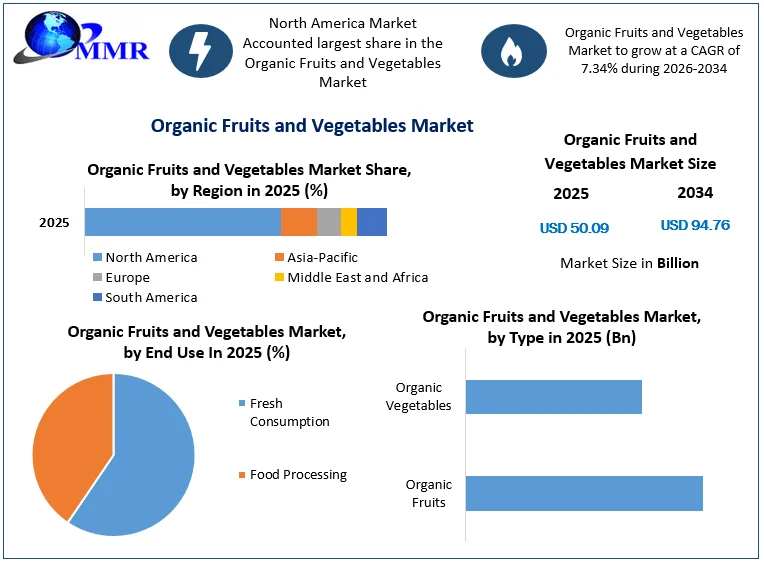
- Market value reached USD 50.09 billion in 2025, establishing organic produce as a major FMCG category.
- Revenue is projected to reach USD 94.76 billion by 2034, indicating continued expansion across global retail channels.
- CAGR of 7.34% (2026–2034) highlights long-term demand rather than short-term consumption spikes.
- Increasing health awareness and higher disposable incomes continue to strengthen consumer demand.
- Sustainable agriculture and chemical-free cultivation remain core competitive differentiators.
- Supermarkets lead distribution due to assortment, accessibility, and consumer convenience.
- Fresh organic produce maintains leadership among product forms.
- North America remains the largest regional market, while Asia-Pacific records the fastest expansion.
Why This Matters Now
Organic food has moved beyond premium positioning. Consumers increasingly evaluate food purchases through the combined lenses of health, sustainability, and transparency. That shift is influencing production models, retailer sourcing strategies, and investment priorities across the food value chain.
At the same time, governments are encouraging organic farming in several markets, while retailers continue expanding shelf space dedicated to certified organic products. Together, these developments are transforming organic produce from a niche offering into a strategic growth category.
Market Overview
The Organic Fruits and Vegetables Market Size is built on farming practices that eliminate synthetic chemicals throughout cultivation and harvesting. As awareness of food quality grows, consumers increasingly associate certified organic products with healthier lifestyles and environmentally responsible agriculture.
Market expansion is supported by a broad ecosystem of producers, food manufacturers, retailers, and agricultural cooperatives. Companies continue investing in sustainable farming methods while expanding product portfolios to meet demand across fresh, frozen, powdered, and processed organic products.
Growth is also supported by improving product availability and expanding retail accessibility, making organic produce increasingly visible to mainstream consumers rather than only specialty shoppers.
Key Trends Driving Growth
Health consciousness remains the market’s strongest demand catalyst. Consumers increasingly seek food perceived as free from synthetic chemicals while prioritizing nutritional quality and long-term wellness.
Clean-label purchasing behavior continues gaining momentum. Buyers increasingly value transparency regarding farming methods, product origin, and production standards, encouraging brands to strengthen certification and traceability.
Sustainability has evolved into a commercial advantage. Organic farming methods, environmentally responsible cultivation, and biodegradable packaging increasingly influence purchasing decisions while supporting broader corporate sustainability commitments.
E-commerce is creating new market opportunities by connecting consumers directly with organic growers and specialized retailers. Digital channels improve accessibility while enabling producers to reach broader customer bases beyond traditional retail networks.
Government support for organic agriculture continues encouraging adoption of certified farming practices, contributing to expanding production capacity and market development.
Despite positive momentum, higher production costs and limited product availability remain significant challenges. Organic cultivation requires greater labor intensity and specialized farming practices, contributing to premium pricing that can limit adoption among price-sensitive consumers. Shorter shelf life also increases supply chain complexity.
Explore detailed analysis, insights, and growth opportunities
Segment Insights
- Dominant Segment: Fresh Form — Consumers continue favoring fresh organic fruits and vegetables because of their natural characteristics, minimal processing, and perceived nutritional advantages.
- Frozen and powdered products address convenience-driven purchasing but remain secondary to fresh offerings.
- Dominant Distribution Channel: Supermarkets — Broad product selection and convenient shopping experiences reinforce supermarket leadership in organic retail.
- Variety stores and convenience stores continue serving complementary roles with comparatively narrower product assortments.
- Fastest-Growing Segment: The report identifies expanding opportunities through online retailing, where digital platforms improve accessibility and strengthen direct relationships between consumers and organic producers.
Regional Growth Story
North America maintains its leadership position through strong consumer awareness surrounding health, food safety, and environmental sustainability. The United States and Canada continue generating substantial demand across multiple organic product categories.
Europe remains a mature organic marketplace led by Germany, France, and the United Kingdom, where established consumer acceptance supports consistent market activity.
Asia-Pacific represents the fastest-growing regional opportunity. Rising disposable incomes alongside increasing health awareness are accelerating demand across Japan, Australia, China, and other regional markets, creating attractive expansion opportunities for producers and retailers.
Competitive Landscape
Competition is shifting from simply selling organic products to building trusted, sustainable supply ecosystems. Companies are investing across sourcing, packaging, production, and retail partnerships rather than relying solely on product differentiation.
Hain Celestial Group emphasizes sustainability and wellness-focused branding to strengthen its market position. Amy’s Kitchen continues targeting consumers seeking organic frozen and packaged meal solutions, including vegetarian and vegan offerings. Whole Foods Market leverages its extensive organic assortment and expanded retail reach to reinforce leadership in premium organic food retail.
Recent corporate activity suggests the next competitive phase will center on supply security, localized sourcing, sustainable packaging, and production scalability. Over the next 12–24 months, companies with integrated supply chains and stronger grower partnerships are likely to strengthen competitive positioning, while businesses dependent on fragmented sourcing may face increasing pressure.
Recent Developments
- January 2025: Dole Food Company expanded its organic portfolio with pre-packaged organic salad kits using fully biodegradable packaging across North America.
- March 2025: Taylor Farms acquired a large-scale organic greenhouse facility in Texas to increase year-round production of organic leafy greens.
- August 2025: SunOpta Inc. partnered with California growers to transition an additional 5,000 acres into certified organic production.
- October 2025: Fresh Del Monte Produce introduced carbon-neutral certified organic pineapples across European retail markets.
- February 2026: Albert Heijn established long-term sourcing agreements with European agricultural cooperatives to prioritize locally sourced seasonal organic vegetables.
Strategic Implications
Organic food companies are entering a period where operational capability becomes as important as brand positioning. Businesses that strengthen local sourcing, invest in environmentally responsible packaging, improve supply resilience, and expand digital distribution are positioned to capture future demand.
Retailers also face increasing pressure to combine product availability with transparency and sustainability, as consumers expect both premium quality and measurable environmental responsibility.
Future Outlook
The Organic Fruits and Vegetables Market is expected to maintain steady long-term expansion as health awareness, clean-label purchasing, sustainable agriculture, and digital commerce reinforce demand worldwide. Companies capable of combining supply-chain resilience with sustainability innovation will be positioned to capture the strongest growth, while competitors that fail to modernize sourcing, packaging, and consumer engagement risk losing market share in an increasingly values-driven food industry.
Analyst Perspective
“The Organic Fruits and Vegetables Market is entering a phase where sustainable production, consumer trust, and retail innovation are becoming equally important growth drivers. Companies that align operational excellence with changing consumer expectations will be best positioned to capitalize on long-term market expansion.” — Siddhi Dole, Analyst
About Maximize Market Research
Maximize Market Research Pvt. Ltd. (MMR) is a global market research and consulting company that provides reliable, data-focused, and practical business insights. The firm serves a wide range of industries, including healthcare, pharmaceuticals, technology, automotive, electronics, chemicals, personal care, and consumer goods. Through market forecasts, competitive analysis, strategic consulting, and industry impact assessments, MMR helps organizations understand changing market conditions, identify growth opportunities, and make informed business decisions for long-term success.
Contact Us :
2nd Floor, Navale IT Park Phase 3
Pune Banglore Highway, Narhe
Pune, Maharashtra 411041, India
+91 9607365656
sales@maximizemarketresearch.com
