Key Highlights
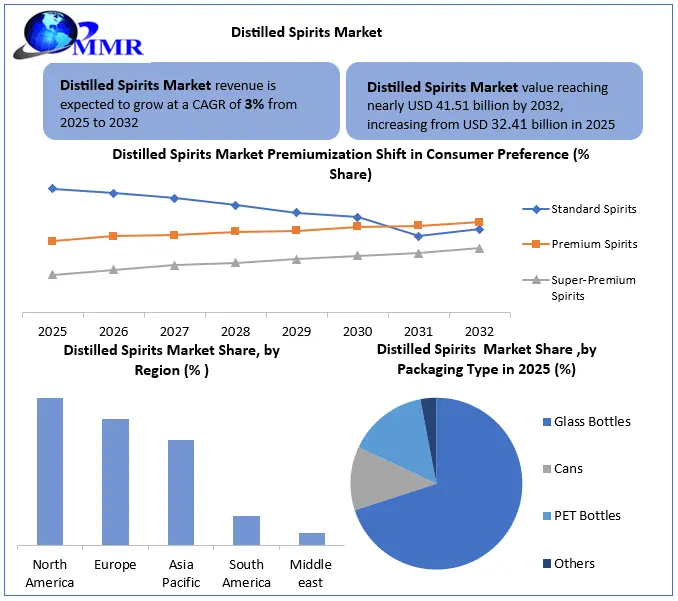
- Global Distilled Spirits Market valued at USD 32.41 billion in 2025 and projected to reach USD 41.5 billion by 2032
- CAGR of 3% (2025–2032) signals stable but structurally evolving demand base
- Growth anchored in premium alcoholic beverage consumption and rising disposable incomes
- Urbanization continues to reshape consumption patterns across emerging economies
- Market segmentation includes product categories and distribution channels (as outlined in the report)
- Competitive activity reflects intensifying focus on premium positioning and portfolio expansion
Why This Matters Now
Alcoholic beverage demand is no longer volume-led. It is value-led, experience-led, and increasingly brand-selective. The Distilled Spirits Market is entering a phase where incremental growth depends less on consumption frequency and more on consumer willingness to trade up.
At USD 32.41 billion in 2025, the market sits at a structural inflection point. The projected rise to USD 41.5 billion by 2032 signals not disruption, but disciplined expansion driven by premiumization rather than expansion in base consumption. For FMCG players, this changes capital allocation logic across brands, geographies, and product tiers.
Market Overview
The Global Distilled Spirits Market is characterized by steady expansion driven by shifting consumer preferences toward premium alcoholic beverages, rising urban populations, and increasing disposable income levels, particularly in emerging economies.
The market is projected to grow from USD 32.41 billion in 2025 to USD 41.5 billion by 2032, registering a CAGR of 3% during the forecast period. This trajectory signals stability rather than volatility, with growth largely anchored in value upgrading rather than consumption surges.
The report indicates structured segmentation across product type and distribution channels, though detailed dominance hierarchy between segments is not explicitly disclosed. The absence of sharp category disruption suggests a mature but evolving competitive environment.
Key Trends Driving Growth
Premiumization remains the dominant structural driver identified in the market outlook. Consumers are increasingly shifting toward higher-quality spirits, indicating a willingness to pay for perceived authenticity, craftsmanship, and brand heritage.
Urbanization is another core growth vector, particularly in emerging economies where lifestyle shifts are aligning with Westernized consumption patterns. This is expanding the consumer base for distilled spirits beyond traditional demographics.
Rising disposable incomes are reinforcing this trend, enabling higher per-capita spending on discretionary FMCG categories, including alcoholic beverages. The report does not provide additional quantified behavioral shifts such as e-commerce penetration or health and wellness influence, indicating limited explicit coverage of these factors.
Clean-label positioning, sustainability initiatives, and digital commerce acceleration are not detailed in the source report, though they remain commonly observed adjacent trends in broader FMCG beverage markets.
Get a free sample:https://www.maximizemarketresearch.com/request-sample/125226/
Segment Insights
- Dominant Segment: Not explicitly specified in the MMR report. The market is structured across product types and distribution channels, with no disclosed leading category.
- Fastest-Growing Segment: Not specified in the report.
The absence of defined segment leadership suggests a balanced competitive structure where growth is distributed across multiple spirit categories rather than concentrated in a single dominant sub-category. This typically indicates portfolio-driven competition among global players rather than category monopolization.
Regional Growth Story
The report highlights broad-based global expansion, with emerging economies playing a key role in demand creation due to rising incomes and urban population growth.
However, it does not provide detailed regional breakdowns or CAGR segmentation by geography. As a result, regional dominance patterns cannot be conclusively identified from the available data.
What is clear is the directional shift: consumption growth is increasingly tied to urban clusters rather than rural expansion, reinforcing the importance of metro-centric distribution and premium retail availability.
Competitive Landscape
The Distilled Spirits Market is shaped by established global and regional players competing primarily on brand equity, product differentiation, and premium positioning strategies.
While the report does not detail specific corporate actions such as mergers, acquisitions, or partnerships, the competitive environment signals a clear strategic direction: portfolio premiumization and brand consolidation.
This implies that smaller brands without strong premium identity risk margin compression as larger players continue to shift marketing investment toward high-margin segments. Over the next 12–24 months, competition is expected to intensify around premium craft positioning and geographic expansion into high-growth urban markets.
The lack of disruptive entry patterns suggests barriers remain anchored in brand loyalty, distribution strength, and regulatory compliance rather than technological disruption.
Recent Developments
- Report does not specify recent company-level developments
- No disclosed M&A activity or partnerships in the provided source
- No quantified innovation or product launch data included
- No regulatory or policy shifts detailed within the report
Strategic Implications
The market trajectory toward USD 41.5 billion reinforces a clear strategic reality: volume growth alone is no longer sufficient for competitive advantage.
Brands must increasingly compete on premium identity, storytelling, and perceived authenticity. With a 3% CAGR, revenue expansion depends on value migration rather than consumer base expansion.
Distribution strategy becomes critical as urban consumption clusters intensify. Players unable to secure strong on-trade and premium retail presence risk losing visibility in high-value consumption environments.
For investors, the market signals predictability rather than volatility, making it attractive for long-term brand consolidation strategies but less suited for aggressive short-cycle growth plays.
Future Outlook
The Distilled Spirits Market will remain structurally stable, but increasingly polarized between premium winners and commoditized laggards, with value capture concentrated in brands that successfully elevate positioning over the next decade.
Analyst Perspective
“Growth in the distilled spirits category is increasingly defined by value migration rather than consumption expansion. Companies that fail to align with premiumization will gradually lose relevance in high-growth urban demand centers,” says Siddhi Dole, Analyst, Maximize Market Research.
About Maximize Market Research
Maximize Market Research Pvt. Ltd. (MMR) is a global market research and consulting company that provides reliable, data-focused, and practical business insights. The firm serves a wide range of industries, including healthcare, pharmaceuticals, technology, automotive, electronics, chemicals, personal care, and consumer goods. Through market forecasts, competitive analysis, strategic consulting, and industry impact assessments, MMR helps organizations understand changing market conditions, identify growth opportunities, and make informed business decisions for long-term success.
2nd Floor, Navale IT Park Phase 3
Pune Banglore Highway, Narhe
Pune, Maharashtra 411041, India
+91 9607365656
sales@maximizemarketresearch.com
