Key Highlights
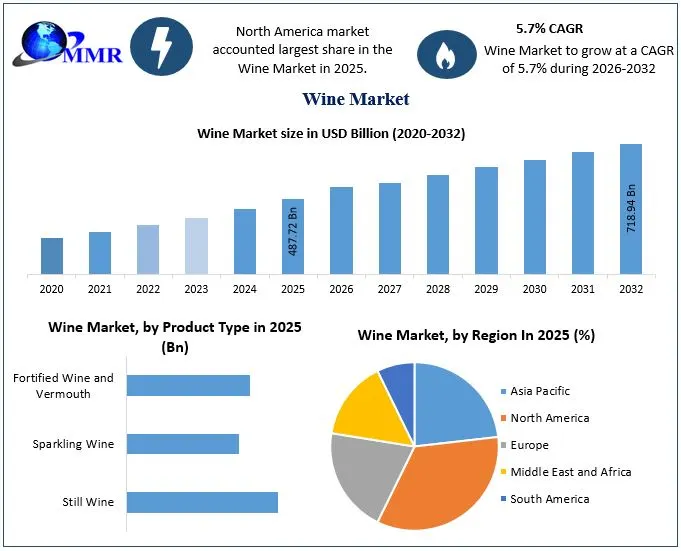
- Wine Market valued at USD 487.72 Billion in 2025, signaling entrenched global demand across developed and emerging economies.
- Forecast to reach USD 718.94 Billion by 2032, reflecting sustained premiumization across consumer segments.
- Growth anchored in rising preference for low-intervention, organic, and sustainable wines.
- Digital retail channels are reshaping distribution, compressing traditional supply layers.
- Consumption patterns are shifting from volume-led purchasing to experience-led and origin-focused buying.
- Competitive intensity is increasing as producers pivot toward branding, terroir storytelling, and direct-to-consumer models.
Why This Matters Now
Wine is no longer a discretionary luxury tied to occasion-based consumption. It is becoming a structured FMCG category shaped by lifestyle identity, wellness perception, and digital accessibility.
At USD 487.72 Billion in 2025, the category is already operating at scale, but the real signal is the direction of demand: consumers are moving away from mass-produced variants toward differentiated, traceable, and premium offerings. That shift forces incumbents to defend margin rather than volume.
Market Overview
The Wine Market is expanding within a structurally mature but behaviorally shifting beverage landscape. The projected rise to USD 718.94 Billion by 2032 at a 5.7% CAGR reflects stable long-term demand rather than cyclical expansion.
Growth is increasingly shaped by value migration rather than volume increase. Consumers are trading up within the category, prioritizing authenticity, production transparency, and health perception. This is repositioning wine from an alcohol commodity to a curated consumption experience.
The FMCG beverage ecosystem is also compressing. Traditional wholesale-heavy distribution is being bypassed by digital-first retail and direct winery-to-consumer models. This reduces intermediary margins but increases brand control over pricing and storytelling.
Key Trends Driving Growth
Health and wellness narratives are reshaping consumption logic. Moderation trends are supporting demand for wines perceived as “cleaner” or lower in additives. Organic and biodynamic production methods are gaining traction as consumers link production processes to lifestyle quality.
E-commerce penetration is another structural driver. Online platforms are expanding category reach beyond traditional wine retail geographies, enabling niche producers to scale without physical retail dependency. Subscription-based wine discovery models are also increasing repeat consumption frequency.
Sustainability has moved from branding to procurement requirement. Water usage, packaging footprint, and carbon reporting are becoming competitive differentiators in procurement decisions, particularly in Europe and North America.
Premiumization continues to dominate growth logic. Instead of expanding consumption frequency, the market is expanding value per bottle through origin branding, aging differentiation, and limited releases.
Get a free sample:https://www.maximizemarketresearch.com/request-sample/189448/
Segment Insights
- Dominant Segment: Not explicitly disclosed in the provided MMR extract. However, the market structure indicates strong leadership from premium and traditional wine categories, driven by established consumption bases in Europe and North America.
- Fastest-Growing Segment: Organic and sustainably produced wines are indicated as high-growth contributors, supported by wellness-led consumption shifts and regulatory alignment in export markets.
Additional segmentation dynamics reflect a clear divergence: mass-market wines are stagnating in value terms, while premium and specialty wines are expanding margin share. The structural implication is margin concentration among differentiated producers.
Regional Growth Story
Europe remains the structural anchor of global wine consumption and production, with entrenched cultural integration supporting stable baseline demand. However, growth velocity is increasingly shifting outside traditional markets.
Asia-Pacific is emerging as a high-potential consumption zone, driven by urbanization, rising disposable incomes, and Western lifestyle adoption. Demand in this region is less tradition-bound, allowing premium imports to scale faster than domestic production.
North America continues to evolve toward premiumization, with strong performance in branded, organic, and boutique wine categories. Digital retail penetration is significantly higher here, accelerating direct-to-consumer disruption.
Emerging markets in Latin America and parts of Africa remain volume-sensitive but are gradually integrating wine into urban consumption patterns, particularly through hospitality channels.
Competitive Landscape
The Wine Market is increasingly defined by brand differentiation rather than production scale alone. Established producers are shifting capital toward portfolio premiumization and vineyard-specific branding to defend pricing power.
Smaller wineries are leveraging digital-first distribution to bypass traditional retail gatekeeping. This is intensifying fragmentation at the mid-tier level while concentrating profitability at the top end.
Strategic partnerships with e-commerce platforms and hospitality chains signal a shift toward controlled distribution ecosystems. The implication is clear: ownership of consumer data is becoming as important as ownership of vineyards.
Over the next 12–24 months, competition will likely intensify around sustainability certification and direct-to-consumer ecosystems rather than pure production capacity.
Recent Developments
- Expansion of organic wine portfolios across major global producers reflecting wellness-driven repositioning.
- Increased investment in direct-to-consumer digital platforms to reduce retail dependency.
- Sustainability-linked packaging innovations targeting carbon reduction benchmarks.
- Growth in subscription-based wine delivery services expanding repeat purchase frequency.
- Strategic focus on vineyard-level branding and origin authentication systems.
Strategic Implications
The industry is shifting from supply-led production economics to demand-shaped value ecosystems. Producers that fail to invest in branding, sustainability, and digital distribution risk margin erosion despite stable demand.
Retail intermediaries face structural pressure as direct-to-consumer channels expand. The value chain is flattening, redistributing margin control upstream toward producers with strong brand equity.
For investors, the key signal is not volume expansion but pricing power durability. The winners will be producers capable of converting terroir, sustainability, and digital reach into defensible premium pricing.
Future Outlook
The Wine Market will increasingly split into two layers: a premiumized, digitally connected global category and a stagnant mass segment fighting for shelf space.
Winners will own brands and consumer data; losers will own only production capacity.
Analyst Perspective
“Wine is transitioning from a geography-led commodity to a brand-led FMCG asset class. The next cycle of growth will be defined by producers that control narrative, distribution, and sustainability credibility simultaneously.”
— Siddhi Dole, Analyst
About Maximize Market Research
Maximize Market Research Pvt. Ltd. (MMR) is a global market research and consulting company that provides reliable, data-focused, and practical business insights. The firm serves a wide range of industries, including healthcare, pharmaceuticals, technology, automotive, electronics, chemicals, personal care, and consumer goods. Through market forecasts, competitive analysis, strategic consulting, and industry impact assessments, MMR helps organizations understand changing market conditions, identify growth opportunities, and make informed business decisions for long-term success.
2nd Floor, Navale IT Park Phase 3
Pune Banglore Highway, Narhe
Pune, Maharashtra 411041, India
+91 9607365656
sales@maximizemarketresearch.com
