Key Highlights
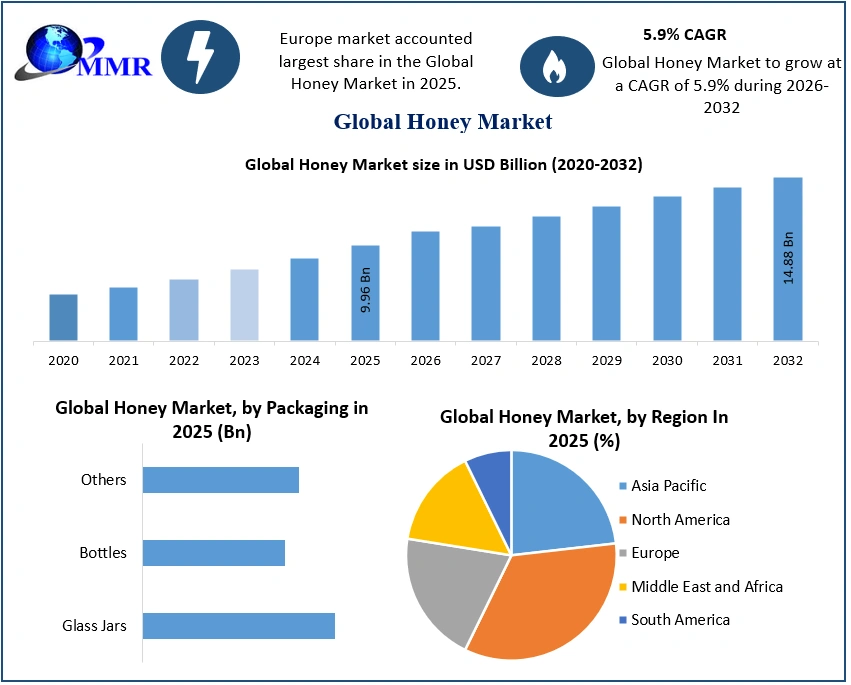
- Honey Market size: USD 9.96 Billion in 2025
- Forecast value: USD 14.88 Billion by 2032
- CAGR: 5.9% (2025–2032)
- Demand anchored in FMCG, food & beverage applications
- Growth linked to natural sweetener substitution trends
Why This Matters Now
Global food manufacturers are recalibrating sugar strategies under mounting regulatory and consumer pressure. Honey is no longer a niche natural sweetener; it is becoming a reformulation lever.
The Honey Market size was valued at USD 9.96 Billion in 2025 and the total Honey revenue is expected to grow at a CAGR of 5.9% from 2025 to 2032, reaching nearly USD 14.88 Billion by 2032.
That expansion signals more than incremental demand. It reflects structural substitution away from refined sugar in packaged foods, beverages, and health-oriented FMCG portfolios. For brand owners, honey is shifting from ingredient choice to product positioning tool.
Market Overview
The Honey Market is moving through a phase of steady expansion shaped by food manufacturing diversification and rising health-conscious consumption.
The projected increase from USD 9.96 Billion in 2025 to USD 14.88 Billion in 2032 indicates sustained demand continuity across retail and industrial channels. At a 5.9% CAGR, the trajectory signals moderate but stable category expansion rather than volatility-driven spikes.
This growth curve positions honey as a resilient natural sweetener category within the broader FMCG ingredients ecosystem. Its adoption is increasingly tied to formulation reformulations in packaged food and beverage portfolios where “natural” claims carry commercial weight.
Key Trends Driving Growth
The Honey Market is influenced by shifting consumption behavior and FMCG product redesign cycles. Clean-label demand is central, with manufacturers reformulating products to remove artificial sweeteners and replace them with natural alternatives.
Health and wellness positioning is strengthening honey’s role in functional foods and beverages. Consumers are associating honey with immunity support, natural energy, and minimally processed nutrition.
E-commerce expansion is also reshaping distribution logic. Online grocery platforms and D2C food brands are increasing honey visibility, improving price transparency, and widening brand competition.
Sustainability narratives are becoming commercially relevant. Bee population awareness and responsible sourcing discussions are influencing procurement strategies, particularly among premium brands.
However, the report does not specify segmented growth drivers or quantified trend contributions, indicating that much of the competitive momentum is distributed across multiple demand channels rather than concentrated in a single driver.
Get a free sample:https://www.maximizemarketresearch.com/request-sample/120330/
Segment Insights
- Dominant Segment: Not specified in the supplied report data
- Fastest-Growing Segment: Not specified in the supplied report data
While segmentation specifics are not detailed in the provided source, the overall market expansion suggests broad-based demand across multiple applications within FMCG and food & beverage categories rather than isolated segment dependency.
This implies category-wide participation rather than segment concentration, reducing volatility risk and supporting stable long-term revenue expansion.
Regional Growth Story
The supplied report does not disclose region-wise market breakdown or geographic leadership patterns.
However, the global valuation growth from USD 9.96 Billion to USD 14.88 Billion indicates multi-regional demand participation rather than reliance on a single geography. This typically reflects parallel adoption across developed markets (driven by clean-label demand) and emerging markets (driven by rising packaged food consumption).
The absence of region-specific dominance data suggests competitive opportunities remain geographically distributed, allowing both global and local brands to compete on similar demand fundamentals.
Competitive Landscape
The report does not list specific companies or market share positioning.
However, the structured growth trajectory indicates a competitive environment defined more by product differentiation than consolidation dominance. In such a scenario, competition typically intensifies around sourcing quality, certification claims (organic, raw, monofloral), and retail placement.
What this signals is a category where branding and supply chain credibility outweigh scale alone. Over the next 12–24 months, competitive pressure is likely to shift toward traceability, sustainability validation, and premium positioning rather than price-led expansion.
For smaller producers, this opens niche premiumization pathways. For large FMCG players, it increases the importance of vertically integrated sourcing and quality assurance systems.
Recent Developments
- No specific mergers, acquisitions, or partnerships are disclosed in the provided report source
- No regulatory or product innovation updates are specified
- No company-level expansions are detailed
The absence of disclosed developments suggests either a fragmented competitive base or a focus on organic growth rather than headline-driven consolidation activity in the report period.
Strategic Implications
The projected growth to USD 14.88 Billion by 2032 at a 5.9% CAGR signals predictable but durable demand expansion. For FMCG leaders, this creates a planning advantage: honey can be embedded into long-cycle reformulation strategies without exposure to high volatility.
Ingredient procurement strategies will increasingly prioritize consistency, authenticity certification, and supplier traceability. Retailers are likely to strengthen private-label honey offerings, intensifying shelf-level competition.
Manufacturers that fail to align with clean-label expectations risk displacement as honey becomes a baseline expectation in “natural” product categories rather than a premium differentiator.
Supply chain resilience also becomes critical. Beekeeping dependencies and agricultural linkages make sourcing stability a strategic constraint, particularly for large-scale FMCG integration.
Future Outlook
The Honey Market’s trajectory toward USD 14.88 Billion reflects disciplined, consumption-led expansion rather than speculative acceleration. Growth will likely remain anchored in food and beverage reformulation cycles, with incremental gains driven by health positioning and retail penetration.
The next phase of competition will not be defined by who produces honey—but by who controls trust, traceability, and premium positioning in an increasingly label-conscious global food system.
Winners will scale credibility faster than volume. Losers will compete on price in a market that is steadily moving beyond it.
Analyst Perspective
“The Honey Market’s projected expansion to USD 14.88 Billion by 2032 at a 5.9% CAGR reflects a structurally stable demand environment where growth is driven less by novelty and more by sustained FMCG reformulation and consumer trust in natural ingredients,” said Siddhi Dole, Analyst at Maximize Market Research.
About Maximize Market Research
Maximize Market Research Pvt. Ltd. (MMR) is a global market research and consulting company that provides reliable, data-focused, and practical business insights. The firm serves a wide range of industries, including healthcare, pharmaceuticals, technology, automotive, electronics, chemicals, personal care, and consumer goods. Through market forecasts, competitive analysis, strategic consulting, and industry impact assessments, MMR helps organizations understand changing market conditions, identify growth opportunities, and make informed business decisions for long-term success.
2nd Floor, Navale IT Park Phase 3
Pune Banglore Highway, Narhe
Pune, Maharashtra 411041, India
+91 9607365656
sales@maximizemarketresearch.com
