Key Highlights
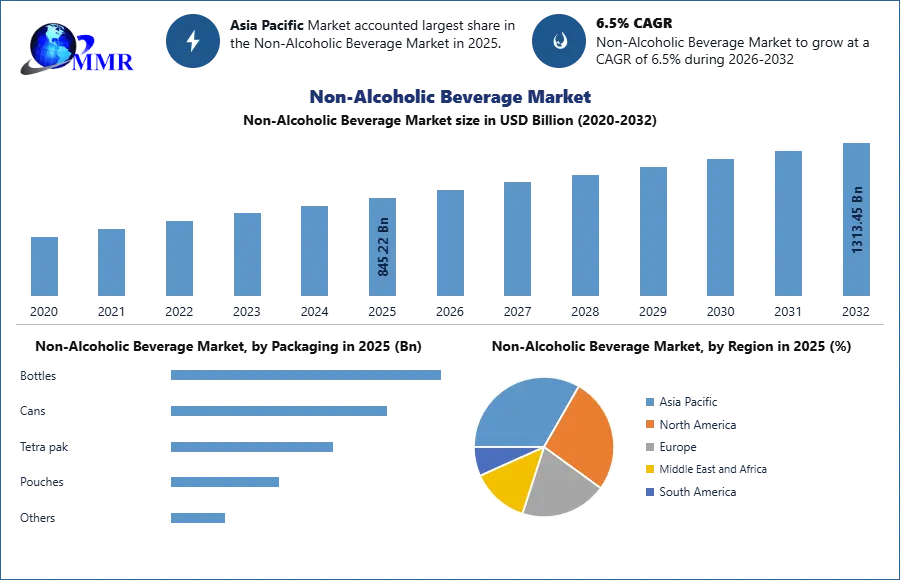
- Non-Alcoholic Beverage Market valued at US$845.22 billion in 2025.
- Projected to reach US$1313.45 billion by 2032, expanding at a 6.5% CAGR.
- Demand momentum concentrated in health-oriented and low-sugar beverage categories.
- FMCG beverage portfolios are shifting toward functional and premium formulations.
- Digital retail channels are accelerating brand visibility and purchase frequency.
- Sustainability pressures are reshaping packaging and supply chain strategies.
Why This Matters Now
The beverage aisle is no longer competing on taste alone. It is competing on health outcomes, ingredient transparency, and lifestyle alignment.
A US$845.22 billion global category expanding toward US$1313.45 billion by 2032 signals more than consumption growth. It signals redistribution of shelf power. Traditional carbonated dominance is being challenged by functional hydration, fortified drinks, and clean-label formulations. Every percentage shift in category mix translates into billions of dollars redirected across FMCG portfolios.
Market Overview
The Non-Alcoholic Beverage Market represents one of the largest and most structurally dynamic segments within global FMCG. It spans packaged water, juices, carbonated soft drinks, ready-to-drink beverages, and emerging functional formats.
The market’s valuation of US$845.22 billion in 2025 underscores its scale as a foundational consumer category. The projected rise to US$1313.45 billion by 2032 at a 6.5% CAGR reflects steady expansion driven by both population-level consumption and per-capita premiumization.
What distinguishes the current cycle is not volume alone, but value migration. Consumers are trading up into beverages positioned around wellness, energy support, digestive health, and sugar reduction. This shift is compressing legacy product dominance while expanding niche, high-margin subcategories.
Key Trends Driving Growth
Health and wellness remain the central force reshaping demand. Consumers are actively reducing sugar intake while increasing demand for beverages with functional claims. This includes hydration-enhanced drinks, vitamin-fortified liquids, and plant-based formulations.
Clean-label expectations are tightening procurement standards. Ingredient transparency is no longer optional in premium retail channels. Products with simplified formulations are gaining shelf preference over chemically complex alternatives.
Urbanization and fast-paced lifestyles are reinforcing ready-to-drink consumption. Convenience is becoming a structural driver rather than a situational one, particularly across working-age populations.
Digital commerce is also altering discovery patterns. Online grocery platforms and quick-commerce ecosystems are increasing trial rates for new beverage formats, reducing dependence on traditional retail shelf placement.
Sustainability is becoming a competitive requirement. Packaging innovation, recyclable materials, and carbon footprint reduction strategies are increasingly tied to brand positioning and procurement eligibility.
Get a free sample:https://www.maximizemarketresearch.com/request-sample/74039/
Segment Insights
- Dominant Segment: Carbonated and packaged beverage categories continue to hold a leading share due to entrenched consumption habits and global distribution penetration.
- Fastest-Growing Segment: Functional and health-oriented beverages are expanding rapidly, driven by demand for immunity support, hydration enhancement, and nutritional enrichment.
Segment competition is shifting from traditional flavor differentiation to benefit-led positioning. This is forcing incumbents to reposition legacy portfolios or risk margin erosion.
Regional Growth Story
Developed markets are witnessing slower volume expansion but stronger value growth through premiumization. Consumers are trading up into health-centric and specialty beverages, increasing average transaction value.
Emerging economies continue to anchor volume growth. Expanding middle-class populations and urban retail infrastructure are increasing per-capita consumption of packaged beverages.
Across regions, climate conditions also influence category strength. Hotter geographies show stronger demand for hydration-focused and refreshment-led beverages, reinforcing structural baseline consumption.
Competitive Landscape
Competition in the Non-Alcoholic Beverage Market is defined by portfolio diversification rather than single-product dominance.
Large beverage manufacturers are expanding across adjacent categories, signaling a shift from beverage producers to wellness and hydration ecosystem players. This transition reflects defensive positioning against functional startups and private-label disruption.
Strategic investment is increasingly concentrated in three areas: product reformulation, acquisition of niche health beverage brands, and expansion into digital-first distribution channels.
The competitive signal is clear: scale alone is no longer sufficient. Speed of innovation is becoming the primary differentiator. Companies unable to reformulate portfolios toward low-sugar and functional claims risk long-term shelf displacement.
Over the next 12–24 months, consolidation pressure is expected to intensify as large players acquire high-growth niche brands to accelerate entry into wellness-led segments.
Recent Developments
- Expansion of low-sugar and zero-calorie beverage portfolios across global FMCG players.
- Increased investment in plant-based and functional drink startups.
- Scaling of recyclable and lightweight packaging formats across major distribution networks.
- Growth of direct-to-consumer beverage subscription models in urban markets.
- Integration of digital retail partnerships to improve product discovery and repeat purchase rates.
Strategic Implications
Category leadership is shifting from distribution control to innovation velocity. Firms that shorten product development cycles will capture disproportionate gains in high-growth segments.
Portfolio simplification is becoming as important as expansion. Legacy SKUs with declining relevance are increasingly being rationalized to fund functional innovation pipelines.
Retailers are gaining influence over product success, as shelf space is increasingly tied to health credentials and sustainability compliance.
The most significant strategic pivot is the convergence of beverage and wellness industries. This is redefining competition beyond FMCG into broader health-oriented consumer ecosystems.
Future Outlook
The Non-Alcoholic Beverage Market’s trajectory toward US$1313.45 billion by 2032 signals sustained expansion, but value capture will not be evenly distributed. Winners will control functional innovation pipelines and digital-first distribution; losers will remain trapped in commoditized, price-sensitive carbonated segments.
Analyst Perspective
“The Non-Alcoholic Beverage Market is entering a structural transition where health, convenience, and digital access are redefining category leadership. The next phase of competition will reward agility in formulation and distribution, not legacy scale,” says Siddhi Dole, Analyst at Maximize Market Research.
About Maximize Market Research
Maximize Market Research Pvt. Ltd. (MMR) is a global market research and consulting company that provides reliable, data-focused, and practical business insights. The firm serves a wide range of industries, including healthcare, pharmaceuticals, technology, automotive, electronics, chemicals, personal care, and consumer goods. Through market forecasts, competitive analysis, strategic consulting, and industry impact assessments, MMR helps organizations understand changing market conditions, identify growth opportunities, and make informed business decisions for long-term success.
2nd Floor, Navale IT Park Phase 3
Pune Banglore Highway, Narhe
Pune, Maharashtra 411041, India
+91 9607365656
sales@maximizemarketresearch.com
