Key Highlights
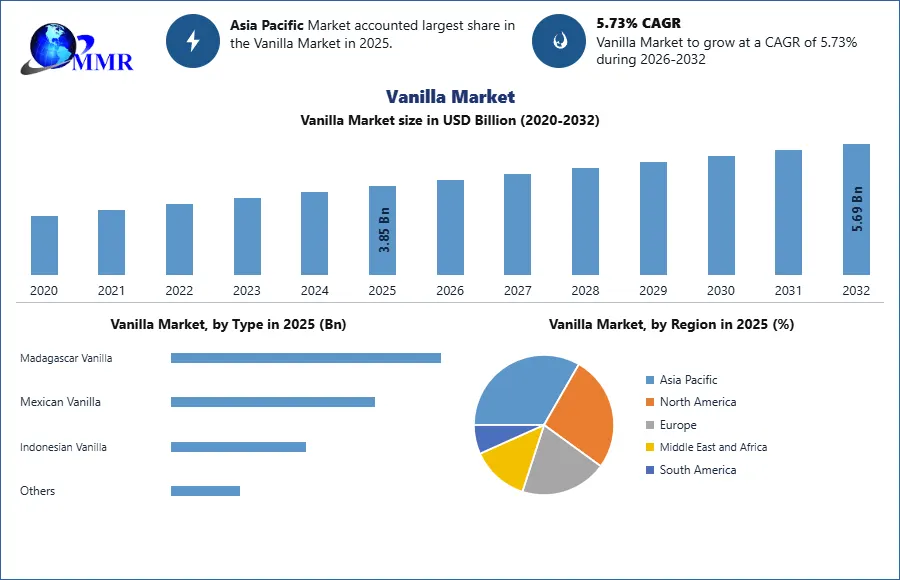
- Vanilla Market size reached USD 3.85 Billion in 2025 and is projected to reach USD 5.73 Billion by 2032, growing at a CAGR of 5.69%.
- Growth signals sustained dependence of FMCG and food & beverage manufacturers on premium natural flavor inputs.
- Vanilla continues to function as a baseline flavor architecture across bakery, dairy, confectionery, and beverage formulations.
- Price sensitivity and supply constraints amplify procurement risk for global manufacturers.
- Clean-label and natural ingredient demand intensifies vanilla’s strategic relevance in product formulation.
Why This Matters Now
Procurement heads are no longer treating vanilla as a commodity input. It has become a volatility point in global flavor supply chains.
At USD 3.85 Billion in 2025, the market already reflects strong downstream dependency across FMCG categories. The projected rise to USD 5.73 Billion by 2032 at 5.69% CAGR signals not just consumption growth, but structural reliance on natural flavor systems that are difficult to substitute at scale.
For food manufacturers, this shifts vanilla from a formulation choice to a supply risk variable.
Market Overview
The Vanilla Market is anchored in widespread application across food and beverage manufacturing, where it functions as a foundational flavoring agent. Its demand profile is closely tied to processed food consumption and branded packaged goods expansion.
The market size of USD 3.85 Billion in 2025 reflects entrenched usage across global FMCG supply chains. The projected expansion to USD 5.73 Billion by 2032 signals steady integration of vanilla into both mass-market and premium product portfolios.
This trajectory indicates that vanilla is no longer confined to traditional bakery or confectionery usage. It is increasingly embedded in diversified product categories where flavor consistency and clean-label positioning are commercial priorities.
Key Trends Driving Growth
The report indicates sustained market expansion, with demand concentration tied to FMCG and food & beverage applications.
A major directional shift is the elevation of natural flavor systems in packaged food positioning. Manufacturers are moving away from artificial substitutes, increasing reliance on vanilla-based formulations to support clean-label claims.
At the same time, supply chain sensitivity remains a defining characteristic of the market. Vanilla production is historically exposed to environmental and agricultural volatility, which translates into pricing pressure for downstream buyers.
Another structural trend is premiumization in consumer food categories. Vanilla is increasingly used not just for flavoring but for perceived quality signaling in product branding.
Get a free sample:https://www.maximizemarketresearch.com/request-sample/31727/
Segment Insights
- Dominant Segment: Not specified in the provided report extract. However, vanilla usage remains concentrated across FMCG food applications, particularly processed food and beverage formulations.
- Fastest-Growing Segment: Not specified in the provided report extract. Growth is broadly distributed across expanding end-use categories within food and beverage manufacturing.
The absence of explicit segmentation data in the source highlights a key market characteristic: vanilla demand is functionally horizontal across multiple FMCG categories rather than concentrated in a single dominant vertical.
Regional Growth Story
The provided report extract does not disclose regional segmentation or geographic performance data.
However, the global valuation of USD 3.85 Billion in 2025 suggests a geographically diversified demand base driven by multinational FMCG supply chains.
This distributed demand structure reduces reliance on any single regional market but increases exposure to global agricultural supply risks, particularly in vanilla-producing ecosystems.
Competitive Landscape
The report does not specify named companies or competitive market shares in the provided extract.
However, the competitive structure of the Vanilla Market is defined by supply sensitivity rather than brand dominance. Market participants operate in an environment where raw material availability and pricing volatility exert stronger influence than product differentiation.
This signals a structural reality: competitive advantage is shifting from branding to supply chain control. Over the next 12–24 months, firms with secured sourcing networks and vertically integrated procurement models are likely to gain disproportionate leverage.
For smaller players, limited access to stable vanilla supply will increasingly translate into margin compression and formulation reformulation risk.
Recent Developments
- The Vanilla Market is projected to expand from USD 3.85 Billion (2025) to USD 5.73 Billion (2032).
- The market is growing at a steady CAGR of 5.69%, indicating sustained FMCG-driven demand.
- Increasing reliance on natural flavoring agents continues to reinforce vanilla’s role in global food systems.
- Market structure remains highly dependent on agricultural supply stability and downstream FMCG consumption cycles.
Strategic Implications
Vanilla is transitioning from a stable input ingredient to a strategic procurement asset. FMCG companies must now treat it as a risk-managed commodity rather than a predictable input cost.
The consistent upward trajectory in valuation signals that demand elasticity remains intact despite pricing volatility. This creates a structural imbalance: downstream demand is stable while upstream supply is inherently constrained.
Procurement diversification, alternative sourcing strategies, and formulation flexibility will define competitive resilience in this category.
Future Outlook
Between 2025 and 2032, the Vanilla Market will continue to expand steadily, but value creation will concentrate in supply chain control rather than consumption growth alone.
The gap between companies that secure vanilla supply stability and those that remain exposed to spot-market volatility will define the next competitive cycle in FMCG flavor formulation.
Analyst Perspective
“Vanilla is no longer a background flavoring input—it has become a supply-chain-sensitive commodity embedded in FMCG pricing strategy. The next phase of growth will reward companies that treat sourcing resilience as seriously as product innovation.”
— Siddhi Dole, Analyst
About Maximize Market Research
Maximize Market Research Pvt. Ltd. (MMR) is a global market research and consulting company that provides reliable, data-focused, and practical business insights. The firm serves a wide range of industries, including healthcare, pharmaceuticals, technology, automotive, electronics, chemicals, personal care, and consumer goods. Through market forecasts, competitive analysis, strategic consulting, and industry impact assessments, MMR helps organizations understand changing market conditions, identify growth opportunities, and make informed business decisions for long-term success.
2nd Floor, Navale IT Park Phase 3
Pune Banglore Highway, Narhe
Pune, Maharashtra 411041, India
+91 9607365656
sales@maximizemarketresearch.com
