Key Highlights
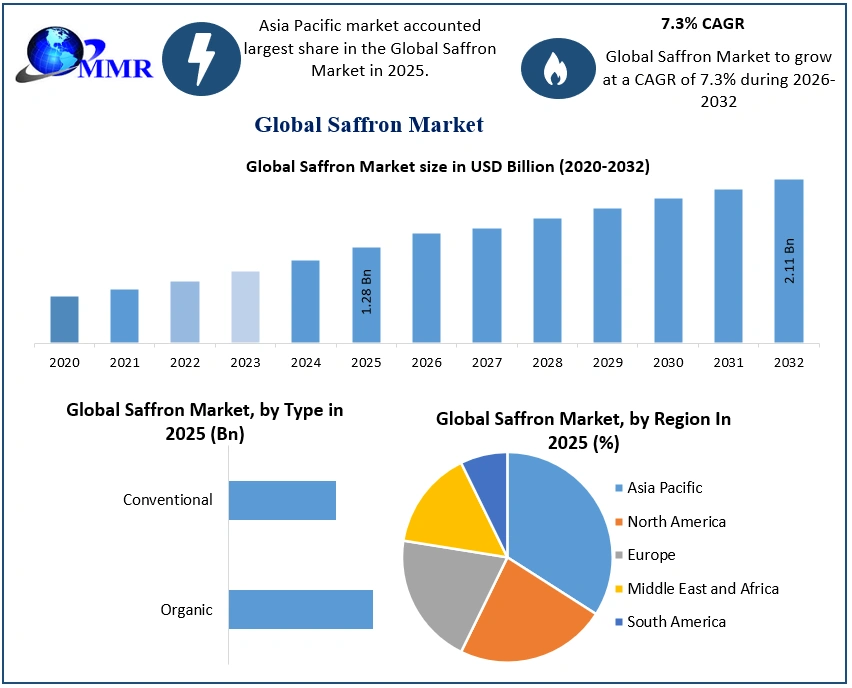
- Saffron Market valued at USD 1.28 Billion in 2025, signaling strong baseline demand in premium spice categories.
- Expected to reach USD 2.11 Billion by 2032, indicating sustained expansion in high-value culinary and FMCG applications.
- Market growth recorded at a CAGR of 7.3% (2025–2032), reflecting consistent upward demand momentum.
- Growth trajectory highlights increasing global commercialization of saffron across food, beverage, and premium wellness segments.
- Report-based insights indicate strengthening demand concentration in value-driven spice consumption markets.
Why This Matters Now
Executives are not dealing with a niche spice story anymore. They are facing a structurally expanding premium ingredient category that is scaling into mainstream FMCG supply chains. The saffron market crossing USD 1.28 Billion in 2025 signals that demand has already moved beyond artisanal consumption into organized global trade.
At a projected USD 2.11 Billion by 2032, saffron is transitioning from a seasonal luxury input to a recurring industrial ingredient in food and beverage systems. The 7.3% CAGR reflects not volatility, but sustained purchasing behavior anchored in premiumization.
This shift forces FMCG players to rethink sourcing stability, pricing architecture, and product differentiation strategies built around high-value natural inputs.
Market Overview
The Saffron Market is positioned within the premium spice and natural ingredient ecosystem of the FMCG and food & beverage sector. According to the provided MMR report, the market is valued at USD 1.28 Billion in 2025 and is projected to reach USD 2.11 Billion by 2032, expanding at a CAGR of 7.3% during the forecast period.
This growth reflects a structurally expanding consumption base for saffron as both a flavoring agent and a value-added ingredient. The valuation trajectory indicates increasing monetization of saffron across commercial food systems rather than isolated culinary use.
The price-sensitive nature of saffron positions the market in a high-margin but supply-constrained category, where incremental demand directly amplifies value realization across the supply chain.
Key Trends Driving Growth
The MMR report highlights an expanding market size trajectory, which directly signals intensifying demand for premium natural ingredients within FMCG and food applications.
Rising valuation from USD 1.28 Billion to USD 2.11 Billion indicates that saffron is increasingly embedded in higher-value consumption baskets. This reflects broader commercialization of premium spice usage across processed foods, beverages, and specialty food products.
The 7.3% CAGR signals steady rather than speculative growth, suggesting long-term integration into industrial food systems rather than cyclical demand spikes.
Beyond numeric expansion, the market movement indicates a shift toward value density in food ingredients, where low-volume, high-value inputs are gaining stronger procurement priority in food manufacturing ecosystems.
Get a free sample:https://www.maximizemarketresearch.com/request-sample/24308/
Segment Insights
- Dominant Segment: Not specified in the provided MMR report data. However, overall market valuation indicates strong dominance of high-value application segments within food and beverage usage categories.
- Fastest-Growing Segment: Not disclosed in the supplied report extract. Growth momentum is broadly aligned with expanding premium FMCG and processed food applications.
Despite the absence of segment-level breakdown in the provided dataset, the overall market expansion suggests that saffron consumption is being absorbed into multiple end-use categories simultaneously, reinforcing diversified demand concentration rather than single-segment dependency.
Regional Growth Story
The supplied report does not provide explicit regional segmentation data. However, the overall market expansion from USD 1.28 Billion to USD 2.11 Billion indicates geographically distributed demand growth across global FMCG and food & beverage ecosystems.
This implies that saffron consumption is no longer confined to traditional production or consumption geographies but is increasingly integrated into international supply chains.
The absence of regional concentration data suggests a market structure driven by globalized demand rather than localized consumption clusters.
Competitive Landscape
The provided MMR report extract does not list specific companies or competitive benchmarking details. However, the market’s projected growth to USD 2.11 Billion by 2032 signals increasing competition intensity in sourcing, processing, and distribution layers of saffron supply chains.
This valuation expansion typically forces market participants to compete on purity, consistency, and supply reliability rather than volume alone.
The 7.3% CAGR trajectory indicates that competitive advantage will likely shift toward players capable of securing stable raw material access and building scalable distribution networks across FMCG channels.
In strategic terms, the market structure implies tightening procurement competition and gradual formalization of what has traditionally been a fragmented supply ecosystem.
Recent Developments
- Market valued at USD 1.28 Billion in 2025, confirming strong baseline demand in premium spice category.
- Forecasted expansion to USD 2.11 Billion by 2032, reinforcing sustained commercial interest.
- Growth rate recorded at 7.3% CAGR during 2025–2032, indicating stable long-term demand trajectory.
- Market evolution highlights increasing integration of saffron into food and beverage applications globally.
- Report indicates continued value expansion across premium ingredient supply chains.
Strategic Implications
For FMCG and food & beverage leaders, saffron is no longer a niche ingredient procurement decision. It is a margin-sensitive input that directly influences product positioning in premium categories.
The move toward USD 2.11 Billion market size by 2032 signals rising pressure on supply chain resilience. Companies dependent on saffron-based formulations will need to secure long-term sourcing strategies to mitigate price volatility risks inherent in premium agricultural commodities.
The 7.3% CAGR suggests predictable but persistent demand expansion, enabling manufacturers to plan long-cycle product development strategies around saffron-infused offerings.
At the category level, saffron is increasingly functioning as a differentiation lever in premium food innovation rather than a discretionary additive.
Future Outlook
The Saffron Market is set to maintain steady expansion through 2032, driven by sustained valuation growth from USD 1.28 Billion to USD 2.11 Billion.
As demand deepens across FMCG and food & beverage ecosystems, supply constraints and quality differentiation will define competitive positioning more than volume expansion.
Winners will control sourcing; losers will compete on pricing in an increasingly premiumized ingredient economy.
Analyst Perspective
“The saffron market’s projected rise to USD 2.11 Billion by 2032 reflects a disciplined, structurally sustained demand curve rather than short-term consumption spikes. The 7.3% CAGR indicates that premium ingredient integration into FMCG systems is becoming permanent, reshaping procurement and product formulation strategies across global food industries.”
— Siddhi Dole, Analyst, Maximize Market Research
About Maximize Market Research
Maximize Market Research Pvt. Ltd. (MMR) is a global market research and consulting company that provides reliable, data-focused, and practical business insights. The firm serves a wide range of industries, including healthcare, pharmaceuticals, technology, automotive, electronics, chemicals, personal care, and consumer goods. Through market forecasts, competitive analysis, strategic consulting, and industry impact assessments, MMR helps organizations understand changing market conditions, identify growth opportunities, and make informed business decisions for long-term success.
2nd Floor, Navale IT Park Phase 3
Pune Banglore Highway, Narhe
Pune, Maharashtra 411041, India
+91 9607365656
sales@maximizemarketresearch.com
