Key Highlights
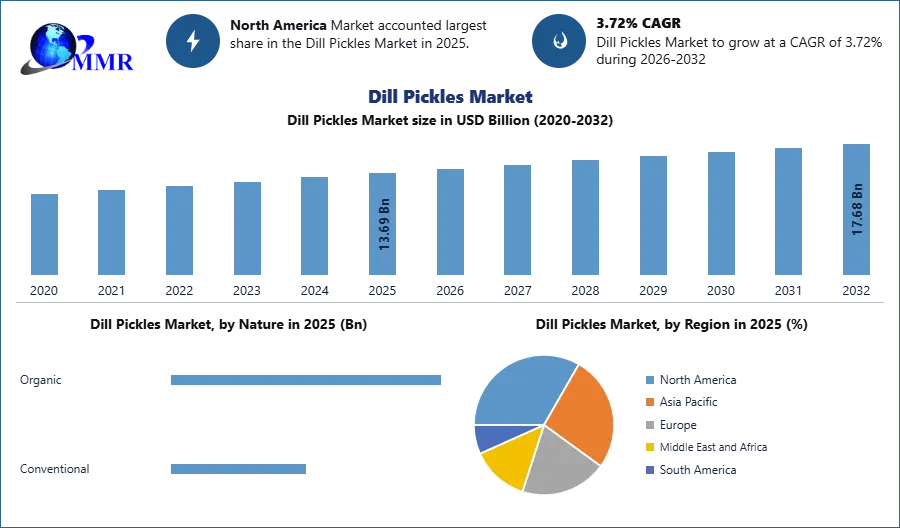
- The Dill Pickles Market was valued at USD 13.69 billion in 2025 and is expected to reach nearly USD 17.68 billion by 2032, growing at 4.6% CAGR. Every percentage point of sustained growth signals expanding opportunities for manufacturers that successfully differentiate beyond price.
- North America remains the largest regional market, supported by strong household consumption and foodservice demand. This reinforces the region’s importance as the industry’s innovation hub.
- Processed dill pickles dominate by nature, while Kosher pickles lead by product type with a 37% market share in 2025. Market leadership continues to favor products balancing familiarity with premium positioning.
- Rising demand for probiotic foods, low-sodium formulations, organic offerings, and convenient packaging is reshaping product development priorities.
- Online retail expansion is widening consumer access while intensifying competition between established brands and emerging premium producers.
Why This Matters Now
The pickle aisle has become a competitive battleground rather than a mature grocery category. Consumer expectations are shifting faster than traditional product cycles, forcing brands to innovate on health, convenience, and premium value simultaneously.
For executives, the market is no longer driven solely by volume. Every investment in cleaner ingredients, differentiated flavors, or digital distribution increasingly determines long-term shelf space, pricing power, and retailer partnerships.
Market Overview
The Dill Pickles Market Size reached USD 13.69 billion in 2025 and is projected to approach USD 17.68 billion by 2032. That expansion signals continued resilience despite a mature food category, supported by evolving consumer eating habits and broader retail availability.
Demand extends well beyond traditional household consumption. Dill pickles have become essential ingredients across burgers, sandwiches, quick-service restaurants, and ready-to-eat meal formats. Efficient preservation technologies and stable cucumber availability continue supporting year-round supply despite seasonal agricultural challenges.
Instead of competing only on price, manufacturers increasingly compete through product positioning. Premium flavors, organic variants, functional health claims, and packaging innovation have become strategic differentiators.
Key Trends Driving Growth
Health and wellness are reshaping purchasing decisions across packaged foods. Consumers increasingly associate fermented products with digestive wellness, encouraging demand for probiotic-rich dill pickles while also increasing interest in naturally fermented products. This expands the category beyond traditional condiment consumption.
Clean-label demand continues influencing product reformulation. Manufacturers are introducing organic recipes, fewer artificial preservatives, and reduced-sodium alternatives to appeal to health-conscious shoppers while meeting evolving regulatory expectations.
Convenience remains another powerful demand driver. Ready-to-eat snacks, portable packaging, and single-serve formats align with busy consumer lifestyles, while supermarkets, convenience stores, and expanding online retail channels improve accessibility across multiple purchasing occasions. Increased e-commerce penetration also enables premium and niche brands to reach consumers without relying exclusively on traditional retail distribution.
Sustainability is becoming more visible within competitive strategies. Smaller producers increasingly emphasize environmentally conscious packaging, small-batch production, and transparent sourcing as differentiators in an increasingly crowded marketplace.
Emerging opportunities are equally significant. Asia-Pacific and Latin America are gaining attention as Western food consumption expands, allowing international brands to diversify geographic revenue while introducing premium and specialty pickle varieties.
Get Your Free Sample Report and Explore the Latest Market Trends
Segment Insights
- Dominant Segment (Nature): Processed dill pickles dominated the market in 2025 due to broad consumer acceptance, efficient production methods, and strong retail presence.
- Dominant Segment (Product Type): Kosher pickles held 37% market share in 2025, supported by traditional recipes and broad consumer appeal.
- Fastest-Growing Segment: The report identifies the Polish pickle segment as projected to grow steadily during the forecast period.
- Retail consumers remain the largest end-user group, followed by restaurants and quick-service establishments, highlighting balanced demand across household and commercial channels.
Regional Growth Story
North America continues leading the global market through strong household demand and extensive foodservice consumption. The United States benefits from significant cucumber production and an established pickle manufacturing ecosystem, creating scale advantages across production and distribution.
Europe remains another major consumption center, supported by longstanding culinary traditions and growing consumer interest in nutritious fermented foods. Higher awareness of healthy eating continues supporting regional demand for premium pickle varieties.
Meanwhile, emerging economies represent the industry’s next expansion frontier. Growing exposure to Western cuisine creates opportunities for global brands seeking new consumers beyond mature markets.
Competitive Landscape
Competition is becoming increasingly innovation-driven rather than volume-driven. Established companies including Mt. Olive Pickle Company, Kraft Heinz, Conagra Brands’ Vlasic, Gedney Foods, Kühne GmbH, and Orkla ASA are investing in organic products, healthier formulations, and packaging improvements to defend shelf leadership.
Premium brands such as Grillo’s Pickles, McClure’s, and Bubbies are reshaping competitive dynamics through naturally fermented products and clean-label positioning. Their success signals that consumers increasingly reward authenticity and perceived product quality instead of simply choosing legacy brands.
Private-label expansion is intensifying price competition, forcing national brands to differentiate through innovation rather than promotional pricing alone. Over the next 12–24 months, competitive advantage is likely to favor companies that combine premium positioning, health-oriented product development, and omnichannel retail execution rather than relying exclusively on manufacturing scale.
Recent Developments
- Patriot Pickle expanded production capacity in Texas, strengthening regional supply resilience for foodservice and private-label customers.
- Kraft Heinz reorganized its condiments division to accelerate clean-label and low-sodium product innovation, signaling faster health-focused product launches.
- Vlasic introduced single-serve “Snack-to-Go” dill pickle pouches, targeting convenience retail and portable snacking occasions.
- Mt. Olive implemented AI-driven automated brining technology to improve consistency and manufacturing efficiency.
- Grillo’s Pickles secured nationwide retail distribution for refrigerated organic products, increasing competitive pressure on conventional shelf-stable brands.
Strategic Implications
Manufacturers can no longer rely solely on traditional jarred products. Growth increasingly depends on health-focused innovation, premium branding, flavor experimentation, and digital retail capabilities.
Retailers should expect expanding shelf competition as premium refrigerated products, clean-label offerings, and private-label alternatives continue capturing consumer attention. Supply chain resilience, consistent product quality, and faster innovation cycles are becoming as important as pricing.
Future Outlook
The next phase of the Dill Pickles Market will be shaped less by preserving cucumbers and more by preserving consumer relevance. Companies investing in clean-label innovation, premium product development, digital commerce, and operational efficiency will strengthen market leadership, while brands that depend only on legacy portfolios risk losing visibility, pricing power, and long-term consumer loyalty.
Analyst Perspective
“The global Dill Pickles Market is entering a phase where product innovation, health-focused formulations, and omnichannel distribution will increasingly determine competitive advantage. Companies that successfully combine premium positioning with operational efficiency are expected to capture the strongest long-term growth opportunities.” — Siddhi Dole
About Maximize Market Research
Maximize Market Research Pvt. Ltd. (MMR) is a global market research and consulting company that provides reliable, data-focused, and practical business insights. The firm serves a wide range of industries, including healthcare, pharmaceuticals, technology, automotive, electronics, chemicals, personal care, and consumer goods. Through market forecasts, competitive analysis, strategic consulting, and industry impact assessments, MMR helps organizations understand changing market conditions, identify growth opportunities, and make informed business decisions for long-term success.
Contact Us
2nd Floor, Navale IT Park Phase 3
Pune Banglore Highway, Narhe
Pune, Maharashtra 411041, India
+91 9607365656
sales@maximizemarketresearch.com
