Key Highlights
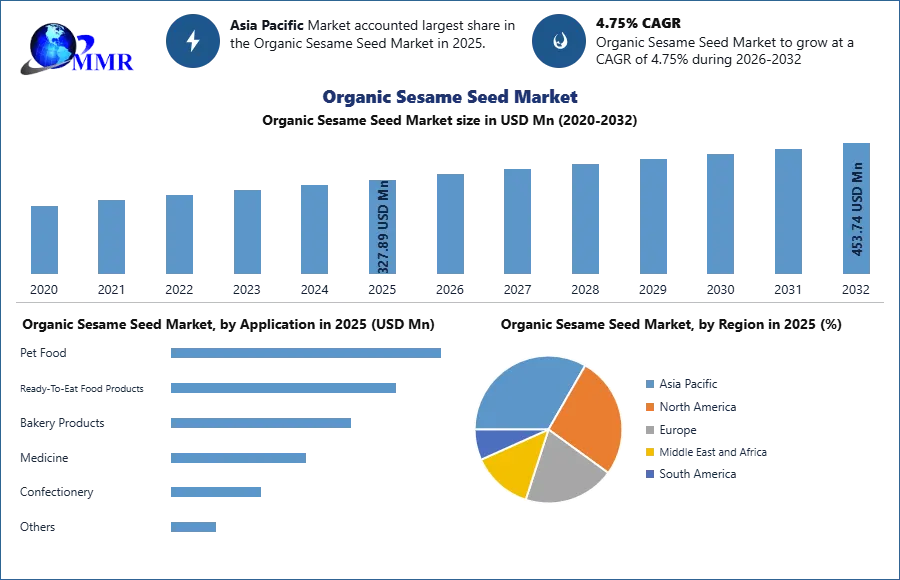
- Market valued at USD 327.89 Million in 2025, projected to reach USD 453.74 Million by 2032
- CAGR of 4.75% (2026–2032) reflects steady, demand-led expansion rather than speculative boom cycles
- Growth anchored in clean-label, plant-based, and organic food consumption trends
- Expanding use in bakery, snacks, oils, nutraceuticals, and cosmetics
- Asia-Pacific remains the dominant production and consumption hub
Why This Matters Now
Food ingredient markets are no longer growing on volume alone—they are being reshaped by trust, traceability, and nutritional positioning. Organic sesame seeds sit directly at this intersection, where consumer preference for transparency is forcing manufacturers to reformulate and reposition core product lines.
At the same time, supply chains for organic inputs are tightening, and premium ingredients are gaining pricing power. This shifts organic sesame seeds from a commodity narrative into a strategic input category for FMCG and health food manufacturers.
Market Overview
The Organic Sesame Seed Market Size is evolving from a niche agricultural trade segment into a structured global ingredient category tied to health-focused consumption.
Valued at USD 327.89 Million in 2025, the market is expected to expand to USD 453.74 Million by 2032, reflecting stable demand growth supported by increasing adoption of organic diets and plant-based nutrition frameworks.
The demand is being shaped by functional nutrition trends. Sesame seeds are increasingly positioned not just as a garnish or oil source, but as a protein-, mineral-, and antioxidant-rich functional ingredient used in multiple processed food categories.
This shift is expanding the market beyond traditional culinary use into packaged food innovation, nutraceutical formulations, and personal care applications.
Key Trends Driving Growth
One of the strongest forces reshaping the market is the shift toward clean-label consumption. Consumers are actively avoiding synthetic additives, pushing food manufacturers to rely more heavily on recognizable, natural ingredients.
Organic sesame seeds benefit directly from this transition because they carry both nutritional and “perceived purity” value. This dual advantage is increasing their penetration in packaged bakery goods, health snacks, and energy foods.
Another major trend is the acceleration of plant-based dietary adoption. As vegan and vegetarian diets expand globally, sesame seeds are being used as a protein-dense ingredient alternative in formulations that require texture, fat content, and micronutrient density.
The rise of functional snacking is also reinforcing demand. Energy bars, granola mixes, and fortified foods are incorporating sesame seeds for both texture and nutritional enrichment.
Finally, supply chain digitization and e-commerce penetration are enabling smaller organic producers to reach global buyers directly, reducing dependency on traditional wholesale networks.
Explore detailed analysis, insights, and growth opportunities
Segment Insights
- Dominant Segment: White Sesame Seeds
White sesame seeds remain widely used due to their mild flavor profile and versatility in bakery, confectionery, and garnish applications. Their neutral sensory profile makes them easier to integrate into mass-market food products. - Fastest-Growing Segment: Black Sesame Seeds
Black sesame seeds are gaining momentum due to their higher antioxidant positioning and premium health perception. They are increasingly used in health-focused foods, premium bakery lines, and nutraceutical applications. - Seed Form Trend: Processed Seeds Lead Demand
Processed forms, including roasted and hulled variants, are preferred due to convenience, consistency, and improved digestibility, especially in industrial food production. - Application Insight: Bakery & Functional Foods Dominate Usage
Bakery and snack applications remain the largest consumption base, while nutraceuticals and functional foods represent the fastest-expanding downstream opportunity.
Regional Growth Story
Asia-Pacific continues to function as both the production engine and consumption base of the Organic Sesame Seed Market. Strong agricultural ecosystems in India, China, and Myanmar support consistent supply, while rising middle-class income supports premium food consumption.
However, the most dynamic demand acceleration is emerging in North America and Europe, where organic food penetration is higher and consumers show stronger willingness to pay premiums for clean-label and certified organic ingredients.
Meanwhile, emerging markets in Latin America, Africa, and the Middle East are transitioning from low awareness to early-stage adoption. These regions represent future volume expansion as income levels rise and food retail modernization deepens.
Competitive Landscape
The market is fragmented, with players such as Dipasa USA Inc., Tradin Organic Agriculture B.V., Delphi Organic GmbH, and Sesaco operating across sourcing, processing, and distribution.
Competition is shifting away from pure supply capability toward traceability, certification strength, and supply chain integration. This is forcing suppliers to invest in organic certification systems, contract farming models, and export-oriented logistics.
What this signals is clear: scale alone is no longer enough. Companies that fail to build verified organic supply chains risk being excluded from premium FMCG procurement channels in North America and Europe.
Over the next 12–24 months, consolidation is likely to accelerate as larger agro-exporters acquire smaller organic-certified producers to secure stable supply pipelines.
Strategic Implications
For FMCG companies, organic sesame seeds are becoming a formulation stabilizer for clean-label product lines, not just an ingredient.
For suppliers, the opportunity lies in moving up the value chain—from raw seed export to processed, branded, and certified ingredient supply.
Retailers and food brands are increasingly prioritizing suppliers who can guarantee:
- Consistent organic certification
- Traceable sourcing
- Stable pricing in volatile agricultural cycles
Future Outlook
The market is expected to maintain steady, demand-driven expansion rather than volatile spikes. Growth will be anchored in health-driven consumption, plant-based diets, and premium ingredient substitution across food categories.
The critical divide in the next phase will be between suppliers who can industrialize organic supply chains and those who remain exposed to fragmented, low-margin commodity trading.
Analyst Perspective
“Organic sesame seeds are transitioning from a traditional agricultural export commodity into a strategic clean-label input for global food manufacturers. The next growth phase will reward players who can prove traceability and scale certified supply chains efficiently.”
— Siddhi Dole, Analyst
About Maximize Market Research
Maximize Market Research Pvt. Ltd. (MMR) is a global market research and consulting company that provides reliable, data-focused, and practical business insights. The firm serves a wide range of industries, including healthcare, pharmaceuticals, technology, automotive, electronics, chemicals, personal care, and consumer goods. Through market forecasts, competitive analysis, strategic consulting, and industry impact assessments, MMR helps organizations understand changing market conditions, identify growth opportunities, and make informed business decisions for long-term success.
Contact Us :
2nd Floor, Navale IT Park Phase 3
Pune Banglore Highway, Narhe
Pune, Maharashtra 411041, India
+91 9607365656
sales@maximizemarketresearch.com
