Key Highlights
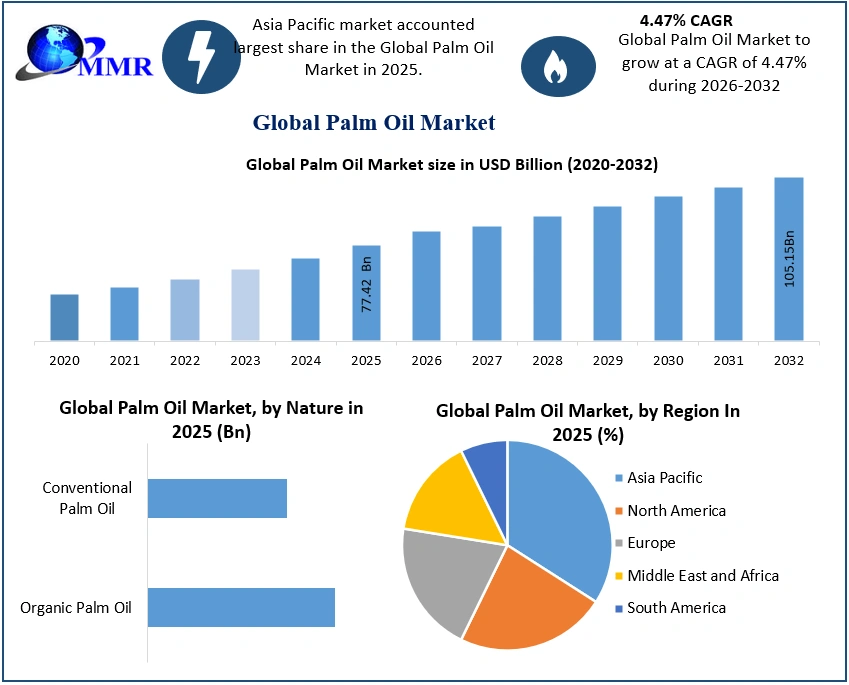
- The Palm Oil Market was valued at USD 77.42 billion in 2025 and is projected to reach USD 105.15 billion by 2032, expanding at a CAGR of 4.47%. This steady growth reflects palm oil’s continued strategic importance across food, consumer goods, and industrial applications.
- Demand from processed foods, bakery products, confectionery, instant foods, and packaged consumer goods continues to strengthen long-term consumption.
- Biodiesel production is creating additional demand beyond traditional food applications, expanding the market’s industrial significance.
- Sustainability certifications and responsible sourcing initiatives are becoming increasingly influential purchasing criteria across global supply chains.
- Manufacturers are investing in supply-chain transparency and operational efficiency as environmental regulations and customer expectations continue to evolve.
Why This Matters Now
Palm oil is no longer competing solely on cost. It is increasingly competing on traceability, sustainability, and supply-chain resilience. Companies unable to adapt face growing commercial and regulatory pressure from global buyers.
The market’s projected growth from USD 77.42 billion in 2025 to USD 105.15 billion by 2032 signals continued reliance on palm oil across multiple industries. For producers and processors, future competitiveness will depend as much on responsible sourcing as production capacity.
Market Overview
The global Palm Oil Market remains one of the largest segments within the edible oils industry. Palm oil continues to serve as a critical ingredient across food manufacturing, bakery products, confectionery, processed foods, cosmetics, personal care products, and industrial applications due to its versatility, productivity, and cost efficiency.
Demand is also benefiting from population growth, urbanization, and expanding consumption of packaged foods. As consumers increasingly purchase processed and convenience foods, manufacturers continue relying on palm oil as a key ingredient for texture, shelf stability, and production efficiency.
Key Trends Driving Growth
Food processing remains the market’s primary demand engine. Rising consumption of packaged foods, baked goods, snacks, confectionery, and ready-to-eat products continues supporting stable long-term demand for palm oil across FMCG manufacturing.
Industrial applications are expanding beyond food. Biodiesel production is creating an additional source of consumption, strengthening demand diversification and reducing dependence on a single end-use sector.
Sustainability has become one of the industry’s defining competitive themes. Manufacturers, retailers, and consumer goods companies increasingly prioritize certified and responsibly sourced palm oil to meet environmental commitments and respond to growing consumer scrutiny regarding deforestation and biodiversity.
Consumer purchasing behavior is also evolving. Increasing awareness of sustainable production practices is encouraging companies to improve traceability throughout their supply chains while strengthening supplier partnerships and certification programs.
Although digital commerce is transforming FMCG distribution more broadly, the report does not specifically identify e-commerce penetration as a major market driver for palm oil. Following the source rule, no additional assumptions are made.
𝐃𝐨𝐰𝐧𝐥𝐨𝐚𝐝 𝐏𝐃𝐅 𝐁𝐫𝐨𝐜𝐡𝐮𝐫𝐞 @https://www.maximizemarketresearch.com/request-sample/112900/
Segment Insights
- Dominant Segment: Crude Palm Oil (CPO) is identified as the dominant product segment due to its broad utilization across food processing and downstream industrial applications.
- Fastest-Growing Segment: The report does not explicitly identify the fastest-growing segment. Following the source rule, no estimate is provided.
- Food applications continue representing the largest end-use category, supported by widespread use across bakery, confectionery, processed foods, and cooking oils.
- Biodiesel and industrial applications continue expanding palm oil’s role beyond traditional edible oil markets.
Regional Growth Story
Asia-Pacific remains the center of the global Palm Oil Market. Indonesia and Malaysia continue serving as the world’s leading producers while regional demand benefits from growing food manufacturing, population growth, and expanding domestic consumption.
Emerging Asian economies continue increasing palm oil imports to support expanding food industries and changing dietary habits. Growing urbanization and rising disposable incomes further strengthen regional demand for processed and packaged food products.
Europe and North America continue emphasizing sustainability and certified sourcing. Buyers increasingly require traceable supply chains and environmental compliance, encouraging producers to strengthen certification programs and responsible production practices.
Competitive Landscape
Competition is shifting from production volume toward supply-chain credibility. Leading companies are investing in sustainable sourcing initiatives, production efficiency, and downstream value-added processing while strengthening relationships with global FMCG manufacturers.
This competitive activity signals a market where operational transparency increasingly influences purchasing decisions. Companies capable of demonstrating responsible sourcing and consistent quality are likely to secure stronger long-term customer relationships despite increasing regulatory scrutiny.
For competitors, the implications are significant. Over the next 12–24 months, sustainability certifications, digital traceability systems, and supply-chain resilience are expected to become increasingly important competitive differentiators as multinational food companies tighten supplier requirements.
The report discusses competitive developments but does not disclose specific mergers, acquisitions, partnerships, or divestitures. Accordingly, no transaction-specific interpretation is included.
Recent Developments
- Producers continue expanding sustainability and certified sourcing initiatives to strengthen market access.
- Investments in supply-chain traceability and responsible production practices remain strategic priorities.
- Biodiesel demand continues supporting diversification of palm oil applications beyond food manufacturing.
- Manufacturers continue improving operational efficiency to respond to changing environmental regulations and customer procurement requirements.
Strategic Implications
The Palm Oil Market is becoming increasingly defined by sustainability performance rather than production scale alone. Companies that successfully combine operational efficiency with responsible sourcing are likely to secure stronger commercial partnerships across global food and consumer goods industries.
Food manufacturers are also becoming more selective in supplier relationships. Reliable traceability, certification compliance, and consistent product quality increasingly influence procurement decisions alongside pricing considerations.
Future Outlook
The Palm Oil Market is entering a period where food demand, industrial diversification, and sustainability objectives increasingly reinforce one another. Population growth and expanding processed food consumption will continue supporting long-term demand while environmental expectations reshape competitive priorities.
As the market approaches USD 105.15 billion by 2032, companies investing in certified sourcing, resilient supply chains, and downstream value creation will strengthen their competitive positions. The winners will transform sustainability into commercial advantage, while slower competitors risk losing market access as global procurement standards continue to tighten.
Analyst Perspective
“The Palm Oil Market is evolving beyond production growth toward responsible value creation. Organizations that combine operational excellence with sustainable sourcing, supply-chain transparency, and customer-focused innovation will be best positioned to capture long-term market opportunities.”
— Siddhi Dole, Analyst
About Maximize Market Research
Maximize Market Research Pvt. Ltd. (MMR) is a global market research and consulting company that provides reliable, data-focused, and practical business insights. The firm serves a wide range of industries, including healthcare, pharmaceuticals, technology, automotive, electronics, chemicals, personal care, and consumer goods. Through market forecasts, competitive analysis, strategic consulting, and industry impact assessments, MMR helps organizations understand changing market conditions, identify growth opportunities, and make informed business decisions for long-term success.
2nd Floor, Navale IT Park Phase 3
Pune Banglore Highway, Narhe
Pune, Maharashtra 411041, India
+91 9607365656
sales@maximizemarketresearch.com
