Key Highlights
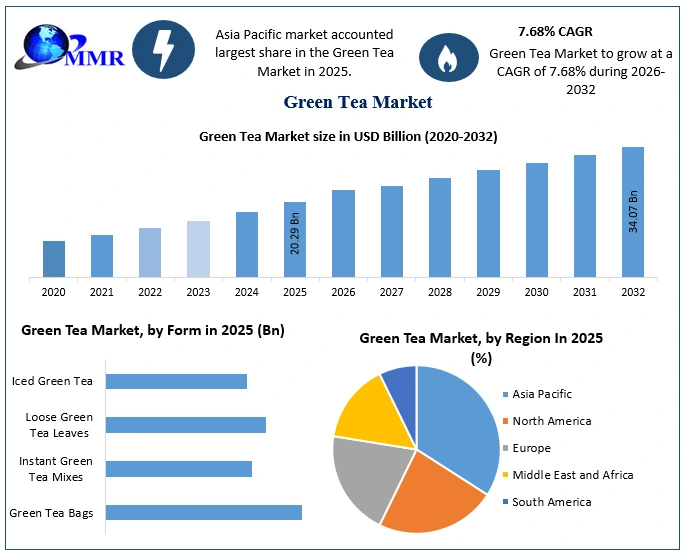
Global Green Tea Market valued at USD 20.29 billion in 2025 and projected to reach USD 34.07 billion by 2032, growing at a 7.68% CAGR. That growth signals sustained premium beverage expansion rather than short-term demand spikes.
Health-conscious consumption is becoming the industry’s primary demand engine, creating opportunities for functional beverage portfolios.
Product innovation increasingly revolves around vitamins, botanicals, flavor extensions and convenience formats.
Asia Pacific continues to lead global consumption, supported by mature tea cultures and rising wellness adoption.
Sustainability, digital commerce and premium positioning are emerging as major competitive differentiators.
Why This Matters Now
The green tea category is no longer competing only within tea. It is competing against every beverage positioned around health, convenience and functional nutrition.
A projected rise from USD 20.29 billion in 2025 to USD 34.07 billion by 2032 means manufacturers are entering a larger but more competitive market. Growth alone will not determine winners. Innovation speed, distribution reach and brand credibility increasingly will.
Green tea has moved beyond its traditional role as a hot beverage. It now occupies a central position within the broader functional beverage economy.
Consumers increasingly associate green tea with antioxidants, weight management and overall wellness. That perception is expanding demand across flavored products, ready-to-drink formats and premium offerings. The result is a market that is growing through product diversification rather than simple volume expansion.
Distribution is evolving alongside consumption. Supermarkets continue to dominate retail sales while online platforms broaden access to premium, specialty and international brands. That combination allows producers to serve both mass-market shoppers and higher-value wellness consumers simultaneously.
Market Overview
Green tea market has moved beyond its traditional role as a hot beverage. It now occupies a central position within the broader functional beverage economy.
Consumers increasingly associate green tea with antioxidants, weight management and overall wellness. That perception is expanding demand across flavored products, ready-to-drink formats and premium offerings. The result is a market that is growing through product diversification rather than simple volume expansion.
Distribution is evolving alongside consumption. Supermarkets continue to dominate retail sales while online platforms broaden access to premium, specialty and international brands. That combination allows producers to serve both mass-market shoppers and higher-value wellness consumers simultaneously.
Key Trends Driving Growth
Health has become the industry’s strongest pricing advantage. Consumers increasingly seek beverages that combine taste with measurable wellness benefits, encouraging manufacturers to add ingredients such as vitamin C, botanicals and functional herbs. This creates higher-value product categories instead of competing solely on price.
Flavor innovation is expanding category reach. Lemon, ginger and herbal combinations help attract consumers who previously viewed traditional green tea as too bitter. Flavor development therefore becomes both an acquisition strategy and a premiumization strategy.
Clean-label expectations continue to influence purchasing decisions. Organic ingredients, transparent formulations and minimally processed products increasingly support premium positioning while broadening appeal among wellness-focused consumers.
Sustainability is moving from corporate messaging to product differentiation. Recycled packaging, ethical sourcing and environmentally responsible production increasingly influence brand selection, particularly among younger consumers.
Digital retail is reducing barriers to global expansion. Online marketplaces provide manufacturers with broader geographic reach while giving consumers easier access to specialized products that were previously difficult to find through conventional retail channels.
Request a Free Sample Copy or View Report Summary: https://www.maximizemarketresearch.com/request-sample/221435/
Segment Insights
Dominant Segment: Lemon-flavored green tea leads the flavored category, supported by strong consumer demand for enhanced taste experiences and continuous flavor innovation.
Fastest-Growing Segment: The report does not explicitly identify the fastest-growing segment.
Dominant Distribution Channel: Supermarkets and hypermarkets remain the leading sales channel because of extensive product assortments, high consumer traffic and strong promotional capabilities.
Online retail continues to expand market accessibility and supports growth for specialty and premium green tea brands.
Regional Growth Story
Asia Pacific continues to define the industry’s center of gravity. China, Japan and India combine deep-rooted tea traditions with growing health awareness, allowing both premium and mainstream green tea categories to expand simultaneously. That regional strength also reinforces Asia Pacific’s influence over global supply and product innovation.
North America is increasingly driven by functional beverage demand. Consumers are embracing flavored and wellness-oriented products, encouraging manufacturers to expand premium portfolios and retail distribution.
Europe continues to benefit from growing interest in healthier beverage choices. Premium positioning, quality messaging and health-focused marketing remain important competitive levers across major markets including the UK, Germany and France.
Competitive Landscape
Competition is shifting from shelf presence toward ecosystem development. Product launches increasingly combine nutrition, flavor, sustainability and convenience rather than focusing on single product improvements.
Marketing partnerships, sustainable packaging investments and wellness-oriented formulations indicate that leading companies are competing for long-term consumer loyalty instead of short-term promotional gains. Rivals that fail to invest across these dimensions risk losing relevance as consumers increasingly evaluate brands on health credentials and environmental performance.
Recent partnerships also suggest that future competition will increasingly involve lifestyle branding. Collaborations with athletes, wellness influencers and strategic supply partners point toward stronger brand ecosystems over the next 12–24 months rather than traditional advertising campaigns.
Recent Developments
Coca-Cola Japan commercialized Ayataka Koi Hojicha, incorporating GABA to target stress reduction and cognitive wellness.
Marubeni Foods established a strategic partnership with a Vietnamese tea manufacturer to strengthen premium green tea supply.
Bigelow Tea expanded marketing through a collegiate NIL partnership with CampusOne and UConn athletes to reach younger wellness consumers.
Anverally & Sons introduced its 2-in-1 Instant Green Tea range at Gulfood 2026, expanding its convenience-focused portfolio.
Ito En launched its 2025 “Oi Ocha” sustainability campaign supporting the “Green Tea for Good” initiative.
Strategic Implications
Future growth will depend less on expanding tea consumption and more on increasing product value. Functional ingredients, premium flavors, sustainable packaging and digital engagement offer stronger pricing power than commodity positioning.
Companies capable of combining scientific wellness claims with brand authenticity are likely to capture higher-margin consumer segments. Those relying primarily on traditional retail expansion may find differentiation increasingly difficult.
Future Outlook
The Green Tea Market is evolving into a premium wellness category where innovation, sustainability and digital accessibility reinforce one another.
As consumer expectations continue shifting toward functional nutrition and clean-label products, competitive advantage will increasingly belong to companies capable of integrating product science, responsible sourcing and omnichannel distribution. Over the coming years, winners will build wellness ecosystems around their brands, while laggards will compete largely on price.
Analyst Perspective
“The Green Tea Market is entering a phase where health-driven innovation, premium positioning and sustainable business practices are becoming the primary engines of competitive growth. Companies that successfully combine functional benefits with consumer trust will be best positioned to capture long-term market expansion.” — Siddhi Dole, Analyst
About Maximize Market Research
Maximize Market Research Pvt. Ltd. (MMR) is a global market research and consulting company that provides reliable, data-focused, and practical business insights. The firm serves a wide range of industries, including healthcare, pharmaceuticals, technology, automotive, electronics, chemicals, personal care, and consumer goods. Through market forecasts, competitive analysis, strategic consulting, and industry impact assessments, MMR helps organizations understand changing market conditions, identify growth opportunities, and make informed business decisions for long-term success.
2nd Floor, Navale IT Park Phase 3
Pune Banglore Highway, Narhe
Pune, Maharashtra 411041, India
+91 9607365656
sales@maximizemarketresearch.com
