Key Highlights
Rising consumer demand for protein-rich diets is strengthening long-term seafood consumption.
Sustainability, traceability, and eco-labeling are becoming purchasing requirements rather than marketing differentiators.
Frozen seafood remains the largest form segment, supported by improved cold-chain infrastructure and export capabilities.
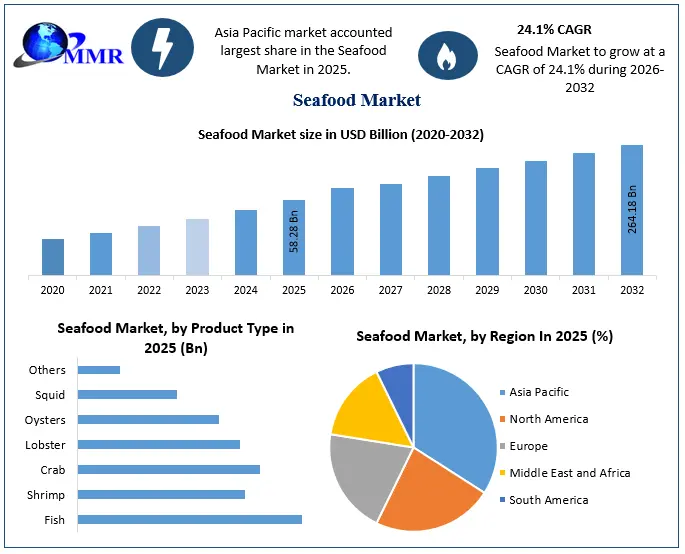
Fish continues to dominate product demand with more than half of market share.
Online retail is the fastest-growing distribution channel as digital grocery adoption expands.
Strategic acquisitions are accelerating consolidation across aquaculture and seafood processing.
Premium, value-added, and ready-to-eat seafood products are creating new revenue opportunities.
Why This Matters Now
Seafood has moved beyond being another protein category. It is becoming a strategic component of global food security, premium nutrition, and sustainable food production. Companies that fail to modernize sourcing and distribution risk losing shelf space as retailers increasingly prioritize verified sustainability and transparent supply chains.
Consumer expectations are changing faster than production models. Businesses that invest now in aquaculture, digital retail, and traceability can strengthen pricing power while improving supply resilience.
Market Overview
The Seafood Market is benefiting from several structural shifts occurring simultaneously. Consumers are seeking healthier sources of protein, retailers are expanding premium seafood assortments, and governments and producers continue investing in aquaculture and modern cold-chain infrastructure.
Every improvement in preservation, transportation, and traceability expands seafood accessibility beyond traditional coastal markets. That creates commercial opportunities across both mature and emerging economies while reducing logistical barriers that historically constrained category growth.
Key Trends Driving Growth
Health and wellness continue to influence purchasing decisions. Seafood’s nutritional profile is encouraging greater adoption among consumers seeking protein-rich diets, translating into stronger demand across retail and foodservice channels. The business implication is sustained category resilience even as consumer spending priorities evolve.
Demand for clean-label products is increasing attention on sourcing transparency. Eco-certification, traceability systems, and sustainable harvesting practices are becoming competitive necessities rather than optional brand features. Businesses capable of proving responsible sourcing gain stronger retailer relationships and higher consumer trust.
Technology is reshaping market accessibility. Advanced freezing technologies, improved cold-chain logistics, and digital commerce are expanding seafood availability into inland and urban markets. Every improvement in logistics broadens addressable demand while reducing spoilage risk throughout the supply chain.
Consumer convenience is also driving product innovation. Ready-to-eat, marinated, and precooked seafood products continue to gain attention as busy households seek premium meal solutions with minimal preparation time.
Segment Insights
Dominant Segment: Fish leads the product category with more than 50% market share, supported by broad consumer acceptance, diverse species availability, expanding aquaculture production, and strong nutritional positioning. This dominance provides producers with consistent volume opportunities across retail and foodservice markets.
Dominant Form Segment: Frozen seafood accounts for over 35% of the market, benefiting from longer shelf life, export efficiency, and improvements in freezing technology and cold-chain infrastructure. Its leadership reflects the industry’s increasing focus on scalable global distribution.
Fastest-Growing Distribution Segment: Online retail is the fastest-growing distribution channel as consumers increasingly value home delivery, broader product selection, and origin transparency. Digital platforms are becoming an increasingly important competitive battleground for seafood brands.
Regional Growth Story
Asia-Pacific remains central to global seafood production through extensive aquaculture expansion and strong consumer demand. Europe also benefits from established seafood consumption and sustainability initiatives, while North America continues strengthening premium seafood offerings through retail innovation.
Improving logistics infrastructure is allowing inland markets to participate more actively in seafood consumption. As cold-chain capabilities expand, geographic limitations become less significant, opening additional commercial opportunities for producers and distributors.
Competitive Landscape
Competitive activity increasingly revolves around consolidation, portfolio expansion, and supply-chain control rather than simple capacity growth.
High Liner Foods’ acquisition of Mrs. Paul’s and Van de Kamp’s strengthens branded retail presence while improving vertical integration. The broader signal is clear: companies are pursuing stronger brand ownership alongside production capabilities to capture greater value across the supply chain.
SalMar’s acquisition of the remaining ownership in Oylaks demonstrates continued consolidation within salmon farming. Full operational control enables greater production efficiency and reinforces the industry’s preference for larger, integrated aquaculture businesses. Smaller independent operators may face increasing competitive pressure over the next 12–24 months.
Yumbah Aquaculture’s acquisition of Clean Seas Seafood indicates growing investment in diversified premium aquaculture assets. The strategy suggests future competition will increasingly focus on traceable, export-ready marine proteins rather than commodity volume alone.
Silver Bay Seafoods’ partnership to acquire OBI Seafoods reflects another strategic priority: securing processing capacity closer to raw material sources. Rivals without integrated processing networks may experience cost disadvantages as operational efficiency becomes a stronger competitive differentiator.
Recent Developments
SalMar agreed to acquire the remaining stake in Oylaks to consolidate salmon production leadership.
High Liner Foods completed the acquisition of Mrs. Paul’s and Van de Kamp’s frozen seafood brands from Conagra Brands.
Yumbah Aquaculture amended its agreement to acquire Clean Seas Seafood.
Silver Bay Seafoods formed a joint venture with Bristol Bay Economic Development Corporation to acquire a controlling interest in OBI Seafoods.
Strategic Implications
The industry’s competitive advantage is shifting from harvesting capacity toward integrated value creation. Companies combining sustainable production, traceable sourcing, premium branding, digital commerce, and efficient cold-chain logistics will be positioned to capture stronger margins.
Investment priorities are also changing. Capital is increasingly flowing toward aquaculture expansion, processing efficiency, retail brand ownership, and digital fulfillment capabilities rather than traditional production scale alone.
Future Outlook
The Seafood Market is likely to become increasingly defined by transparency, sustainability, and operational integration. Consumer demand for healthy protein, premium products, and verified sourcing will continue shaping investment decisions throughout the value chain.
Companies that combine responsible aquaculture, advanced logistics, and digital customer engagement will strengthen competitive positioning, while businesses that delay modernization risk losing both retailer confidence and consumer loyalty.
Analyst Perspective
“The Seafood Market is entering a period where competitive success will depend less on production volume and more on supply-chain intelligence, sustainability, and consumer trust. Businesses investing in traceability, premium product development, and digital distribution today will be better positioned to capture long-term value as global demand evolves.” — Siddhi Dole, Analyst
About Maximize Market Research
Maximize Market Research Pvt. Ltd. (MMR) is a global market research and consulting company that provides reliable, data-focused, and practical business insights. The firm serves a wide range of industries, including healthcare, pharmaceuticals, technology, automotive, electronics, chemicals, personal care, and consumer goods. Through market forecasts, competitive analysis, strategic consulting, and industry impact assessments, MMR helps organizations understand changing market conditions, identify growth opportunities, and make informed business decisions for long-term success.
2nd Floor, Navale IT Park Phase 3
Pune Banglore Highway, Narhe
Pune, Maharashtra 411041, India
+91 9607365656
sales@maximizemarketresearch.com
