Key Highlights
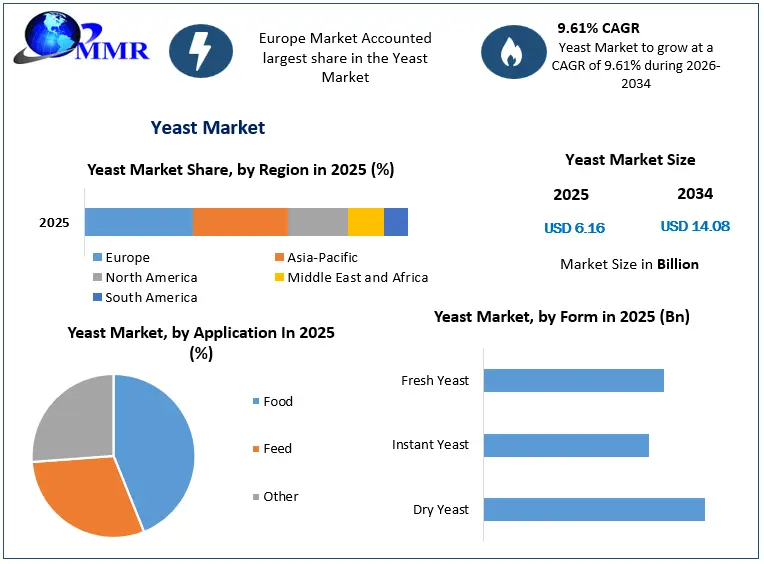
Market Scaling: The global yeast market achieved a valuation of USD 5.13 billion in 2023 and is projected to expand to USD 9.75 billion by 2030.
Compounded Momentum: The sector is advancing at a strong Compounded Annual Growth Rate (CAGR) of 9.61% during the 2024–2030 forecast window.
Segment Dominance: Baker’s yeast remains the single largest commercial type segment, anchored by structural volume requirements in global bread and pastry manufacturing.
Application Engine: The food industry commands the largest market application share, driven directly by intense global consumption of packaged and convenience foods.
Regional Leadership: Europe maintains the largest localized market share, supported by a highly developed corporate bakery infrastructure and mature processed food sectors.
Why This Matters Now
Volatility in carbohydrate consumption and the rapid premiumization of the industrial baking sector are forcing global food conglomerates to re-evaluate their core fermentation supply chains. Commercial manufacturers that treat yeast as a simple bulk commodity face immediate margin compression as consumer demand shifts toward clean-label formulation, rapid gas production, and specialized nutritional profiles. For Chief Procurement Officers and functional ingredient buyers, securing stable, high-performance yeast strains is now a critical prerequisite for protecting retail margin structures and meeting stringent clean-label mandates.
Market Overview
The Yeast Market corporate mechanics of the global yeast market rely on the biochemical efficiency of this unicellular fungus to convert sugars into metabolic energy, biomass, and carbon dioxide. This natural gas-production capability forms the foundation of commercial leavening and ethanolic fermentation across massive global industries. Structurally, the industrial market spans multiple functional categories—including baker’s yeast, brewer’s yeast, probiotic yeast, and wine yeast—to serve diverse sectors like commercial baking, alcoholic beverage production, bioethanol manufacturing, and specialized animal feed.
Global processing volumes are scaling rapidly as lifestyle changes and urbanization patterns alter baseline calorie consumption across developing economies. While mature Western markets maintain steady baseline procurement for traditional bread and beer portfolios, manufacturers across Asian countries are aggressively increasing regional fermentation capacities to meet expanding domestic consumer demand. This structural realignment has transformed yeast from an industrial baking component into a critical high-value ingredient across the entire fast-moving consumer goods (FMCG) matrix.
Key Trends Driving Growth
The steady expansion of the packaged food and commercial confectionery sector acts as the primary volume driver for industrial yeast suppliers. Rising disposable incomes and shifting urban lifestyles have made packaged breads, cookies, biscuits, and snack cakes staple dietary components worldwide. Because industrial-scale bakeries require absolute consistency in proofing times and crumb structure, corporate buyers are consolidating contracts around premium suppliers who can guarantee high-viability strains that survive automated production lines.
Simultaneously, the global beverage industry is expanding its deployment of specialized fermentation agents to capitalize on changing social consumption habits. The rising popularity of premium beer, wine, craft spirits, and regional alcoholic beverages during social events has created high-margin revenue streams for wine and brewer’s yeast varieties. Ingredient processors are responding by engineering strain-specific solutions that optimize alcohol yield, manage temperature tolerances, and introduce distinct flavor profiles required by modern craft breweries and industrial distilleries.
The emerging integration of yeast into the functional probiotic and gut-health ecosystem represents a major high-margin growth trend. Modern consumers increasingly understand the connection between active micro-nutrients and immune performance, creating an immediate demand for fermented food matrixes and dietary supplements containing live cultures. This healthcare transition has forced yeast producers to scale their production of specialized probiotic yeast strains, which provide documented antibacterial and immune-boosting support inside human and animal digestive systems.
𝐃𝐨𝐰𝐧𝐥𝐨𝐚𝐝 𝐏𝐃𝐅 𝐁𝐫𝐨𝐜𝐡𝐮𝐫𝐞 @ https://www.maximizemarketresearch.com/request-sample/617/
Segment Insights
Baker’s Yeast [Dominant Segment]: Functioning as the primary volume engine of the global market, this segment leads industry market share due to non-negotiable structural requirements across industrial bread baking, retail confectionery, and at-home baking applications.
Probiotic & Wine Yeast [Fastest-Growing Segment]: Catalyzed by the global consumer shift toward gut-health optimization and premium craft beverage consumption, these high-purity, specialized categories are expanding rapidly to capture margin-rich retail and clinical sectors.
Food Industry [Dominant Application]: This category holds the majority of global market volume, driven by the expanding consumption of packaged convenience foods, baseline bakery items, and naturally extracted, clean-label ingredients.
Feed & Technical Applications: Emerging as an important operational sector, this segment leverages yeast biomass to fortify animal nutrition lines, improving livestock feed efficiency and immune resistance without relying on synthetic antibiotics.
Regional Growth Story
Europe commands the dominant market position within the global yeast industry, sustained by a highly sophisticated processed food infrastructure and a deeply rooted industrial baking culture. European consumers exhibit high per-capita spending on packaged convenience items and artisanal bakery goods, requiring regional processors to maintain immense, uninterrupted production capacity. Furthermore, strict regional regulations favoring natural, clean-label ingredients over chemical additives insulate the European market from cheaper synthetic alternatives.
Concurrently, the Asia-Pacific region is experiencing the most dynamic capacity expansions, led by rapid investments across China and emerging Southeast Asian manufacturing hubs. Growing populations, rising household purchasing power, and the westernization of daily diets are fueling a major surge in commercial bakery and beer consumption across Asian metropolitan centers. To capture these emerging volume streams, global ingredient giants are actively partnering with local enterprises to build localized, high-capacity fermentation facilities.
Competitive Landscape
The global competitive arena is defined by concentrated consolidation, with a handful of established multi-national corporations controlling the majority of high-purity processing assets. Tier-one operators—including Associated British Foods plc (UK), AngelYeast Co., Ltd. (China), Lesaffre (France), and Lallemand Inc. (Canada)—are actively weaponizing their massive research and development budgets to outpace smaller competitors. This consolidation strategy allows dominant firms to secure exclusive long-term procurement contracts with multinational food brands by offering superior strain stability and global supply security.
For regional manufacturers and smaller market entrants, survival in the next 12 to 24 months dictates a definitive move away from low-margin, generic commodity yeast. Competitors unable to match the massive capital expenditure required for automated, high-volume bioreactor setups are forced to focus on hyper-specialized niches, such as certified organic strains or chemical-free clean-label agents. Companies failing to execute this portfolio specialization will face intense margin erosion as global leaders leverage their economies of scale to dominate bulk retail and commercial channels.
Recent Developments
Corporate R&D Expansion: Major global players like AngelYeast and Lesaffre have significantly increased their capital allocations toward specialized biotechnology facilities, focusing on developing non-GMO yeast strains optimized for automated baking lines and bioethanol extraction.
Supply Chain Localization: Tier-one manufacturers are shifting from centralized production models to localized regional manufacturing hubs across Asia and Africa, reducing cross-border shipping friction and insulating corporate logistics from geopolitical disruptions.
Probiotic Product Rollouts: Leading ingredient formulators have introduced new lines of heat-stable dry probiotic yeast specifically engineered to survive the extreme thermal processing conditions found in commercial pet food and animal feed extrusion.
Clean-Label Partnerships: Global yeast suppliers are forming direct technical alliances with industrial baking conglomerates to replace chemical dough conditioners with enzymatic yeast solutions that satisfy modern retail clean-label mandates.
Strategic Implications
The operational shifts observed in recent quarters clarify that capacity alone is no longer an absolute economic moat; strain optimization is the true determinant of market retention. The decision by industry leaders to pour capital into non-GMO, temperature-resilient strains is a direct response to tightening international food safety standards and retail demands for short, recognizable ingredient lists. By replacing legacy chemical dough conditioners with advanced enzymatic yeast solutions, these conglomerates are locking up multi-year supply contracts with global FMCG brands, effectively locking out commodity processors who cannot provide identical functional performance.
Furthermore, the defensive localization of manufacturing assets across developing regions reveals an industry-wide effort to mitigate macro-logistical risks. By building fully integrated fermentation facilities directly inside high-demand zones like Asia, global suppliers eliminate the extreme freight costs and port delays associated with shipping temperature-sensitive living cultures across continents. This regional infrastructure deployment allows dominant firms to comfortably underbid unaligned domestic suppliers while maintaining stable, predictable delivery schedules for critical local food security supply chains.
At the same time, the aggressive entry of premium yeast strains into the animal feed and pet food sectors represents a calculated move to insulate corporate margins from retail bakery price wars. Livestock producers face growing regulatory bans on prophylactic antibiotics, creating an immediate need for natural biological alternatives that stabilize animal gut biomes and maintain growth ratios. By mastering the extrusion stability required for industrial feed manufacturing, top-tier yeast processors are creating high-margin, counter-cyclical business units that balance out seasonal fluctuations in the human food beverage sector.
Future Outlook
The global yeast market will continue to consolidate around highly automated, bio-technologically advanced operators capable of balancing immense bulk volumes with specialized strain differentiation. Over the next 24 months, expects an acceleration in market entry barriers as digital bioreactor tracking, genomic strain profiling, and clean-label compliance become standard client procurement requirements. Ultimate market victory belongs to corporate operators who successfully transition their portfolios from basic leavening commodities into high-value, scientifically validated functional nutrition and bio-industrial platforms.
Analyst Perspective
“The global yeast industry is transitioning out of its legacy identity as a basic baking component and entering an era defined by precision biotechnology and functional health. Global volume expansion is no longer just about meeting bread demand; it is about mastering specialized strain performance—whether that means optimizing fermentation yields for craft beverage lines or guaranteeing cell viability in clinical probiotic supplements. Success in this capital-intensive market requires deep integration across regional supply chains and continuous R&D investment to deliver certified clean-label solutions.”
— Siddhi Dole, Research Analyst, Maximize Market Research
About Maximize Market Research
Maximize Market Research Pvt. Ltd. (MMR) is a global market research and consulting company that provides reliable, data-focused, and practical business insights. The firm serves a wide range of industries, including healthcare, pharmaceuticals, technology, automotive, electronics, chemicals, personal care, and consumer goods. Through market forecasts, competitive analysis, strategic consulting, and industry impact assessments, MMR helps organizations understand changing market conditions, identify growth opportunities, and make informed business decisions for long-term success.
2nd Floor, Navale IT Park Phase 3
Pune Banglore Highway, Narhe
Pune, Maharashtra 411041, India
+91 9607365656
sales@maximizemarketresearch.com
