Key Highlights
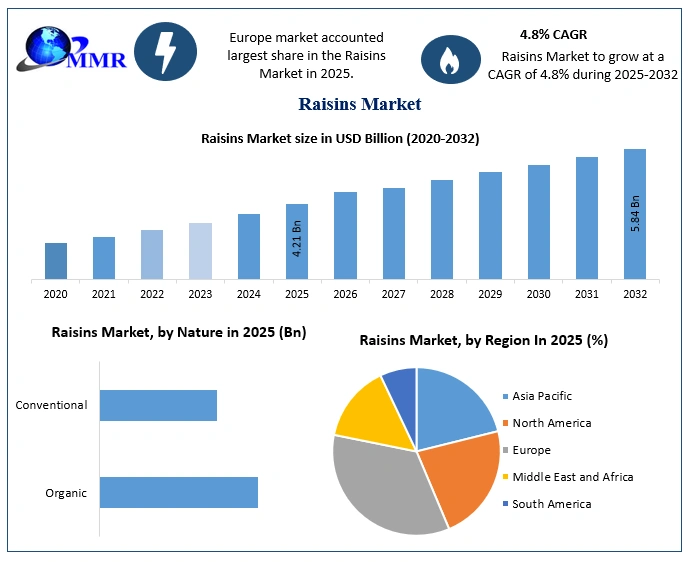
Market Scale: The global raisins market size achieved a valuation of USD 4.21 billion in 2025 and is projected to expand to USD 5.84 billion by 2032.
Growth Pace: The industry is advancing at a steady Compounded Annual Growth Rate (CAGR) of 4.8% during the 2026–2032 assessment timeframe.
Type Segment Dominance: The sultana segment held the highest proportion of the global market in 2024, driven by extensive industrial utilization.
Core Application Engine: The food industry segment commanded the largest market share in 2024, utilizing the ingredient for its dense mineral content, including iron, calcium, potassium, manganese, and zinc.
Regional Leadership: Europe held the highest share of the worldwide market in 2024, accounting for 31.77% of total sales, with Germany leading the country-level market share.
Why This Matters Now
FMCG snack portfolios face immediate volume disruption if they fail to secure highly traceable, tariff-compliant agricultural channels against tightening cross-border import regulations and localized crop bottlenecks. Category procurement teams who treat dried fruit as an elastic, interchangeable commodity risk losing operational processing windows to rivals who lock down early allocations of high-yield sultana varieties. For boardroom executives and manufacturing directors, navigating the direct competition of finely minced fruit substitutes is now a critical strategic requirement to protect long-term confectionery and industrial baking margins.
Market Overview
The corporate mechanics of the Raisins Market size rely on dehydration processes to convert fresh grape harvests into nutrient-dense, shelf-stable ingredients with year-round industrial utility. Containing highly concentrated levels of essential minerals—such as iron, calcium, potassium, manganese, and zinc—raisins function as a natural sweetening and texturizing agent across mass-market production lines. Structurally, the commercial marketplace processes multiple distinct sub-segments, including Natural Seedless, Golden Seedless, Black Currant, Sultana, Muscat, and Monukka, to satisfy diverse formulation specifications.
Global supply chains face structural vulnerabilities due to geographic production dependencies and international shipping frictions. For example, trade bottlenecks have previously delayed critical shipments from major regional exporters like Afghanistan to primary buying markets such as China, immediately affecting localized pricing and ingredient availability. Consequently, large-scale industrial food processors are adjusting their bulk purchasing structures, focusing heavily on establishing diversified, multi-origin supplier networks to protect their continuous manufacturing pipelines from regional geopolitical disruptions.
Key Trends Driving Growth
The steady expansion of the global food processing industry acts as the primary volume catalyst for raisin ingredient production lines. Rapid urbanization patterns and changing daily lifestyles are permanently reshaping baseline consumer eating habits, driving robust global demand for novel flavors and convenient snack options. Because raisins provide clean-label, natural sweetening properties that align with modern dietary parameters, commercial bakeries and packaged snack manufacturers are consistently increasing their bulk inclusion rates.
Concurrently, a powerful consumer health and wellness wave is accelerating the demand for premium, organic dried fruit variants across mature retail economies. Modern grocery shoppers are actively prioritizing nutrient-rich, unpreserved foods, recognizing dried vine fruits as an excellent source of natural energy and vital micro-nutrients. This behavioral shift is prompting major consumer packaged goods brands to prominently feature whole dried fruits in specialized morning cereals, functional energy bars, and premium health mix portfolios.
Simultaneously, emerging economies across the Asia-Pacific territory are recording sharp increases in the consumption of sweet dried fruits. Rapidly climbing household disposable incomes combined with a rising awareness of preventative health benefits are creating major new consumer demographics in urban centers across China and India. To capitalize on these expanding revenue vectors, international ingredient suppliers are executing targeted distribution expansions, adapting product packaging formats to match localized retail preferences and convenience-driven purchasing habits.
𝐃𝐨𝐰𝐧𝐥𝐨𝐚𝐝 𝐏𝐃𝐅 𝐁𝐫𝐨𝐜𝐡𝐮𝐫𝐞 @ https://www.maximizemarketresearch.com/request-sample/29649/
Segment Insights
Sultana Raisins [Dominant Segment]: Anchored by massive volume availability and widespread industrial utility, this type segment commanded the highest proportion of the global market in 2024 due to its deep integration within commercial bakery lines.
Food Industry [Dominant End User]: Representing the primary operational avenue of the business, this application segment held the largest overall market share in 2024 as manufacturers leverage the fruit’s dense iron, calcium, and potassium profiles for product fortification.
Organic & Conventional Nature Segments: While conventional processing continues to support low-margin, high-volume retail lines, the organic sub-segment is capturing premium market share within wellness-oriented distribution networks.
Food Service Providers & Households: Functioning as secondary demand channels, these segments maintain steady procurement volumes for hospitality menus, institutional dining matrices, and direct at-home cooking applications.
Regional Growth Story
The industrial landscape of Europe stands as the dominant revenue hub for the global raisins market size, accounting for 31.77% of total market share in 2024. This regional leadership is fueled by an intensifying consumer desire for organic, health-focused dietary options and a massive, mature commercial baking sector. Germany maintains the largest country-level market share within the European territory, functioning as a high-volume processing and distribution center for fortified food products, and is projected to comfortably preserve its leading position throughout the assessment window.
Concurrently, the Asia-Pacific region is positioned to register the most dynamic growth in demand for sweet dried fruit variants over the 2026–2032 forecast period. This rapid expansion is underpinned by significant macroeconomic transformations, specifically a large increase in household disposable incomes across developing nations. As health consciousness climbs among APAC consumer demographics, spending patterns are actively pivoting toward premium nutritional items, forcing global ingredient exporters to reallocate marketing capital toward Asian distribution channels.
Competitive Landscape
The global competitive arena is defined by established agricultural processing entities managing vast international sourcing and supply networks. Key industry participants—including Sunbeam Foods Pty Ltd., Dole Food Company, Inc., Geobres Nemean Currants, Sultana Raisins S.A., Bergin Fruit and Nut Company Inc., Sun-Maid Growers of California, Kiantama Oy, and Sunsweet Growers Inc.—are actively optimizing their logistics frameworks to preserve product quality across long shipping lanes. To defend operating margins against volatile crop yields, these market leaders rely heavily on automated sorting technologies and strict processing parameters.
For mid-tier suppliers and regional producers, the competitive pressure is intensified by the widespread availability of low-cost raisin substitutes. Rivals offering dried currants, prunes, dried cranberries, dried cherries, dried apricots, or dried pineapples can finely mince these alternative fruits to replicate raisin dimensions while introducing unique taste profiles to the market. Furthermore, strict government regulations and changing compliance mandates for import/export food goods place an ongoing administrative burden on companies operating across borders, penalizing unaligned processors unable to absorb regulatory compliance costs.
Recent Developments
Supply Chain Risk Management: Tier-one agri-business processors are expanding their sourcing infrastructure beyond historically volatile export regions, establishing parallel agricultural pipelines to insulate international procurement from shipping bottlenecks.
Substitute Diversification Strategies: Snack manufacturing brands are actively testing blends of minced alternative fruits alongside traditional sultanas, neutralizing raw material price spikes while catering to consumer demands for novel taste experiences.
Import/Export Compliance Upgrades: Leading international raisin suppliers are integrating automated tracking systems into their logistics chains to comply with tightening cross-border safety standards and customs documentation requirements.
Localized APAC Product Launching: Global dried fruit brands are executing targeted product rollouts across tier-one cities in China and India, utilizing specialized retail networks to capture climbing disposable incomes.
Strategic Implications
The corporate realities of recent quarters confirm that raw material supply isolation is a major operating risk; logistical agility is the true differentiator for margin protection. The historical disruption of shipping networks connecting central Asian suppliers to Chinese manufacturing hubs demonstrates how quickly unaligned processors can face severe input shortages. Agri-business conglomerates that proactively secure multi-origin cultivation contracts across independent geographic zones are successfully insulating their corporate buyers from localized geopolitical transit blocks.
Concurrently, the rising operational threat from finely minced dried fruit substitutes like cranberries, prunes, and cherries highlights a critical formulation vulnerability. When alternative fruit processors optimize their dicing dimensions to seamlessly match traditional raisin specifications, they provide industrial baking clients with an immediate escape valve during raisin price surges. Raisin suppliers must counter this substitution threat by emphasizing the specific, non-replicable mineral densities—including exact iron and potassium metrics—that clean-label manufacturers require to maintain their functional health claims on consumer packaging.
Furthermore, tightening government import/export regulations mean that regulatory mastery is now an active tool for market exclusion. Small and mid-sized agricultural exporters that rely on legacy manual customs clearance processes face increasing clearance delays and potential product spoilage at international ports. In contrast, dominant market leaders who invest heavily in digital supply chain compliance systems can clear strict border protocols smoothly, allowing them to consolidate volume share across high-value European and North American grocery distribution networks.
Future Outlook
The global raisins market will continue to split based on regional supply chain insulation and premium organic certification. Over the next 12 to 24 months, look for an increase in strategic supply chain partnerships across the Asia-Pacific territory as rising disposable incomes alter traditional snack food procurement standards. Ultimate market victory belongs to well-capitalized agricultural processors who can guarantee year-round volume stability under strict clean-label parameters, while suppliers unable to mitigate cross-border regulatory friction will face escalating margin erosion.
Analyst Perspective
“The global raisins industry is navigating a operational transition where supply chain security and international regulatory mastery are determining market leadership. While changing consumer eating habits continue to expand the volume requirements within the food processing sector, producers must aggressively manage the competitive threat from minced dried fruit substitutes and cross-border transport bottlenecks. Success requires a definitive shift toward diversified agricultural sourcing and deep capital commitment to automated import compliance infrastructure.”
— Siddhi Dole, Research Analyst, Maximize Market Research
About Maximize Market Research
Maximize Market Research Pvt. Ltd. (MMR) is a global market research and consulting company that provides reliable, data-focused, and practical business insights. The firm serves a wide range of industries, including healthcare, pharmaceuticals, technology, automotive, electronics, chemicals, personal care, and consumer goods. Through market forecasts, competitive analysis, strategic consulting, and industry impact assessments, MMR helps organizations understand changing market conditions, identify growth opportunities, and make informed business decisions for long-term success.
2nd Floor, Navale IT Park Phase 3
Pune Banglore Highway, Narhe
Pune, Maharashtra 411041, India
+91 9607365656
sales@maximizemarketresearch.com
