Key Highlights
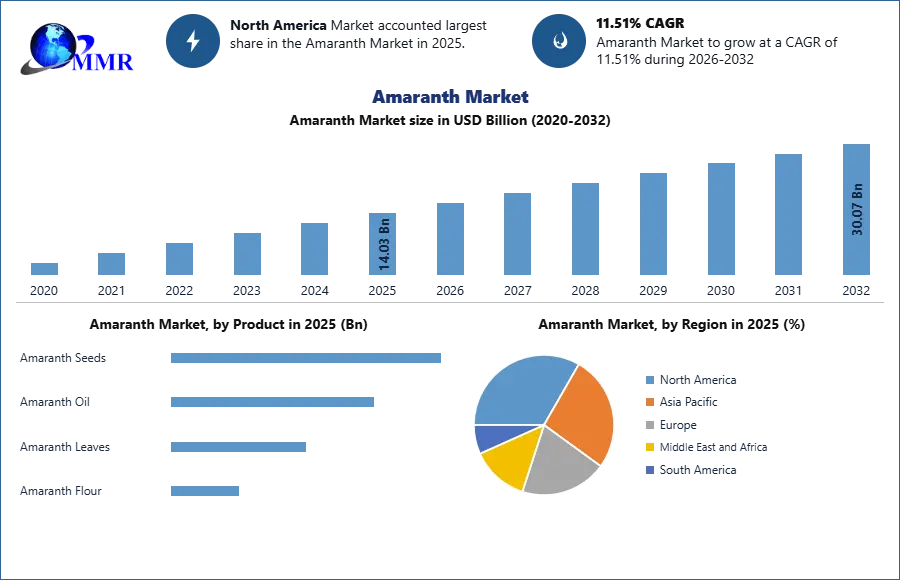
Valuation Surge: The global amaranth market size achieved a valuation of USD 14.03 Billion in 2025 and is projected to reach USD 30.07 Billion by 2032.
Compounded Growth: Total industrial revenue is expanding at an estimated Compound Annual Growth Rate (CAGR) of 11.51% over the 2026–2032 forecast horizon.
Core Catalyst: High concentrations of squalene, minerals, and proteins are accelerating adoption across functional food processing, clinical pharmaceuticals, and clean-label personal care lines.
Supply Dynamics: Organic amaranth commands a premium price tier at USD 0.66 per pound or more, compared to the conventional price floor of USD 0.41 per pound.
Geographic Centers: North America dominates the global landscape with a 44.47% market share in 2025, while the Asia-Pacific territory emerges as the fastest-growing zone with a projected 12.2% CAGR.
Why This Matters Now
Legacy grains are losing shelf space as consumer preference rotates toward ancient, nutrient-dense ingredients. Food and beverage giants can no longer treat pseudocereals as niche health-food extensions without risking category displacement. The global amaranth market size reached USD 14.03 Billion in 2025, signaling a deep structural pivot into mass manufacturing.
This macro trajectory means that ingredients procurement and brand portfolio managers must lock down supply lines now. Amaranth functions as a hyper-versatile raw material across food processing, cosmetic compounding, and pharmaceutical synthesis. Because the crop offers a complete nutritional profile—packed with vitamins, fiber, antioxidants, and anti-inflammatory properties—it satisfies the clean-label demands of modern consumer bases. Companies failing to formulate with amaranth over the next 24 months risk missing the structural transition from premium organic novelty to mainstream base ingredient.
Market Overview
The corporate economics of the global amaranth market Size show a high-growth sector moving toward a valuation of USD 30.07 Billion by 2032. Operating at an 11.51% CAGR between 2026 and 2032, the raw material volume moving through global supply chains is scaling rapidly. This expansion is driven by a strong, resilient supply chain that ensures predictable global availability for major industrial processors.
However, the industry faces clear pricing discrepancies at the farm gate. Conventional amaranth hovers near USD 0.41 per pound, while organic variants command premium rates of USD 0.66 per pound or higher. While this price spread incentivizes farmers to transition to certified organic crops, it forces corporate buyers to balance higher premium input costs against consumer willingness to pay. Encouragingly, baseline agricultural production costs mirror those of standard sorghum and soybeans, and can even trend lower. This keeps crop farming highly profitable and guarantees a steady supply of raw material for manufacturing plants.
𝐃𝐨𝐰𝐧𝐥𝐨𝐚𝐝 𝐏𝐃𝐅 𝐁𝐫𝐨𝐜𝐡𝐮𝐫𝐞 @ https://www.maximizemarketresearch.com/request-sample/81299/
Key Trends Driving Growth
Clean-Label Cosmetic Transition: Personal care formulators are replacing synthetic emollients with natural ingredients, utilizing amaranth to satisfy consumer demand for chemical-free personal care items.
Squalene Extraction Scaling: Industrial extraction of amaranth-derived squalene is rising due to its proven anti-inflammatory, anti-oxidation, and anti-aging properties.
Gluten-Free Substitution: The food industry is using milled amaranth flour as a direct substitute for wheat to capture the expanding demographic of consumers with gluten sensitivities.
Spiraling Organic Cultivation: Rising global demand for organic packaged foods is driving farmers to convert traditional acreage into certified amaranth fields to capture higher profit margins.
Segment Insights
Amaranth Seeds [Dominant Segment & Fastest-Growing Segment]: This segment held a commanding 52.45% share of the global market in 2025 and is projected to maintain its position with the highest product-type CAGR of 11.6%. Industrial buyers favor raw seeds because they contain high levels of essential minerals like calcium, iron, and phosphorus, while farmers value the plant’s aggressive growth characteristics.
Personal Care [Dominant Application Segment]: The cosmetics and personal care sector held a major 62.05% application share in 2025. This heavy concentration reflects high consumer acceptance and established formulation practices among major brands, especially within emerging economies.
Food & Beverages [Fastest-Growing Application Segment]: The food and beverage segment is projected to grow at a category-leading 10.81% CAGR. This growth is driven by heavy commercial demand for ground seeds and flours used in large-scale production of cookies, breads, granolas, noodles, cereals, and pancakes.
Regional Growth Story
North America remains the center of commercial volume, commanding 44.47% of the global market share in 2025. This regional dominance is directly linked to advanced manufacturing infrastructure built around squalene extraction for premium cosmetics and anti-aging products. Additionally, North American pharmaceutical firms are actively developing new bio-based medications, providing a steady institutional customer base for raw amaranth derivatives.
Concurrently, the Asia-Pacific region is emerging as the fastest-growing geopolitical zone, with a projected CAGR of 12.2% through 2032. This rapid growth is driven by rising disposable incomes and huge consumer bases in India and China. In China, anti-aging skincare products have become the most popular personal care segment among adult consumers, creating a major market for amaranth oil. This strong consumer demand, combined with increased corporate R&D spending, makes APAC the primary growth target for multinational players looking to expand their footprints.
Competitive Landscape
The corporate structure of the amaranth sector shows a clear tier system. In the United States, commercial grain supply is highly concentrated, with three primary buyers controlling the market: Arrowhead Mills (Texas), Health Valley (California), and Nu-World Amaranth (Chicago, Illinois). Major downstream food processors, such as Pepperidge Farm, rely on these three gatekeepers to secure their raw materials. This consolidation gives the top aggregators significant leverage over wholesale pricing.
For secondary brands and new market entrants, this means trying to buy raw grain directly from farms is inefficient. Growth requires establishing long-term supply agreements with these core primary processors. Both Arrowhead Mills and Health Valley are vertically integrated, selling branded, processed consumer goods directly to retail stores while simultaneously supplying bulk whole seeds and flour bags to competing manufacturers. This dual role as both supplier and retail competitor creates a complex landscape for independent brands trying to maintain stable margins.
Recent Developments
March 14, 2026: The Mexico Ministry of Agriculture officially designated amaranth as its priority crop for the FAO One Country, One Priority Product (OCOP) initiative. This state-level backing will strengthen regional value chains and boost global export volumes of Mexican-grown seeds over the next 12 to 24 months.
March 09, 2026: Flavex Naturextracte GmbH expanded its production lines for supercritical CO2-extracted amaranth oil tailored for high-purity natural cosmetics. This expansion secures their position as a top supplier for premium skincare brands focused on sensitive skin.
January 15, 2025: U.S. Grain Processors implemented industry-wide supply chain digitalization to mitigate the impact of 2025 tariff updates on seed imports. This technical upgrade provides the operational resilience needed to protect thin manufacturing margins from geopolitical trade shocks.
Strategic Implications
Corporate procurement teams must address the realities of a consolidated supply chain. Relying on spot-market purchases leaves brands exposed to sudden price spikes, especially given the rising demand for organic amaranth. Food and beverage companies should establish multi-year supply contracts with dominant aggregators like Arrowhead Mills or Nu-World Foods to insulate their production lines from supply shortages.
For product development teams, the priority is reformulating mid-tier product lines to capture the premium returns of functional foods. Integrating amaranth flour into baked goods, cereals, and snack lines allows brands to command higher clean-label retail prices. Cosmetic manufacturers should shift their formulations toward amaranth-derived squalene to meet the growing consumer demand for verified, bio-based anti-aging ingredients.
Future Outlook
The next decade will draw a clear line between proactive corporate buyers who secure stable, long-term amaranth supply chains to capture clean-label market share, and slow-moving legacy brands whose margins will be eroded by rising raw ingredient costs and shifting consumer preferences.
Analyst Perspective
“We are tracking a permanent shift in how agribusiness and consumer packaged goods brands view pseudocereals. Amaranth is no longer just an alternative ingredient for health-food brands; it has become a core driver of volume growth across global food, beverage, and personal care portfolios. Companies that build direct relationships with dominant processors now will secure a major competitive advantage as the market climbs toward the USD 30 Billion mark.” — Siddhi Dole, Research Analyst, Maximize Market Research
About Maximize Market Research
Maximize Market Research Pvt. Ltd. (MMR) is a global market research and consulting company that provides reliable, data-focused, and practical business insights. The firm serves a wide range of industries, including healthcare, pharmaceuticals, technology, automotive, electronics, chemicals, personal care, and consumer goods. Through market forecasts, competitive analysis, strategic consulting, and industry impact assessments, MMR helps organizations understand changing market conditions, identify growth opportunities, and make informed business decisions for long-term success.
2nd Floor, Navale IT Park Phase 3
Pune Banglore Highway, Narhe
Pune, Maharashtra 411041, India
+91 9607365656
sales@maximizemarketresearch.com
