Key Highlights
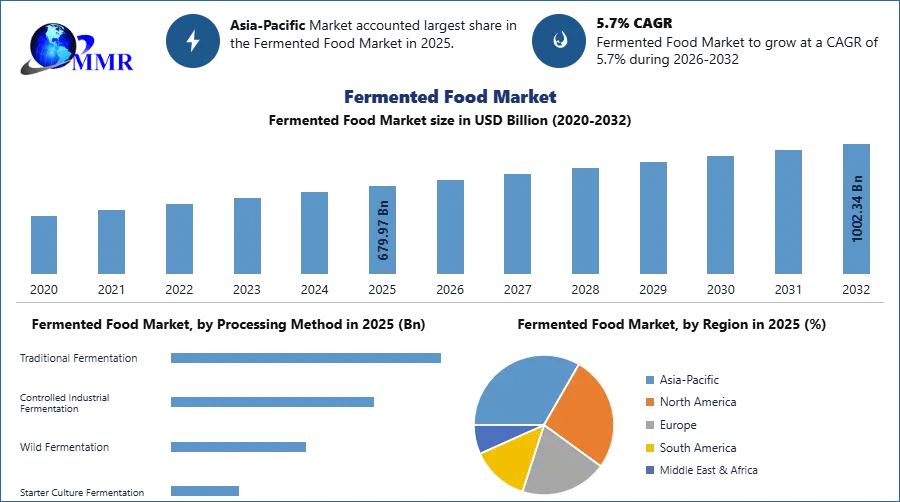
The global Fermented Food Market commanded a valuation of USD 679.97 billion in 2025 and is projected to scale to USD 1002.35 billion by 2032, advancing at a compound annual growth rate (CAGR) of 5.7%.
The dairy sector maintains structural dominance within the food-type breakdown, backed by established multi-century global consumer familiarity with yogurt and cheese formats.
Strategic fermentation processes serve dual corporate mandates: eliminating synthetic chemical additives via natural preservation while enhancing raw material digestibility.
Cross-contamination within manufacturing facilities represents a primary operational risk, where trace allergen contact threatens costly product recalls and severe liability exposure.
The Asia Pacific territory commands the largest global market share, sustained by deep-rooted regional culinary traditions and rising consumer interest in probiotic gut health.
Why This Matters Now Consumer brand portfolios face immediate irrelevance if they fail to address the rapid behavioral shift from synthetic pill supplementation to functional, whole-food probiotic solutions. Modern shoppers increasingly reject chemical ingredient listings, forcing food engineers to swap synthetic stabilizers for natural, microbially active alternatives. Companies that delay converting their production pipelines to accommodate live cultures will likely lose space on retail shelves to fast-moving, health-focused competitors.
At the same time, this category transformation requires significant capital allocation to modify traditional supply chain frameworks. Maintaining the viability of live microorganisms demands strict cold-chain infrastructure and precise quality control, or brands risk delivering inactive products that undermine consumer trust. As a result, mastering large-scale biological stability has shifted from a technical challenge to a core business requirement for market survival.
Market Overview The global Fermented Food Market Size established a baseline valuation of USD 679.97 billion in 2025. Driven by widespread consumer investments in wellness and natural preservation methods, global revenues are projected to reach USD 1002.35 billion by 2032. This trajectory represents a steady 5.7% CAGR over the seven-year forecast window, demonstrating consistent capital commitment across both established and emerging product portfolios.
Market Valuation Horizon (USD Billion)
2025: ████████████████ 679.97
2032: ████████████████████████ 1002.35 (Projected at 5.7% CAGR)
This structural expansion shows how quickly fermentation is evolving from an artisanal technique into a highly controlled industrial science. Industrial food production lines are continually upgrading to utilize custom biological pathways that maximize the nutritional value of raw ingredients. This systematic shift turns everyday grocery staples into targeted health items, protecting corporate profit margins against rising agricultural commodity prices.
Key Trends Driving Growth Widespread awareness of gut microbiome health acts as the primary driver for industry expansion. Clinical validation linking digestive microflora to immunity, metabolism, and inflammation is shifting consumer priorities toward functional eating habits. Shoppers are actively choosing foods that contain live cultures to ease digestive discomfort and improve overall well-being.
This health awareness is closely tied to the accelerating clean-label trend across major retail channels. Consumers want simple, transparent ingredient lists that are completely free from synthetic additives and artificial chemical preservatives. Because fermentation uses natural microbial action to extend shelf life, it helps brands deliver clean labels that appeal to health-conscious shoppers.
Furthermore, changing production practices highlight the environmental benefits of biological preservation. Modern fermentation lines help reduce food waste by stabilizing seasonal agricultural surpluses without relying on energy-intensive chemical processing. This efficiency allows corporate sustainability teams to lower total manufacturing energy costs while maintaining a stable, localized ingredient supply.
𝐃𝐨𝐰𝐧𝐥𝐨𝐚𝐝 𝐏𝐃𝐅 𝐁𝐫𝐨𝐜𝐡𝐮𝐫𝐞 @ https://www.maximizemarketresearch.com/request-sample/213506/
Segment Insights
Dairy Product Types [Dominant & Fastest-Growing Segment]: Holding a dominant position in the global market, this category is projected to sustain a significant growth rate due to deep-rooted cultural familiarity, high protein and calcium profiles, and the widespread availability of functional yogurt and kefir options in retail channels.
Beverages: This category continues to see expanding shelf space as brands launch functional, carbonated probiotic drinks designed to capture market share from traditional high-sugar sodas.
Vegetables: This segment is expanding past niche health channels into mainstream grocery distribution, supported by rising consumer interest in traditional, clear-label side dishes.
Advanced Biocontrol Formulations: This processing category is gaining traction among industrial food manufacturers using automated systems to maintain stable batch acidity and minimize production loss.
Regional Growth Story The Asia Pacific region maintains the largest share of the global Fermented Food Market and is projected to lead the industry through the forecast period. This dominant position is built on a strong cultural heritage of consuming microbially aged staples alongside growing consumer interest in preventative healthcare. Rising middle-class incomes across India, China, and Japan are translating directly into increased spending on premium, health-focused food items.
Regional Market Drivers & Structuring Elements
Asia Pacific: Largest Global Share / High Consumer Shift to Probiotic Microflora
Europe:       40%+ Independent Infrastructure Using Traditional Bio-Preservation
Americas:     High Demand for Clean-Label Ingredients / Low-Sugar Plant Formulations
Europe remains a key market, supported by strong consumer demand for traditional fermented dairy products like premium yogurts and cheeses. European shoppers place a high value on regional agricultural transparency, which helps clear-label products command premium pricing across major supermarket networks.
Concurrently, North American food companies are focused on updating active product lines to match specialized dietary trends. Manufacturers are launching vegan, low-sugar, and gluten-free fermented options to appeal to shoppers following personalized nutrition plans. This focus on customized functional products helps brands tap into high-margin consumer segments across the United States and Canada.
Competitive Landscape The competitive arena requires established market players to move beyond basic product labeling toward precise, scientifically backed culture formulation. Major processing brands are shifting capital into bio-engineering labs to secure exclusive proprietary rights to specific microbial strains. This focus on specialized strain selection gives companies a clear advantage, allowing them to promise targeted health benefits like enhanced nutrient absorption or superior immune system support.
For smaller regional producers, this trend presents a clear challenge: entry-level products without verified, stable bacterial counts face being squeezed out of premium retail spaces. Over the next 12 to 24 months, look for increased acquisition activity as multi-brand conglomerates buy up regional fermented brands to gain access to their specialized production facilities and local ingredient networks. This consolidation will help larger companies standardize production quality across different markets while lowering total ingredient procurement costs.
Recent Developments
Processing engineers are rolling out automated inline monitoring systems that track batch pH and temperature in real time to prevent product spoilage on high-volume manufacturing lines.
Product development teams are rolling out multi-strain dairy cultures designed to survive longer on grocery shelves without losing their probiotic strength.
R&D departments are scaling up specialized fermentation techniques that shorten production cycles while maintaining the deep flavor profiles consumers expect.
Manufacturers are updating factory allergen management practices to isolate shared equipment and prevent cross-contamination across different product lines.
Strategic Implications Allergen management and cross-contamination prevention represent a critical operational challenge for modern manufacturing facilities. Utilizing shared processing equipment across different product lines creates a constant risk of trace allergen contamination, which can lead to severe allergic reactions for consumers and costly product recalls. This threat requires companies to invest heavily in dedicated production lines and automated cleaning systems to protect their brands from legal liabilities.
Corporate Operational Expenditure Focus
├─ Production Isolation: Secondary dedicated lines for allergen control
├─ Biocontrol Technology: Real-time automated pH, temperature, and strain tracking
└─ Cold-Chain Logistics: Constant temperature management to protect live cultures
At the same time, strict labeling regulations require brands to guarantee exact live culture counts right up to the end of a product’s shelf life. Maintaining this biological stability requires seamless cold-chain logistics, as any temperature breaks during transport can degrade live bacteria and lead to inconsistent quality. Consequently, managing precise storage conditions has become a critical factor in maintaining strong retail partnerships.
Future Outlook The global industry will increasingly favor companies that combine traditional fermentation methods with modern, automated quality control systems. Success will depend on a brand’s ability to consistently deliver verified live cultures within clean-label ingredient profiles. Companies that invest in advanced biocontrol technology to prevent batch variation will capture high-margin retail spaces, while manufacturers relying on unmonitored, variable processing methods will likely struggle with rising production waste and shrinking margins.
Analyst Perspective “Fermentation is shifting from a traditional method of food preservation into a highly scientific category within personalized nutrition,” states Siddhi Dole, Research Analyst at Maximize Market Research. “The consumer product companies winning the market are those investing in precise strain selection and automated production controls, allowing them to back up their clean-label health claims with consistent, verified batch quality.”
About Maximize Market Research
Maximize Market Research Pvt. Ltd. (MMR) is a global market research and consulting company that provides reliable, data-focused, and practical business insights. The firm serves a wide range of industries, including healthcare, pharmaceuticals, technology, automotive, electronics, chemicals, personal care, and consumer goods. Through market forecasts, competitive analysis, strategic consulting, and industry impact assessments, MMR helps organizations understand changing market conditions, identify growth opportunities, and make informed business decisions for long-term success.
2nd Floor, Navale IT Park Phase 3
Pune Banglore Highway, Narhe
Pune, Maharashtra 411041, India
+91 9607365656
sales@maximizemarketresearch.com
