Key Highlights
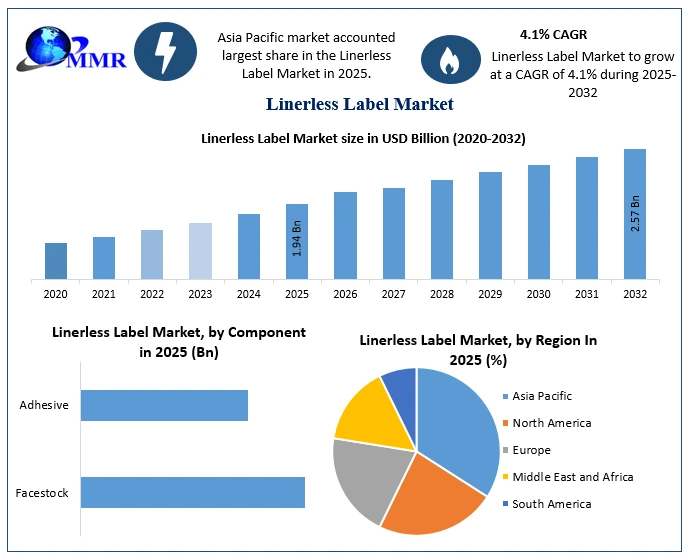
- The Linerless Label Market was valued at USD 1.94 Billion in 2025 and is expected to reach USD 2.57 Billion by 2032, growing at a 4.1% CAGR. Every percentage point of growth signals increasing investment in packaging efficiency rather than simple volume expansion.
- Sustainability regulations are accelerating the transition toward linerless labeling across food, beverage, retail, and logistics industries.
- Food & beverage applications remain the industry’s primary demand engine as brands seek waste reduction and operational productivity.
- Digital and advanced printing technologies continue expanding application flexibility while supporting shorter production runs and product personalization.
- Asia-Pacific continues to emerge as a major growth engine as manufacturing, organized retail, and packaged food consumption expand.
Why This Matters Now
Packaging has moved from a cost center to a boardroom priority. Every unnecessary gram of waste now affects sustainability targets, logistics costs, and brand reputation simultaneously.
Linerless labels address multiple challenges with a single packaging decision. Eliminating release liners reduces material waste while increasing labels per roll, improving operational productivity and lowering transportation requirements. That changes procurement strategies as much as it changes packaging operations.
Market Overview
The Linerless Label Market is entering a new phase where environmental compliance and manufacturing efficiency reinforce one another instead of competing for investment. The market was valued at USD 1.94 Billion in 2025 and is projected to reach USD 2.57 Billion by 2032, expanding at a 4.1% CAGR. For packaging suppliers, that indicates stable long-term demand supported by structural industry changes rather than temporary consumer cycles.
Unlike conventional labels, linerless formats eliminate release liners, reducing waste generation throughout production and disposal. The business implication extends beyond sustainability. Manufacturers can transport more labels per roll, reduce inventory interruptions, and improve labeling throughput across production facilities.
As food producers continue optimizing packaging costs while meeting stricter environmental expectations, linerless labels increasingly become part of broader operational transformation initiatives rather than isolated packaging upgrades.
Key Trends Driving Growth
Sustainability remains the strongest catalyst. Companies are under pressure to reduce packaging waste without compromising product presentation or regulatory compliance. Linerless labels directly support both objectives.
Consumer purchasing behavior is also influencing packaging decisions. Growing demand for packaged foods, ready-to-eat meals, and convenience products increases labeling requirements across production lines. That creates opportunities for high-efficiency labeling technologies capable of supporting larger production volumes.
E-commerce expansion continues reshaping packaging operations. More shipments require more labeling, while distribution centers seek faster, continuous labeling processes that reduce downtime. Linerless technology aligns well with automated logistics environments where operational efficiency translates directly into cost savings.
Printing innovation is another major growth accelerator. Improvements across flexographic and digital printing technologies allow manufacturers to produce higher-quality graphics while supporting product customization and shorter production runs. This enables brands to respond more quickly to promotional campaigns and regional product variations.
Get a free sample for :https://www.maximizemarketresearch.com/request-sample/122602/
Segment Insights
- Dominant Segment: Food & Beverages application continues to account for the largest demand due to extensive packaging requirements and the industry’s focus on operational efficiency and sustainability.
- Fastest-Growing Segment: The report highlights continued momentum in Digital Printing Technologies, supported by increasing demand for flexible production, personalization, and efficient short-run labeling.
- Permanent, removable, and repositionable adhesive solutions allow manufacturers to address diverse packaging requirements across FMCG, pharmaceuticals, retail, and logistics applications.
- Water-based, solvent-based, hot melt, and UV-curable inks continue expanding performance capabilities for specialized packaging environments.
Regional Growth Story
Asia-Pacific is becoming increasingly important as packaged food consumption, industrial manufacturing, and retail modernization accelerate across multiple economies. Growing investments in organized retail and logistics infrastructure continue supporting broader adoption of efficient labeling technologies.
North America and Europe remain mature markets where sustainability legislation and corporate ESG commitments continue driving replacement demand. Here, adoption is less about adding new labeling capacity and more about improving operational efficiency while reducing environmental impact.
Emerging economies are expected to provide additional opportunities as manufacturers modernize packaging operations and multinational FMCG companies standardize sustainable packaging practices across global supply chains.
Competitive Landscape
Competition is increasingly shifting from label manufacturing toward complete packaging solutions. Suppliers that combine advanced adhesives, printing technologies, and sustainability expertise are strengthening long-term customer relationships instead of competing solely on price.
Recent product innovation demonstrates this transition. Developments in specialized adhesive technologies improve production efficiency while expanding linerless applications into quick-service restaurants and other high-volume packaging environments. These investments signal that future competition will focus on integrated performance rather than commodity label production.
For competitors, this raises the competitive threshold. Companies unable to invest in advanced materials, digital printing capabilities, and sustainable product portfolios may find it increasingly difficult to defend market share over the next 12–24 months. The competitive advantage is gradually shifting toward innovation ecosystems rather than manufacturing scale alone.
Recent Developments
- Ritrama developed its Core Linerless Solutions (CLS) technology in collaboration with Omet to strengthen linerless labeling capabilities.
- Bostik introduced a new adhesive solution designed to improve production line efficiency while supporting sustainable packaging applications for quick-service restaurants.
- Continued investment in digital printing technologies is expanding customization capabilities across consumer packaging applications.
Strategic Implications
Packaging decisions increasingly influence manufacturing economics, sustainability reporting, logistics efficiency, and consumer perception simultaneously.
For FMCG companies, linerless labels offer measurable operational benefits through reduced material consumption and improved production continuity. For converters, investment priorities should increasingly emphasize digital printing integration, advanced adhesive technologies, and sustainable material innovation.
Retailers also benefit through improved inventory management and more efficient distribution operations, particularly as omnichannel fulfillment continues expanding.
Future Outlook
The next phase of industry growth will depend less on label volume and more on value creation through sustainability, automation, and intelligent packaging technologies.
As environmental regulations tighten and supply chains become increasingly digitized, linerless labels are positioned to become a standard packaging solution across multiple industries rather than a niche alternative. Companies investing early in advanced labeling capabilities will strengthen operational resilience, while those delaying modernization risk losing both efficiency and competitive relevance.
The winners will treat linerless labeling as a strategic manufacturing asset; the losers will continue viewing it as a packaging expense.
Analyst Perspective
“The linerless label industry is evolving beyond sustainable packaging into a strategic productivity solution. Organizations that align packaging innovation with operational efficiency and environmental goals will be best positioned to capture long-term competitive advantage.” — Siddhi Dole, Analyst.
About Maximize Market Research
Maximize Market Research Pvt. Ltd. (MMR) is a global market research and consulting company that provides reliable, data-focused, and practical business insights. The firm serves a wide range of industries, including healthcare, pharmaceuticals, technology, automotive, electronics, chemicals, personal care, and consumer goods. Through market forecasts, competitive analysis, strategic consulting, and industry impact assessments, MMR helps organizations understand changing market conditions, identify growth opportunities, and make informed business decisions for long-term success.
2nd Floor, Navale IT Park Phase 3
Pune Banglore Highway, Narhe
Pune, Maharashtra 411041, India
+91 9607365656
sales@maximizemarketresearch.com
