Key Highlights
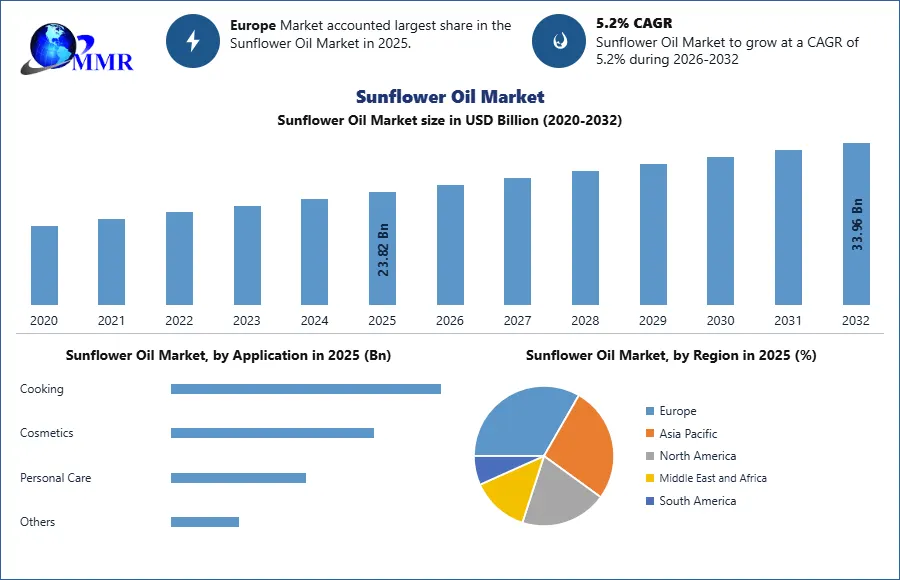
- The Sunflower Oil Market was valued at USD 23.82 billion in 2025 and is projected to reach USD 33.96 billion by 2032, growing at a 5.2% CAGR. Every percentage point of sustained growth signals expanding procurement opportunities for processors, retailers, and ingredient suppliers.
- Rising consumer preference for healthier cooking oils is strengthening demand across households and food manufacturers. This creates pricing power for brands with strong nutritional positioning.
- Industrial demand is broadening beyond food into cosmetics, energy, and chemical applications, expanding revenue sources for producers.
- Innovation in hybrid sunflower cultivation is improving production capabilities to meet rising global demand. This supports longer-term supply resilience.
Why This Matters Now
The edible oils business is no longer competing only on price. It is competing on nutrition, ingredient transparency, and supply security. Companies that fail to reposition around these priorities risk losing shelf space and industrial contracts.
The Sunflower Oil Market reaching USD 33.96 billion by 2032 signals more than market expansion. It points to sustained investment opportunities across agriculture, refining, branded foods, private-label manufacturing, and industrial ingredients.
Market Overview
The Sunflower Oil Market has become one of the world’s most versatile vegetable oils. Its neutral taste, high vitamin E content, and balanced fatty acid profile have expanded its role from household kitchens to large-scale food manufacturing, cosmetics, and industrial applications.
Demand is increasingly supported by consumers seeking healthier alternatives to conventional cooking oils. Rich concentrations of oleic and linoleic acids, combined with growing awareness of cardiovascular wellness, continue to strengthen its position across retail and commercial foodservice. Every increase in health-driven consumption translates into greater demand stability for producers and processors.
The report also highlights that advances in genome analysis and hybrid sunflower development are helping producers respond to rising global consumption while improving agricultural productivity. That makes innovation a competitive differentiator rather than simply an efficiency initiative.
Key Trends Driving Growth
Health and wellness have become commercial growth engines rather than marketing themes. Consumers increasingly associate sunflower oil with healthier diets because of its beneficial fatty acid composition and vitamin E content. This continues to support higher adoption across households and packaged food manufacturers.
Clean-label food is reshaping procurement strategies across FMCG companies. Manufacturers increasingly favor recognizable ingredients that align with consumer expectations for simpler formulations. Sunflower oil benefits directly from this transition as brands reformulate products to strengthen nutritional credentials.
Urbanization and changing lifestyles are accelerating consumption of processed and convenience foods. Food manufacturers therefore require reliable supplies of stable cooking oils that perform consistently across large-scale production environments. That demand extends sunflower oil beyond retail consumption into industrial purchasing.
Government initiatives supporting edible oil production and nutrition programs are also influencing market development. The report notes that vegetable oil fortification initiatives in developing economies are encouraging wider use of nutrient-rich edible oils to address nutritional deficiencies.
Get a free sample :https://www.maximizemarketresearch.com/request-sample/122497/
Segment Insights
- Dominant Segment: The supplied report confirms that the food industry/application remains the primary demand center because sunflower oil is extensively used for cooking, frying, and food manufacturing.
- Fastest-Growing Segment: Industrial applications are highlighted as expanding rapidly, supported by growing use in cosmetics, energy, and chemical industries.
- Household consumption continues to provide stable baseline demand as consumers increasingly replace conventional cooking oils with healthier alternatives.
- Food processors benefit from sunflower oil’s neutral flavor and nutritional profile, enabling use across multiple packaged food categories.
Regional Growth Story
The report identifies Asia and Africa as important demand centers where vegetable oil fortification programs are supporting nutritional improvement initiatives. These public health efforts are simultaneously expanding commercial demand for sunflower oil, creating long-term volume opportunities for suppliers.
India remains strategically important because of its significant dependence on sunflower oil imports. The report notes that policy measures, including import duties and domestic agricultural incentives, could influence future market dynamics. For suppliers, regulatory decisions become as important as consumer demand in determining growth opportunities.
Global supply chains also continue to influence pricing competitiveness, particularly in major importing markets where procurement decisions respond quickly to relative vegetable oil prices.
Competitive Landscape
Competition is moving beyond production scale. Leading participants are positioning themselves around supply reliability, agricultural innovation, and diversified end-use applications.
Investment in hybrid sunflower development signals that future market leadership will increasingly depend on productivity gains rather than acreage expansion alone. Companies capable of delivering stable supply during agricultural volatility will strengthen long-term customer relationships.
Expansion into industrial applications—including cosmetics, renewable energy, and specialty chemicals—also indicates competitive diversification. Rivals focused solely on traditional edible oil markets may face margin pressure as diversified producers capture higher-value opportunities.
Over the next 12–24 months, competitive advantage is likely to depend on integrated sourcing, stronger relationships with food manufacturers, and innovation in value-added sunflower oil products rather than commodity pricing alone.
Recent Developments
- Growing investment in genome analysis and hybrid sunflower development to improve production efficiency and meet rising global demand.
- Continued expansion of sunflower oil use in food manufacturing driven by rising health awareness and demand for PUFA- and MUFA-rich cooking oils.
- Increasing utilization of sunflower oil in industrial sectors including cosmetics and energy applications.
- Government-supported edible oil fortification initiatives continue to expand consumption across developing economies.
Strategic Implications
Food manufacturers should treat sunflower oil as a strategic ingredient rather than a commodity purchase. Health positioning increasingly influences purchasing decisions, making ingredient selection central to brand differentiation.
Retailers can capitalize on premiumization by emphasizing nutrition, transparency, and clean-label messaging. Agricultural producers, meanwhile, face growing incentives to invest in productivity improvements that secure long-term supply contracts with processors.
Industrial buyers also represent an expanding opportunity as demand broadens beyond traditional food applications.
Future Outlook
The Sunflower Oil Market is evolving into a nutrition-driven, innovation-led industry where product quality, agricultural resilience, and diversified applications increasingly determine competitive success.
Companies that invest early in healthier product portfolios, supply chain resilience, and industrial diversification will capture the next wave of value creation; those that continue competing primarily on commodity pricing risk losing both margins and market relevance.
Analyst Perspective
“The Sunflower Oil Market is transitioning from a traditional edible oil business into a broader nutrition and industrial ingredient ecosystem. Companies aligning health-focused consumer demand with agricultural innovation and diversified applications will be best positioned to create sustainable competitive advantage over the coming decade.” — Siddhi Dole
About Maximize Market Research
Maximize Market Research Pvt. Ltd. (MMR) is a global market research and consulting company that provides reliable, data-focused, and practical business insights. The firm serves a wide range of industries, including healthcare, pharmaceuticals, technology, automotive, electronics, chemicals, personal care, and consumer goods. Through market forecasts, competitive analysis, strategic consulting, and industry impact assessments, MMR helps organizations understand changing market conditions, identify growth opportunities, and make informed business decisions for long-term success.
2nd Floor, Navale IT Park Phase 3
Pune Banglore Highway, Narhe
Pune, Maharashtra 411041, India
+91 9607365656
sales@maximizemarketresearch.com
