Key Highlights
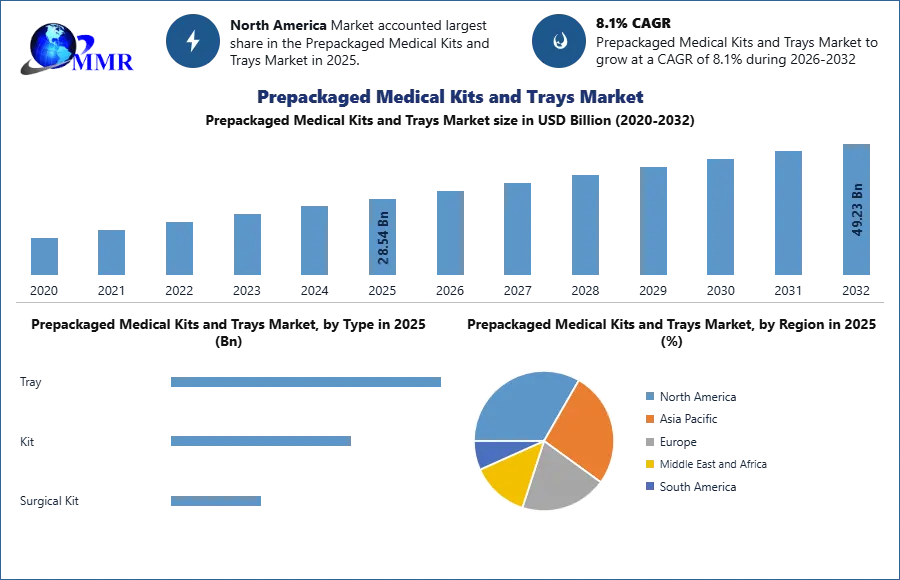
- Market size projected to reach USD 49.23 billion by 2032
- CAGR of 8.1% during 2026–2032
- Rising healthcare-associated infections continue to strengthen demand for disposable medical products.
- Increasing surgical procedures and chronic disease prevalence are expanding market opportunities.
- Hospitals remain the primary end-user segment.
- Surgery continues to represent the leading application area.
- North America maintains market leadership.
- Asia-Pacific is expected to register the fastest growth during the forecast period.
- Customized surgical kits improve operating room efficiency and workflow.
- Expanding healthcare infrastructure across developing economies supports long-term demand.
Why This Matters Now
Hospital administrators continue to face mounting pressure to reduce procedure delays, improve clinical efficiency, and minimize healthcare-associated infections. Standardized medical kits have become an operational solution that supports these objectives by reducing preparation time and ensuring procedural consistency.
Growing patient volumes further increase demand. Aging populations and the rising prevalence of chronic and complex diseases have contributed to higher numbers of surgical procedures worldwide. This trend is encouraging hospitals to adopt customized prepackaged kits that simplify inventory management while improving operating room productivity.
Healthcare providers are also focusing on reducing unnecessary handling of surgical instruments and consumables. Ready-to-use kits help streamline workflows and lower contamination risks, making them increasingly attractive across hospitals and surgical centers.
Market Overview
The Prepackaged Medical Kits and Trays Market Size has evolved from a convenience-driven product category into an essential component of modern healthcare delivery. Hospitals increasingly rely on preassembled kits containing procedure-specific instruments and disposable supplies that support standardized clinical protocols.
Healthcare-associated infections remain one of the industry’s major operational concerns. As hospitals manage larger patient populations, preventing cross-contamination has become a strategic priority. The wider adoption of disposable medical products—including gloves, medical devices, and prepackaged kits—continues to strengthen market demand.
Another major growth driver is the increasing volume of surgical procedures. Rising incidences of chronic diseases and an expanding geriatric population have contributed to higher surgical intervention rates. This directly increases demand for procedure-specific kits designed to improve preparation speed while supporting consistent clinical practices.
Customization has emerged as a key competitive advantage. Hospitals increasingly prefer kits configured for specific medical procedures, allowing surgeons and operating room staff to access required instruments immediately without assembling individual components. This improves workflow efficiency while reducing procedural delays.
The report indicates that demand for general surgical and instrument kits is expected to remain strong throughout the forecast period. At the same time, ophthalmic custom trays are projected to experience particularly robust growth as healthcare providers seek greater procedural specialization.
Key Trends Driving Market Growth
Rising Focus on Infection Prevention
Healthcare-associated infections continue to influence purchasing decisions across hospitals and healthcare facilities. Disposable, sterile medical kits reduce handling of instruments and contribute to improved infection control practices, supporting broader adoption across clinical environments.
Increasing Surgical Volumes
Growing numbers of surgical procedures continue to expand the addressable market. Aging populations and higher prevalence of chronic diseases are increasing demand for standardized surgical supplies that improve operating room efficiency and reduce preparation time.
Customized Procedure-Specific Kits
Healthcare providers increasingly favor customized kits tailored for specific procedures. These solutions reduce inventory complexity, simplify logistics, and enable clinical teams to focus more on patient care rather than equipment preparation.
Hospital Workflow Optimization
Hospitals continue to prioritize operational efficiency. Prepackaged medical kits reduce setup time before procedures, improve resource utilization, and support standardized treatment protocols across departments.
Healthcare Infrastructure Expansion
Developing countries continue investing in hospitals, surgical centers, and emergency medical facilities. Expanding healthcare infrastructure creates sustained demand for disposable medical products and procedure-ready kits capable of supporting higher patient volumes.
Explore detailed analysis, insights, and growth opportunities
Segment Insights
- Dominant Type: Surgical Kits continue to benefit from increasing surgical procedures and growing hospital demand for standardized procedural supplies.
- Fastest-Growing Type: Ophthalmic custom trays are expected to record strong growth during the forecast period due to increasing procedural specialization.
- Dominant End User: Hospitals remain the largest end-user segment as they perform the majority of surgical procedures and require standardized infection-control products.
- Application Leader: Surgery represents the leading application segment, supported by rising surgical interventions globally.
- Distribution Channels: Direct sales, medical supply distributors, online sales, and other channels continue supporting product availability across healthcare providers.
Regional Growth Story
North America is expected to maintain the leading position in the global market throughout the forecast period. The United States accounts for the largest regional share, supported by extensive hospital infrastructure, widespread surgical activity, and continued emphasis on infection prevention.
Asia-Pacific is projected to become the fastest-growing regional market. Rising healthcare awareness, population growth, expanding hospital networks, government initiatives supporting healthcare development, increasing emergency medical facilities, and greater demand for advanced surgical equipment collectively strengthen regional growth prospects.
Countries including China, Japan, India, South Korea, Australia, Indonesia, Malaysia, Vietnam, Taiwan, Bangladesh, and Pakistan continue expanding healthcare capacity, creating new opportunities for manufacturers of prepackaged medical kits and trays.
Europe maintains steady demand across the UK, Germany, France, Italy, Spain, Sweden, Austria, and the rest of the region, while the Middle East & Africa and South America continue benefiting from ongoing healthcare infrastructure development.
Competitive Landscape
Competition remains centered on product quality, customization capabilities, pricing strategies, distribution reach, and hospital partnerships. Manufacturers are focusing on expanding customized product portfolios that improve procedural efficiency while supporting infection prevention.
Key market participants include Angiokard Medizintechnik GmbH, B Braun Melsungen AG, Becton Dickinson and Company, C.R. Bard, Inc., Boston Scientific Corporation, Cardinal Health, Inc., Cypress Medical Products, LLC, Hogy Medical Co., Ltd., Kimal Plc, Medical Action Industries, Inc., Medtronic Plc, Med-Italia Biomedica Srl, Medline Industries, Inc., Mölnlycke Health Care AB, Rocialle Limited, Smith & Nephew PLC, and Teleflex Medical.
Recent Developments
- Increasing adoption of customized procedure-specific medical kits.
- Rising hospital investment in disposable medical products for infection control.
- Expansion of healthcare facilities across developing economies.
- Growing demand for ophthalmic custom trays.
- Continued focus on improving operating room efficiency through standardized surgical kits.
Strategic Implications
Hospitals are shifting procurement strategies toward standardized, ready-to-use medical kits that improve efficiency and reduce contamination risks. Manufacturers capable of delivering customized solutions, maintaining reliable supply chains, and supporting expanding healthcare infrastructure will be well positioned to capitalize on sustained market growth. As healthcare systems continue modernizing, procedure-specific kits are expected to become an increasingly important component of surgical workflows.
Future Outlook
The Prepackaged Medical Kits and Trays Market is expected to experience sustained expansion through 2032 as healthcare providers continue investing in infection prevention, surgical efficiency, and standardized clinical practices. Companies that combine product customization, operational reliability, and strong hospital partnerships will be best positioned to lead the next phase of market growth.
Analyst Perspective — Komal Patil
“Growing surgical volumes, rising infection prevention requirements, and increasing adoption of customized procedure-specific kits are transforming prepackaged medical kits from operational conveniences into essential components of modern healthcare delivery. Manufacturers that align product innovation with hospital workflow optimization are expected to strengthen their competitive position throughout the forecast period.”
About Maximize Market Research
Maximize Market Research Pvt. Ltd. (MMR) is a global market research and consulting company that provides reliable, data-focused, and practical business insights. The firm serves a wide range of industries, including healthcare, pharmaceuticals, technology, automotive, electronics, chemicals, personal care, and consumer goods. Through market forecasts, competitive analysis, strategic consulting, and industry impact assessments, MMR helps organizations understand changing market conditions, identify growth opportunities, and make informed business decisions for long-term success.
Contact Us :
2nd Floor, Navale IT Park Phase 3
Pune Banglore Highway, Narhe
Pune, Maharashtra 411041, India
+91 9607365656
sales@maximizemarketresearch.com
