Key Highlights
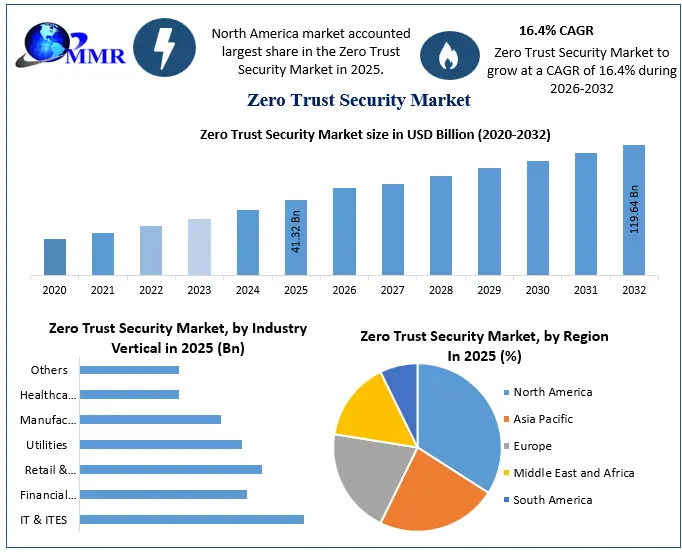
- Market size reached USD 41.32 Billion in 2025.
- Market is projected to reach USD 119.64 Billion by 2032.
- Expected CAGR stands at 16.4% during 2026–2032.
- North America remains the leading regional market.
- Cloud migration and remote work continue accelerating Zero Trust adoption.
- Multi-Factor Authentication strengthens enterprise identity protection.
- Cloud-based deployment gains momentum across enterprise environments.
- Financial services, healthcare, manufacturing, retail, utilities, and IT sectors continue expanding adoption.
Why This Matters Now
Enterprise cybersecurity has entered a new operating model. Organizations are no longer defending a clearly defined network perimeter—they are protecting users, applications, workloads, APIs, and data distributed across hybrid cloud environments and remote workplaces.
The Zero Trust Security Market, valued at USD 41.32 Billion in 2025, is projected to reach USD 119.64 Billion by 2032, growing at a 16.4% CAGR. The scale of this expansion signals more than market growth. It reflects a structural shift in how enterprises build digital resilience, secure cloud investments, and enable business transformation without sacrificing security.
Market Overview
Zero Trust Security Market Size replaces traditional perimeter-based security with a model that continuously authenticates and validates every user, device, workload, and application before granting access. Whether users operate inside corporate offices, from home, or through cloud environments, trust is never assumed.
This transition is becoming increasingly important as organizations modernize IT infrastructure through hybrid cloud deployments, SaaS applications, digital workplaces, and distributed enterprise networks. Traditional network boundaries have become increasingly difficult to defend, making identity, authentication, device verification, and continuous monitoring central to enterprise cybersecurity strategies.
Technology leaders are therefore shifting investments from conventional firewall-centric architectures toward intelligent identity-centric security platforms capable of protecting increasingly decentralized digital ecosystems.
Key Trends Driving Growth
One of the strongest catalysts is the permanent evolution of remote and hybrid work. Employees now routinely access enterprise resources from multiple devices and locations, significantly increasing attack surfaces. Zero Trust addresses this challenge by requiring authentication and authorization for every access request, reducing the likelihood of unauthorized entry and data breaches.
Cloud migration represents another major transformation. As organizations move applications and infrastructure to public, private, and hybrid cloud environments, conventional perimeter security loses effectiveness. Zero Trust provides granular access controls, continuous verification, and cloud-native security policies that align with modern infrastructure strategies.
Artificial intelligence and advanced analytics are also becoming increasingly valuable within Zero Trust frameworks. Security analytics solutions strengthen proactive threat detection by identifying behavioral anomalies and suspicious activity before attacks escalate. This improves incident response while supporting enterprise automation initiatives.
API ecosystems continue expanding as organizations integrate digital platforms and enterprise software. As APIs become essential for application connectivity, dedicated API security solutions are emerging as an increasingly important component of Zero Trust architectures.
Digital transformation initiatives across financial services, healthcare, manufacturing, retail, and utilities further reinforce market demand. Organizations are simultaneously modernizing customer experiences, enterprise applications, and operational technologies, making identity-centric security a strategic requirement rather than a compliance exercise.
Balancing stronger authentication with user productivity remains another defining trend. The report highlights guidance from the National Institute of Standards and Technology (NIST), recommending risk-based authentication approaches that maintain robust protection while minimizing unnecessary friction for employees.
Explore detailed analysis, insights, and growth opportunities : https://www.maximizemarketresearch.com/request-sample/83776/
Segment Insights
- Dominant Authentication Segment: Single-Factor Authentication maintains notable market presence, particularly among organizations where baseline identity verification remains sufficient for operational requirements.
- Fastest-Growing Authentication Trend: Multi-Factor Authentication (MFA) continues gaining momentum as enterprises strengthen identity security through multiple verification methods that significantly reduce unauthorized access risks.
- Dominant Deployment Segment: On-Premises Deployment maintains a significant share among organizations requiring greater control over security infrastructure and sensitive information.
- Fastest-Growing Deployment Segment: Cloud-Based Deployment is expanding rapidly as enterprises prioritize scalability, accessibility, operational flexibility, and alignment with broader cloud transformation strategies.
- Leading Solution Categories: Network Security, Data Security, Endpoint Security, Security Analytics, API Security, Security Orchestration Automation & Response (SOAR), Security Policy Management, and specialized Zero Trust solutions collectively form comprehensive enterprise security architectures.
- Industry Adoption: IT & ITES, Financial & Insurance, Healthcare & Social Assistance, Manufacturing, Retail & Trade, Utilities, and other enterprise sectors continue integrating Zero Trust principles into digital transformation strategies.
The diversity of solution categories demonstrates that Zero Trust is evolving beyond identity management. Enterprises increasingly require integrated platforms capable of protecting networks, endpoints, cloud workloads, APIs, data, and security operations through unified policy enforcement and continuous monitoring.
Rather than deploying isolated cybersecurity products, organizations are moving toward comprehensive Zero Trust ecosystems that simplify security operations while improving visibility across increasingly complex IT environments. This shift creates opportunities for vendors offering integrated security platforms capable of combining identity management, analytics, orchestration, and cloud-native protection into a single enterprise framework.
Regional Growth Story
North America continues to define the competitive benchmark for the Zero Trust Security Market. The region benefits from mature digital infrastructure, stringent cybersecurity regulations, and sustained investment in advanced security technologies. The United States remains the principal growth engine, supported by large enterprises in finance, healthcare, and technology that are accelerating adoption of Zero Trust frameworks to strengthen cyber resilience. The market’s leadership is reinforced by strong regulatory compliance requirements and a proactive approach to protecting enterprise networks, cloud environments, and sensitive data.
Europe is strengthening its position through regulatory-driven cybersecurity modernization. The General Data Protection Regulation (GDPR) continues to influence enterprise security strategies by encouraging organizations to adopt Zero Trust principles that improve identity verification, access control, and data protection. Governments and critical infrastructure operators are also increasing cybersecurity investments to safeguard utilities, transportation networks, and other essential services. Cross-border cybersecurity initiatives further encourage consistent security standards across the region.
Asia Pacific is emerging as a major opportunity as organizations expand digital transformation, cloud adoption, and enterprise modernization initiatives. Large technology markets including China, Japan, India, and South Korea are investing in advanced IT infrastructure, creating favorable conditions for Zero Trust implementation across both public and private sectors. As enterprises continue modernizing digital operations, the demand for scalable cloud-based security architectures is expected to strengthen.
The Middle East & Africa and South America are also advancing cybersecurity capabilities as governments and enterprises increase investments in digital infrastructure and cloud technologies. Organizations across these regions are recognizing Zero Trust as an effective approach for protecting distributed digital environments against increasingly sophisticated cyber threats.
Competitive Landscape
Competition in the Zero Trust Security Market is shifting beyond standalone cybersecurity products toward integrated security platforms capable of protecting increasingly distributed digital ecosystems.
Google LLC’s introduction of BeyondCorp Remote Access signals the growing commercial maturity of Zero Trust architectures. By enabling secure access to internal applications without relying on traditional VPNs, the company reinforces a broader industry transition toward identity-based access management designed for hybrid work and cloud-first enterprises.
BlackBerry strengthened its enterprise security strategy through the launch of the Spark platform, integrating Unified Endpoint Security with Unified Endpoint Management. This reflects increasing demand for unified platforms that simplify endpoint protection while supporting Zero Trust implementation across multiple devices.
Palo Alto Networks expanded its cloud security capabilities through the acquisition of PureSec. The move highlights how vendors are strengthening cloud-native security portfolios as organizations deploy serverless applications and multi-cloud environments. Rather than competing solely on network security, leading providers are building comprehensive cloud protection ecosystems capable of securing modern application architectures.
Cisco continues investing heavily in its global partner ecosystem through the expansion of its Marketing Velocity initiative. By consolidating partner resources, marketing enablement, and digital engagement capabilities, Cisco is strengthening its channel strategy while accelerating enterprise adoption of advanced cybersecurity technologies. The initiative demonstrates that partner ecosystems are becoming strategic competitive advantages alongside product innovation.
Akamai has also enhanced its Partner Program by simplifying onboarding, improving pricing incentives, and increasing operational transparency. These initiatives reflect a broader market shift toward ecosystem-driven growth, where long-term customer success depends not only on technology capabilities but also on partner experience, service delivery, and recurring value creation.
Collectively, these developments indicate that competition is increasingly centered on cloud readiness, platform integration, ecosystem expansion, and enterprise simplicity rather than individual security products alone.
Recent Developments
- Google LLC introduced BeyondCorp Remote Access, enabling secure enterprise application access without traditional VPN infrastructure.
- BlackBerry launched the Spark platform with Unified Endpoint Security integration to strengthen Zero Trust implementation.
- Palo Alto Networks acquired PureSec to expand serverless application security and enhance Prisma Cloud capabilities.
- Cisco expanded its Marketing Velocity initiative to strengthen partner marketing capabilities across its global ecosystem.
- Akamai enhanced its Partner Program with simplified onboarding, improved pricing incentives, and greater operational transparency for channel partners.
Strategic Implications
Zero Trust is evolving from a cybersecurity initiative into a strategic business capability. As enterprises accelerate cloud migration, digital transformation, and hybrid workforce models, security increasingly becomes an enabler of innovation rather than a constraint.
Technology leaders are prioritizing identity-centric architectures that provide continuous authentication, granular access controls, and real-time monitoring across users, devices, applications, and cloud workloads. This approach enables organizations to adopt emerging technologies with greater confidence while maintaining regulatory compliance and operational resilience.
The market also highlights the growing importance of integrated security platforms. Enterprises increasingly prefer solutions that combine network security, endpoint protection, analytics, orchestration, API security, and policy management into unified environments capable of reducing operational complexity.
For investors, the market signals sustained opportunities across cloud security, identity management, security analytics, and enterprise software ecosystems. Vendors capable of delivering scalable, cloud-native platforms supported by strong partner networks are likely to strengthen competitive positioning as enterprise security requirements continue evolving.
Future Outlook
The next phase of the Zero Trust Security Market will be defined by deeper integration between cloud computing, intelligent security analytics, automation, and enterprise identity management. Organizations will continue embedding Zero Trust principles across digital transformation initiatives as hybrid infrastructures become the operational standard.
Cloud-based deployments, Multi-Factor Authentication, API protection, security analytics, and orchestration technologies are expected to remain central components of enterprise cybersecurity strategies. As digital ecosystems expand across cloud platforms, connected devices, and distributed workforces, integrated security architectures will become increasingly important for sustaining operational resilience.
The organizations that embed Zero Trust into every layer of their digital infrastructure will define the next generation of technology leadership, while those relying on legacy perimeter-based security risk falling behind in an increasingly cloud-driven and cyber-intensive economy.
Analyst Perspective
“Zero Trust Security is rapidly becoming a foundational element of enterprise digital transformation. As organizations accelerate cloud adoption and modernize IT environments, continuous authentication, identity-centric security, and integrated protection strategies will shape the next phase of cybersecurity investment and competitive advantage.” — Yash Ghosalkar, Analyst
About Maximize Market Research
Maximize Market Research Pvt. Ltd. (MMR) is a global market research and consulting company that provides reliable, data-focused, and practical business insights. The firm serves a wide range of industries, including healthcare, pharmaceuticals, technology, automotive, electronics, chemicals, personal care, and consumer goods. Through market forecasts, competitive analysis, strategic consulting, and industry impact assessments, MMR helps organizations understand changing market conditions, identify growth opportunities, and make informed business decisions for long-term success.
Contact Us :
2nd Floor, Navale IT Park Phase 3
Pune Banglore Highway, Narhe
Pune, Maharashtra 411041, India
+91 9607365656
sales@maximizemarketresearch.com
