Key Highlights
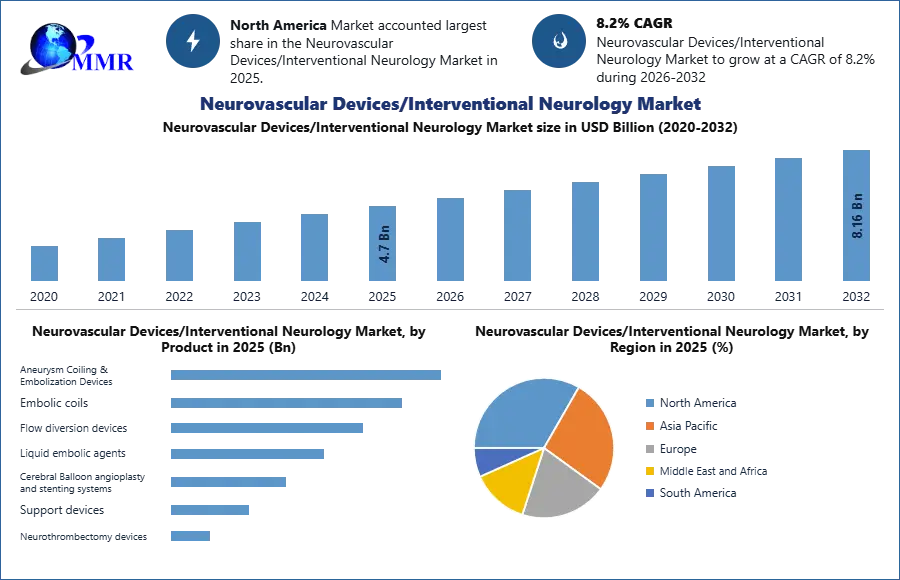
- The market was valued at USD 4.7 billion in 2025.
- Revenue is projected to reach USD 8.16 billion by 2032.
- The market is expected to expand at a CAGR of 8.2% during 2026–2032.
- Growing incidence of stroke and cerebrovascular disorders continues to increase demand for neurovascular intervention.
- Hospitals are expanding advanced neurointerventional capabilities to improve treatment outcomes and reduce disability.
- Continuous innovation in minimally invasive devices is reshaping clinical practice and improving procedural efficiency.
- North America remains the leading regional market, while Asia-Pacific presents significant long-term growth opportunities.
Why This Matters Now
Stroke remains one of the world’s leading causes of mortality and long-term disability, placing growing pressure on healthcare systems to improve treatment speed and patient outcomes. Healthcare providers, medical device manufacturers, investors, and policymakers are accelerating investments in neurovascular care because every improvement in intervention directly influences survival rates, rehabilitation costs, and hospital efficiency.
The Neurovascular Devices/Interventional Neurology Market is entering a phase where technological innovation, expanding access to specialized stroke centers, and increasing awareness of minimally invasive procedures are reshaping competitive dynamics. Companies capable of delivering faster, safer, and more precise neurovascular interventions stand to gain substantial market advantage as treatment volumes continue to rise.
Market Overview
The Neurovascular Devices/Interventional Neurology Market was valued at USD 4.7 billion in 2025 and is forecast to reach nearly USD 8.16 billion by 2032, growing at a CAGR of 8.2%.
The market encompasses medical devices designed to diagnose and treat cerebrovascular disorders, including ischemic stroke, cerebral aneurysms, arteriovenous malformations, carotid artery disease, and other neurological vascular conditions. These technologies support minimally invasive procedures that reduce recovery time while improving procedural precision.
Healthcare systems increasingly prioritize rapid intervention because timely treatment significantly improves neurological recovery while lowering long-term healthcare expenditure. As hospitals strengthen neurointerventional capabilities, demand continues to expand across developed and emerging healthcare markets.
Growing investments in advanced imaging technologies, specialized neurovascular centers, and physician training are creating favorable conditions for sustained market expansion. Medical device innovation also continues to improve procedural success rates while broadening treatment eligibility for patients.
Key Trends Driving Growth
The increasing global burden of stroke remains the primary growth catalyst. Aging populations and lifestyle-related risk factors continue to increase the number of patients requiring advanced neurovascular treatment. Healthcare providers are therefore expanding specialized stroke programs to improve emergency response and clinical outcomes.
Minimally invasive intervention has become a preferred treatment approach for many neurovascular conditions. Compared with conventional surgery, catheter-based procedures reduce hospital stays, shorten recovery periods, and minimize complications. This clinical advantage continues to support wider physician adoption.
Continuous innovation across neurovascular devices is strengthening treatment effectiveness. Manufacturers are developing next-generation technologies designed to improve navigation, clot retrieval, embolization, and aneurysm management. Product innovation has become a major competitive differentiator across the industry.
Hospital infrastructure is also evolving. More healthcare institutions are establishing comprehensive stroke centers equipped with advanced imaging systems and specialized neurointerventional teams. Improved infrastructure enables faster diagnosis and treatment while supporting greater procedure volumes.
Digital technologies are increasingly influencing neurovascular care. Advanced imaging, clinical decision support, and workflow optimization help physicians identify appropriate treatment strategies more efficiently. As hospitals continue digital transformation initiatives, integration between imaging and intervention platforms is expected to expand.
Healthcare spending focused on neurological care is also supporting long-term demand. Governments and healthcare organizations recognize that effective stroke treatment reduces disability-related costs, improves quality of life, and lowers long-term rehabilitation expenses.
Download a Sample Report for Competitive Landscape and Growth Analysis
Segment Insights
- Dominant Segment: According to the MMR report, the Stroke application segment holds the largest share of the Neurovascular Devices/Interventional Neurology Market due to the increasing incidence of cerebrovascular disease and growing adoption of minimally invasive stroke intervention.
- Fastest-Growing Segment: The report identifies Aneurysm treatment as the fastest-growing application segment, supported by continuous advances in neurovascular treatment technologies and increasing diagnosis rates.
- Hospitals remain the primary end users because they possess specialized neurointerventional infrastructure, advanced imaging capabilities, and multidisciplinary clinical teams required for complex cerebrovascular procedures.
- Rising adoption of minimally invasive neurovascular procedures continues to increase demand across both established healthcare systems and developing medical markets.
Regional Growth Story
North America continues to lead the Neurovascular Devices/Interventional Neurology Market through strong healthcare expenditure, advanced hospital infrastructure, widespread adoption of innovative neurovascular technologies, and established stroke treatment pathways. The region also benefits from continuous investment in medical device innovation and specialized neurointerventional centers.
Europe remains a significant contributor, particularly across Germany and the UK, where well-developed healthcare systems continue expanding access to advanced stroke treatment and minimally invasive neurovascular procedures. Growing emphasis on improving patient outcomes supports sustained technology adoption.
Asia-Pacific is emerging as a major growth engine. China, Japan, India, and South Korea continue strengthening healthcare infrastructure while expanding access to specialized neurological care. Rising awareness of stroke management, increasing healthcare investments, and improving hospital capabilities are expected to support long-term regional growth.
Developing healthcare systems are also investing in advanced diagnostics and neurovascular intervention to reduce the growing socioeconomic burden associated with neurological diseases. This trend creates substantial opportunities for global medical device manufacturers seeking geographic expansion.
Competitive Landscape
Competition within the Neurovascular Devices/Interventional Neurology Market is increasingly centered on technological differentiation, physician adoption, clinical performance, and product innovation.
Medical device manufacturers continue investing in research and development to improve device precision, procedural efficiency, and patient safety. Innovation has become essential as hospitals seek technologies capable of supporting faster intervention and better clinical outcomes.
Product launches and technology upgrades also strengthen competitive positioning by expanding treatment options for physicians while supporting broader reimbursement opportunities. Companies that successfully demonstrate clinical value can strengthen relationships with hospitals and healthcare providers while improving long-term market share.
Strategic investment in physician education, clinical evidence generation, and healthcare partnerships continues to shape competitive advantage as adoption expands across global healthcare systems.
Recent Developments
- Continued innovation in minimally invasive neurovascular treatment technologies.
- Growing investments supporting advanced neurointerventional procedures.
- Expansion of hospital capabilities for comprehensive stroke care.
- Ongoing development of technologies designed to improve procedural accuracy and patient outcomes.
- Increasing emphasis on faster diagnosis and treatment pathways for cerebrovascular disease.
Strategic Implications
Healthcare providers are moving beyond expanding procedure volumes toward delivering measurable improvements in patient outcomes. Investments in neurovascular infrastructure now influence hospital competitiveness, clinical quality metrics, and long-term operational efficiency.
Medical device manufacturers face growing pressure to deliver solutions that combine clinical effectiveness with procedural simplicity. Technologies that shorten intervention times while improving physician confidence are likely to achieve broader adoption.
Investors continue to view neurovascular intervention as an attractive healthcare segment because demographic trends, increasing neurological disease burden, and ongoing innovation provide durable long-term growth potential. Companies capable of expanding clinical evidence while supporting physician adoption are positioned to strengthen competitive leadership.
Healthcare policymakers also benefit from improved neurovascular care through reduced disability rates, lower rehabilitation costs, and enhanced healthcare system efficiency.
Future Outlook
The Neurovascular Devices/Interventional Neurology Market is expected to maintain strong momentum through 2032 as rising stroke incidence, expanding minimally invasive treatment adoption, technological innovation, and strengthening hospital infrastructure continue driving demand. Organizations that combine clinical innovation, physician engagement, and scalable healthcare solutions will define the next generation of market leadership, while slower adopters risk losing competitive relevance.
Analyst Perspective
“The Neurovascular Devices/Interventional Neurology Market is entering a transformative phase driven by increasing demand for minimally invasive stroke treatment, continuous technological advancement, and expanding hospital capabilities. Companies that focus on innovation while addressing evolving clinical needs will be best positioned to capture long-term growth opportunities across global healthcare systems.” — Komal Patil, Analyst
About Maximize Market Research
Maximize Market Research Pvt. Ltd. (MMR) is a global market research and consulting company that provides reliable, data-focused, and practical business insights. The firm serves a wide range of industries, including healthcare, pharmaceuticals, technology, automotive, electronics, chemicals, personal care, and consumer goods. Through market forecasts, competitive analysis, strategic consulting, and industry impact assessments, MMR helps organizations understand changing market conditions, identify growth opportunities, and make informed business decisions for long-term success.
Contact Us
2nd Floor, Navale IT Park Phase 3
Pune Banglore Highway, Narhe
Pune, Maharashtra 411041, India
+91 9607365656
sales@maximizemarketresearch.com
