Key Highlights
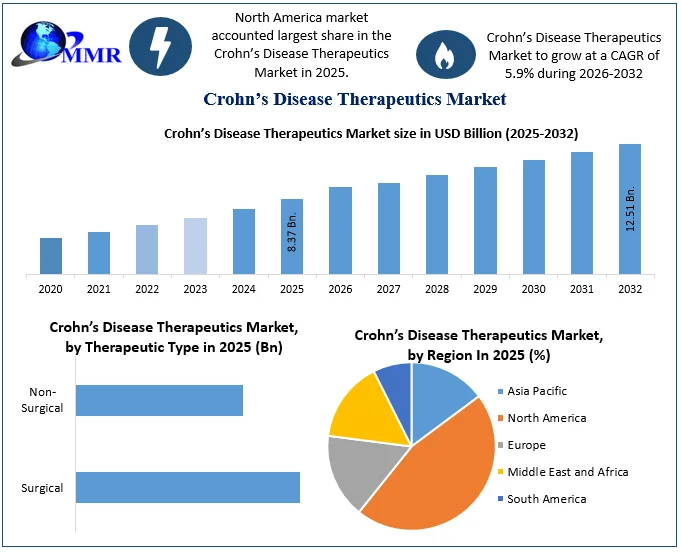
- The market was valued at USD 8.37 Billion in 2025 and is projected to reach USD 12.51 Billion by 2032, expanding at a 5.9% CAGR.
- Rising disease prevalence and expanding drug pipelines remain the primary growth drivers.
- Biosimilars are improving treatment accessibility through lower-cost biological therapies.
- The Non-Surgical therapeutic segment held the largest 49% market share in 2025.
- North America remained the leading regional market in 2025 due to strong research capabilities and advanced healthcare infrastructure.
- Pharmaceutical companies continue to strengthen their positions through partnerships, acquisitions, and development of innovative therapies.
Why This Matters Now
Crohn’s disease continues to create long-term healthcare challenges as patient numbers increase across developed and developing markets. Pharmaceutical companies are responding by expanding biologic portfolios, advancing biosimilar development, and investing in next-generation therapies. These changes are reshaping treatment standards while creating new commercial opportunities across global healthcare markets.
Market Overview
The Crohn’s Disease Therapeutics Market Size includes surgical and non-surgical treatment options designed to manage chronic inflammatory bowel disease. Demand continues to rise as diagnosis rates increase and healthcare systems focus on improving long-term disease management.
The market is primarily supported by increasing disease prevalence, expanding pharmaceutical research, and a growing pipeline of innovative therapies. Industrialization, changing dietary habits, smoking, environmental influences, and hereditary factors continue to contribute to increasing disease incidence, particularly in developing countries.
Supply-side growth is being driven by continuous pharmaceutical innovation. Companies are expanding biologic therapies, biosimilars, and advanced immune-modulating treatments to improve patient outcomes while reducing treatment costs.
Key Trends Driving Growth
Development of biosimilars has become one of the most influential trends shaping the market. Lower-cost biological medicines are generating savings for healthcare systems while increasing patient access to advanced therapies.
Innovation remains focused on biological agents with new mechanisms of action, anti-cytokine therapies, and stem cell-based treatment approaches. TNF inhibitors such as Infliximab and Adalimumab continue to demonstrate effectiveness in disease management and support wider adoption of biologic treatment strategies.
Regulatory approvals continue to strengthen competitive positioning. The report highlights the FDA approval of Stelara for Crohn’s disease treatment announced by Johnson & Johnson in 2025, reinforcing the importance of continuous product development in maintaining market leadership.
The report does not provide information regarding sustainability initiatives, raw material pricing trends, or international trade developments.
Explore detailed analysis, insights, and growth opportunities
Segment Insights
Dominant Segment – Non-Surgical Therapeutics
The Non-Surgical segment accounted for 49% of the market in 2025, making it the largest therapeutic category.
This leadership reflects the growing preference for medication-based disease management before surgical intervention becomes necessary. Anti-inflammatory drugs remain the first line of treatment, supporting widespread clinical adoption. Their established role allows healthcare providers to manage disease progression while reducing the need for invasive procedures.
From a business perspective, the dominance of non-surgical therapies encourages continued investment in pharmaceutical innovation, particularly among companies developing targeted biologics and immune-modulating medicines.
Fastest-Growing Segment – Immune System Suppressors
Within the non-surgical category, immune system suppressors are expected to expand at a CAGR of 3.2% during the forecast period.
The segment benefits from demonstrated safety and effectiveness while reducing hospitalization, surgery, and mortality rates. Improved patient quality of life further supports long-term adoption.
The report identifies ongoing clinical development by Genentech Inc., including the immune suppressor etrolizumab, which showed promising safety and efficacy during Phase II clinical studies. Successful certification of these therapies could strengthen future market growth.
Additional Sub-Segments
The anti-inflammatory drug category maintained the highest share within non-surgical therapeutics in 2025 because these medicines represent the primary treatment option for many patients.
Other treatment categories include antibiotics and additional supportive therapies that contribute to comprehensive disease management. Distribution continues through hospital pharmacies, retail pharmacies, and eCommerce channels, providing multiple pathways for patient access.
Regional Growth Story
North America generated the highest market revenue in 2025.
Its leadership is supported by advanced healthcare infrastructure, strong research capabilities, increasing disease prevalence, and continuous introduction of innovative therapeutics. According to the report, the Crohn’s and Colitis Foundation estimates that approximately 1.6 million Americans are affected by the disease, creating sustained demand for advanced treatment options.
The United States and Canada continue to benefit from established pharmaceutical research ecosystems that accelerate therapeutic development and commercialization.
Europe remains an important regional market supported by the availability of biosimilars and developed healthcare systems, although the report does not provide country-level market shares.
Asia Pacific represents an expanding opportunity as industrialization, changing dietary patterns, and increasing disease prevalence support long-term market development. Countries including China, India, Japan, South Korea, and Australia form part of the regional market covered in the report.
The Middle East & Africa and South America also remain part of the global market landscape, although detailed regional analysis is not provided.
Competitive Landscape
Competition is centered on expanding biologic portfolios, advancing pipeline products, and strengthening research capabilities.
Major companies include AbbVie Inc., Allergan, Bayer AG, Bristol-Myers Squibb, Boehringer Ingelheim GmbH, F. Hoffmann-La Roche, Eli Lilly and Co., GlaxoSmithKline plc, Janssen Biotech, Johnson & Johnson, Novartis International AG, Pfizer Inc., Sanofi, Takeda Pharmaceutical Company Limited, Salix Pharmaceuticals, Gilead Sciences Inc., Genentech Inc., and UCB India Private Limited.
The report indicates that partnerships with research institutions and acquisitions of smaller companies remain key competitive strategies. These activities allow pharmaceutical companies to strengthen product pipelines, accelerate innovation, and maintain long-term market positioning. Continued investment in novel therapies reflects an industry focused on improving treatment effectiveness while expanding commercial opportunities through differentiated products.
Recent Developments
- Johnson & Johnson announced FDA approval of Stelara for the treatment of Crohn’s disease in 2025.
- Pharmaceutical companies continue expanding partnerships with research institutes to strengthen product development.
- Acquisition of smaller companies remains an important strategy for enhancing competitive positioning.
- Genentech Inc. continues clinical evaluation of etrolizumab, demonstrating promising Phase II safety and efficacy results.
- Industry investment remains focused on biologics, biosimilars, anti-cytokine agents, and stem cell-based therapeutic development.
Future Outlook
Companies that successfully commercialize innovative biologics and cost-effective biosimilars while expanding strategic research collaborations will be best positioned to capture the next phase of growth in the Crohn’s Disease Therapeutics Market.
About Maximize Market Research
Maximize Market Research Pvt. Ltd. (MMR) is a global market research and consulting company that provides reliable, data-focused, and practical business insights. The firm serves a wide range of industries, including healthcare, pharmaceuticals, technology, automotive, electronics, chemicals, personal care, and consumer goods. Through market forecasts, competitive analysis, strategic consulting, and industry impact assessments, MMR helps organizations understand changing market conditions, identify growth opportunities, and make informed business decisions for long-term success.
Contact Us :
2nd Floor, Navale IT Park Phase 3
Pune Banglore Highway, Narhe
Pune, Maharashtra 411041, India
+91 9607365656
sales@maximizemarketresearch.com
