Key Highlights
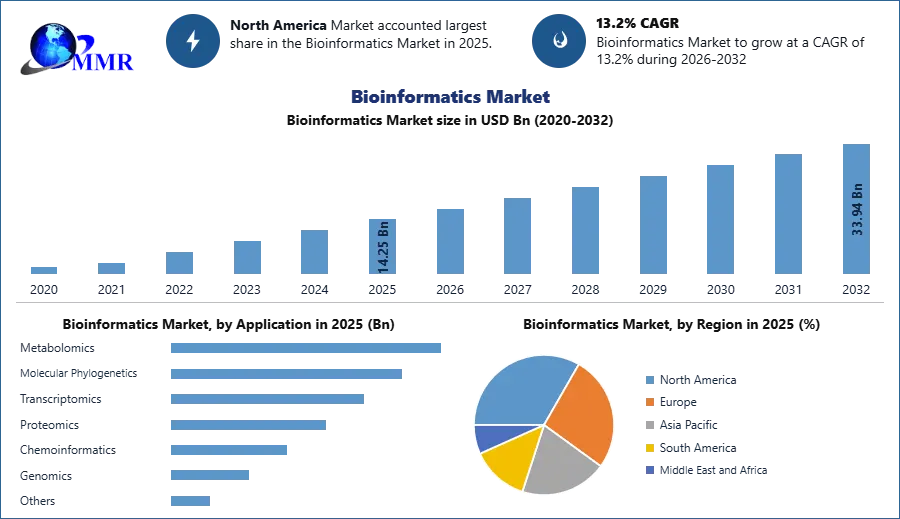
- Market value reached USD 14.25 billion in 2025.
- Expected to grow to USD 33.94 billion by 2032.
- Projected CAGR stands at 13.2% during the forecast period.
- North America remains the leading regional market.
- AI-enabled bioinformatics platforms are accelerating genomic analysis and drug discovery.
- Precision medicine continues to expand demand for advanced genomic data interpretation.
- Pharmaceutical and biotechnology companies remain major end users.
- Cloud computing and next-generation sequencing continue to improve accessibility and scalability.
Why This Matters Now
Healthcare is entering an era where clinical decisions increasingly depend on data-driven biological insights. Advances in sequencing technologies have dramatically increased the volume of genomic information, creating demand for sophisticated analytical platforms capable of transforming raw data into actionable medical intelligence.
This shift is reshaping research priorities across pharmaceutical development, hospital systems, biotechnology, and academic research. Organizations capable of integrating artificial intelligence with bioinformatics workflows are reducing research timelines while improving treatment personalization and clinical outcomes.
Market Overview
The Bioinformatics Market combines biology, computer science, statistics, and data analytics to interpret complex biological information. Its applications span genomics, proteomics, molecular diagnostics, clinical research, drug discovery, agricultural biotechnology, and personalized healthcare.
The market is expanding as healthcare systems increasingly adopt precision medicine strategies that rely on genomic profiling and biomarker identification. Growing investment in biotechnology research, rising adoption of next-generation sequencing technologies, and expanding computational capabilities continue to strengthen industry demand.
Artificial intelligence has become a significant growth catalyst. Machine learning algorithms improve genomic interpretation, automate sequence analysis, and support predictive modeling for therapeutic development. These capabilities help researchers identify promising drug candidates faster while reducing development costs.
The pharmaceutical industry is also using bioinformatics to optimize clinical trial design, identify novel therapeutic targets, and improve patient stratification. These efficiencies have become increasingly valuable as companies seek to shorten development cycles and improve regulatory success rates.
Key Trends Driving Growth
Artificial intelligence is transforming bioinformatics from a research support function into a strategic decision-making platform. AI-powered analytical tools process massive genomic datasets more efficiently, enabling researchers to identify disease-associated genetic variations and potential therapeutic pathways with greater speed.
Precision medicine continues to reshape healthcare delivery. Physicians increasingly rely on genomic information to customize treatment strategies based on individual patient characteristics, improving therapeutic effectiveness while reducing unnecessary interventions.
Drug discovery is becoming increasingly data intensive. Bioinformatics platforms help pharmaceutical companies analyze molecular interactions, identify biomarkers, and evaluate potential compounds earlier in development. This reduces scientific uncertainty and supports more targeted investment decisions.
Cloud-based bioinformatics solutions are improving collaboration across healthcare organizations, research institutions, and biotechnology companies. Scalable computing infrastructure allows organizations to process large genomic datasets without extensive on-premise investments.
The growing use of next-generation sequencing technologies has significantly expanded genomic research. Faster sequencing combined with declining sequencing costs continues to increase data generation, further driving demand for advanced analytical software and services.
Download a Sample Report for Competitive Landscape and Growth Analysis
Segment Insights
- Dominant Segment: The Products and Services segment holds the largest market share, supported by increasing demand for bioinformatics software, databases, analytical tools, and consulting services across pharmaceutical, biotechnology, and research organizations.
- Fastest-Growing Segment: The Genomics application segment is projected to witness the fastest growth due to rising adoption of genomic sequencing, precision medicine, and personalized therapeutic development.
- Pharmaceutical and biotechnology companies remain major end users as they expand investments in genomic research and drug development.
- Academic research institutes continue to strengthen market demand through collaborative research programs and expanding life sciences funding.
- Cloud-enabled analytical platforms are improving accessibility for organizations seeking scalable computational capabilities.
Regional Growth Story
North America maintains its leadership position due to substantial healthcare expenditure, advanced biotechnology ecosystems, significant pharmaceutical R&D investment, and early adoption of precision medicine. The United States continues to lead genomic research initiatives supported by strong digital healthcare infrastructure and continuous innovation.
Germany and the United Kingdom remain major European contributors through established life sciences industries, expanding genomic research programs, and supportive healthcare innovation policies. Investments in molecular diagnostics and personalized medicine continue to strengthen regional demand.
China is rapidly expanding its biotechnology capabilities through increasing research investment, genomic sequencing initiatives, and digital healthcare development. Growing pharmaceutical innovation is supporting wider adoption of bioinformatics solutions across research institutions and commercial organizations.
Japan continues to integrate genomic medicine into advanced healthcare delivery while supporting biotechnology innovation and precision diagnostics. An aging population is increasing interest in personalized therapeutic approaches.
India is strengthening its position through expanding biotechnology research, growing pharmaceutical manufacturing, digital health initiatives, and increasing genomic research collaborations. Greater healthcare digitization continues to create new opportunities for bioinformatics adoption.
South Korea remains an important innovation hub due to continued investments in biotechnology, artificial intelligence, healthcare digitalization, and precision medicine research.
Competitive Landscape
Competition is increasingly centered on technological innovation rather than software availability alone. Companies are investing in artificial intelligence, cloud-native platforms, advanced analytics, and integrated genomic databases to improve analytical accuracy and workflow efficiency.
Strategic collaborations between biotechnology companies, pharmaceutical manufacturers, healthcare providers, and research institutions are expanding product capabilities while accelerating commercialization. These partnerships also improve access to large biological datasets necessary for advanced machine learning applications.
Product innovation remains focused on simplifying complex genomic analysis while improving scalability, automation, and interoperability across healthcare systems. Vendors capable of delivering integrated platforms that combine sequencing analysis, clinical interpretation, and research collaboration are strengthening competitive positioning.
Investment activity throughout the industry signals continued confidence in precision medicine, computational biology, and AI-driven healthcare innovation.
Recent Developments
- Artificial intelligence integration continues to enhance genomic data interpretation and clinical research efficiency.
- Precision medicine initiatives are expanding adoption of genomic analytics across healthcare providers.
- Cloud-based bioinformatics platforms are improving collaboration among pharmaceutical companies, research institutes, and biotechnology organizations.
- Drug discovery investments continue to accelerate development of advanced computational biology solutions.
- Next-generation sequencing adoption is increasing demand for scalable analytical software and high-performance computing capabilities.
Strategic Implications
Healthcare providers are increasingly using bioinformatics to improve diagnostic precision, patient stratification, and treatment planning. Better integration of genomic insights into clinical practice supports improved patient outcomes while enabling more personalized healthcare delivery.
For pharmaceutical and biotechnology companies, bioinformatics has become an essential competitive capability rather than a supporting technology. Organizations that successfully integrate AI-driven analytics throughout research and development can reduce development timelines, improve target identification, and optimize clinical trial performance.
Hospital systems are expected to expand investments in genomic diagnostics and digital health platforms as personalized medicine becomes more widely adopted. Payers also stand to benefit through more targeted treatment selection that can improve clinical effectiveness while reducing unnecessary healthcare costs.
Regulators are increasingly supporting innovation in genomics and digital healthcare, encouraging broader adoption of technologies that improve clinical evidence generation and patient care.
Future Outlook
The Bioinformatics Market is entering a sustained growth phase driven by precision medicine, artificial intelligence, genomic research, and pharmaceutical innovation. As biological data volumes continue expanding, organizations will require increasingly sophisticated computational platforms capable of delivering faster, more accurate clinical insights.
Future growth will depend on the industry’s ability to integrate genomic intelligence into routine healthcare delivery while improving collaboration across research, diagnostics, and therapeutics. Companies that combine AI, scalable cloud infrastructure, and advanced genomic analytics will define the next generation of healthcare innovation, while slower adopters risk losing competitive relevance.
Analyst Perspective
“The Bioinformatics Market is evolving beyond research laboratories into a strategic foundation for modern healthcare. The convergence of artificial intelligence, genomics, and precision medicine is creating new opportunities for pharmaceutical innovation, clinical diagnostics, and personalized patient care. Organizations investing in scalable bioinformatics capabilities today will be better positioned to lead the next wave of life sciences transformation.” — Komal Patil, Analyst
About Maximize Market Research
Maximize Market Research Pvt. Ltd. (MMR) is a global market research and consulting company that provides reliable, data-focused, and practical business insights. The firm serves a wide range of industries, including healthcare, pharmaceuticals, technology, automotive, electronics, chemicals, personal care, and consumer goods. Through market forecasts, competitive analysis, strategic consulting, and industry impact assessments, MMR helps organizations understand changing market conditions, identify growth opportunities, and make informed business decisions for long-term success.
Contact Us
2nd Floor, Navale IT Park Phase 3
Pune Banglore Highway, Narhe
Pune, Maharashtra 411041, India
+91 9607365656
sales@maximizemarketresearch.com
