Key Highlights
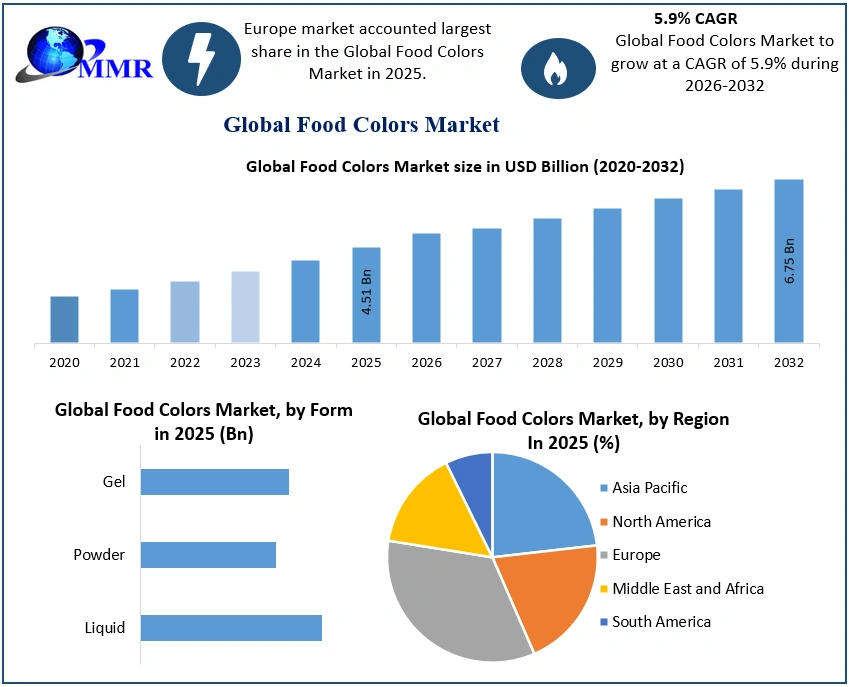
- The Food Colors Market was valued at USD 4.51 Billion in 2025.
- The market is forecast to reach USD 6.75 Billion by 2032.
- The industry is expected to expand at a CAGR of 5.9% during 2025–2032.
- Clean-label product development is accelerating demand for natural color solutions.
- Product appearance has become a strategic purchasing driver across packaged foods and beverages.
- Innovation in plant-based pigments is reshaping competitive positioning across ingredient suppliers.
Why This Matters Now
Consumers no longer buy food with taste alone. Color has become an instant quality signal, and brands that fail to meet expectations risk losing shelf visibility before shoppers even read the label.
That commercial reality explains why the Food Colors Market is projected to grow from USD 4.51 Billion in 2025 to nearly USD 6.75 Billion by 2032. The 5.9% CAGR is more than a growth statistic—it signals sustained investment opportunities across ingredient suppliers, food processors, and consumer brands seeking differentiation in increasingly competitive retail channels.
Market Overview
Food manufacturers face two simultaneous pressures. Products must look more attractive while ingredient labels become shorter and easier for consumers to trust. Those demands are transforming food colors from a formulation ingredient into a strategic brand asset.
Across bakery, dairy, beverages, confectionery, and processed foods, manufacturers are reformulating products to balance appearance, stability, regulatory compliance, and consumer expectations. The industry’s steady expansion reflects this structural shift rather than temporary demand spikes. Every new product launch increasingly requires color systems that support both visual appeal and clean-label positioning.
Key Trends Driving Growth
Health-conscious consumers continue to scrutinize ingredient lists. That behavioral shift is pushing manufacturers toward naturally sourced color solutions while reducing dependence on traditional synthetic alternatives. The business implication is clear: ingredient innovation has become a competitive requirement rather than a premium feature.
Clean-label demand is also influencing purchasing decisions across global retail channels. Brands are investing in botanical pigments and naturally derived formulations that align with evolving regulatory standards and consumer expectations. Companies capable of delivering stability without compromising label simplicity are likely to capture higher-value contracts.
Sustainability is emerging as another competitive differentiator. Producers are expanding investments in plant-derived ingredients, resource-efficient production, and environmentally responsible sourcing. These initiatives increasingly support procurement decisions among multinational food manufacturers.
Digital commerce is reinforcing these trends. Online grocery shopping exposes consumers to wider product comparisons, making packaging appearance and ingredient transparency even more influential during purchase decisions. Food colors therefore contribute directly to both digital merchandising and physical shelf performance.
𝐃𝐨𝐰𝐧𝐥𝐨𝐚𝐝 𝐏𝐃𝐅 𝐁𝐫𝐨𝐜𝐡𝐮𝐫𝐞 @https://www.maximizemarketresearch.com/request-sample/12515/
Segment Insights
- Dominant Segment: The supplied report identifies segmentation by Type, Application, Source, Form, and Solubility, but the publicly available report extract does not disclose which segment held the largest market share.
- Fastest-Growing Segment: The supplied report extract does not specify the fastest-growing segment.
- Food colors continue to serve diverse applications including dairy products, non-dairy foods, carbonated and non-alcoholic beverages, and alcoholic beverages.
- Market segmentation increasingly reflects customer demand for application-specific performance, regulatory compliance, and natural ingredient sourcing rather than cost alone.
Regional Growth Story
Food color adoption is becoming increasingly global as packaged food consumption expands across developed and emerging markets.
North America and Europe continue to benefit from mature food manufacturing ecosystems and strong regulatory oversight, encouraging premium ingredient adoption. Meanwhile, Asia-Pacific offers expanding opportunities as urbanization, rising disposable incomes, and processed food consumption support higher demand for innovative food ingredients.
For suppliers, regional expansion is no longer simply about geographic reach. Success increasingly depends on local formulation capabilities, regulatory expertise, and customized application support for regional food preferences.
Competitive Landscape
Competition is moving beyond price. The market increasingly rewards companies capable of combining natural ingredient portfolios with formulation expertise, application support, and supply chain resilience.
Leading participants—including AromataGroup (Fiorio Colori SPA), Givaudan (Naturex S.A.), Kalsec, Archer Daniels Midland Company, Chr. Hansen, D.D. Williamson (DDW), Döhler Group, International Flavors & Fragrances, Koninklijke DSM, Sensient Technologies Corporation, and Roha Dye Chem—continue strengthening product portfolios and expanding technical capabilities.
For competitors, this signals an industry entering a capability race rather than a volume race. Companies that invest in natural pigment technologies, regulatory compliance, and customer co-development are likely to strengthen long-term customer relationships. Over the next 12–24 months, competitive advantage is expected to shift toward suppliers capable of accelerating reformulation timelines while maintaining product consistency across global manufacturing networks.
Recent Developments
- The report highlights ongoing company developments and competitive benchmarking across major market participants.
- Industry participants continue expanding product portfolios focused on natural and specialty food color solutions.
- Competitive activity increasingly emphasizes innovation, strategic partnerships, and portfolio enhancement to address changing customer requirements.
Strategic Implications
Food colors have evolved into a value-creation tool rather than a commodity ingredient. Their influence now extends across branding, product positioning, regulatory compliance, and premium pricing strategies.
Manufacturers that integrate clean-label innovation into broader product development programs can strengthen consumer trust while reducing reformulation risks. Ingredient suppliers that provide technical collaboration alongside raw materials are likely to become preferred strategic partners rather than transactional vendors.
Investment priorities are therefore shifting toward research, sustainable sourcing, formulation expertise, and application-specific innovation.
Future Outlook
The Food Colors Market is expected to maintain steady expansion through 2032 as manufacturers respond to stronger consumer demand for visually appealing products with transparent ingredient labels. The projected increase from USD 4.51 Billion in 2025 to USD 6.75 Billion by 2032 confirms that demand is being supported by structural shifts across the global food and beverage industry rather than short-term consumption cycles.
The next competitive divide will not be between companies selling colors and those that do not—it will separate suppliers that lead clean-label innovation from those still competing primarily on price.
Analyst Perspective
“The Food Colors Market is transitioning from an ingredient-focused industry to a strategic innovation platform for food manufacturers. Companies that combine natural color technologies, regulatory readiness, and formulation expertise will be best positioned to capture long-term value as global demand for clean-label products accelerates.” — Komal Patil, Analyst
About Maximize Market Research
Maximize Market Research Pvt. Ltd. (MMR) is a global market research and consulting company that provides reliable, data-focused, and practical business insights. The firm serves a wide range of industries, including healthcare, pharmaceuticals, technology, automotive, electronics, chemicals, personal care, and consumer goods. Through market forecasts, competitive analysis, strategic consulting, and industry impact assessments, MMR helps organizations understand changing market conditions, identify growth opportunities, and make informed business decisions for long-term success.
2nd Floor, Navale IT Park Phase 3
Pune Banglore Highway, Narhe
Pune, Maharashtra 411041, India
+91 9607365656
sales@maximizemarketresearch.com
